
Ready by 9:12am Sep 17, 2026
How to Write a Dissertation Abstract, With Examples
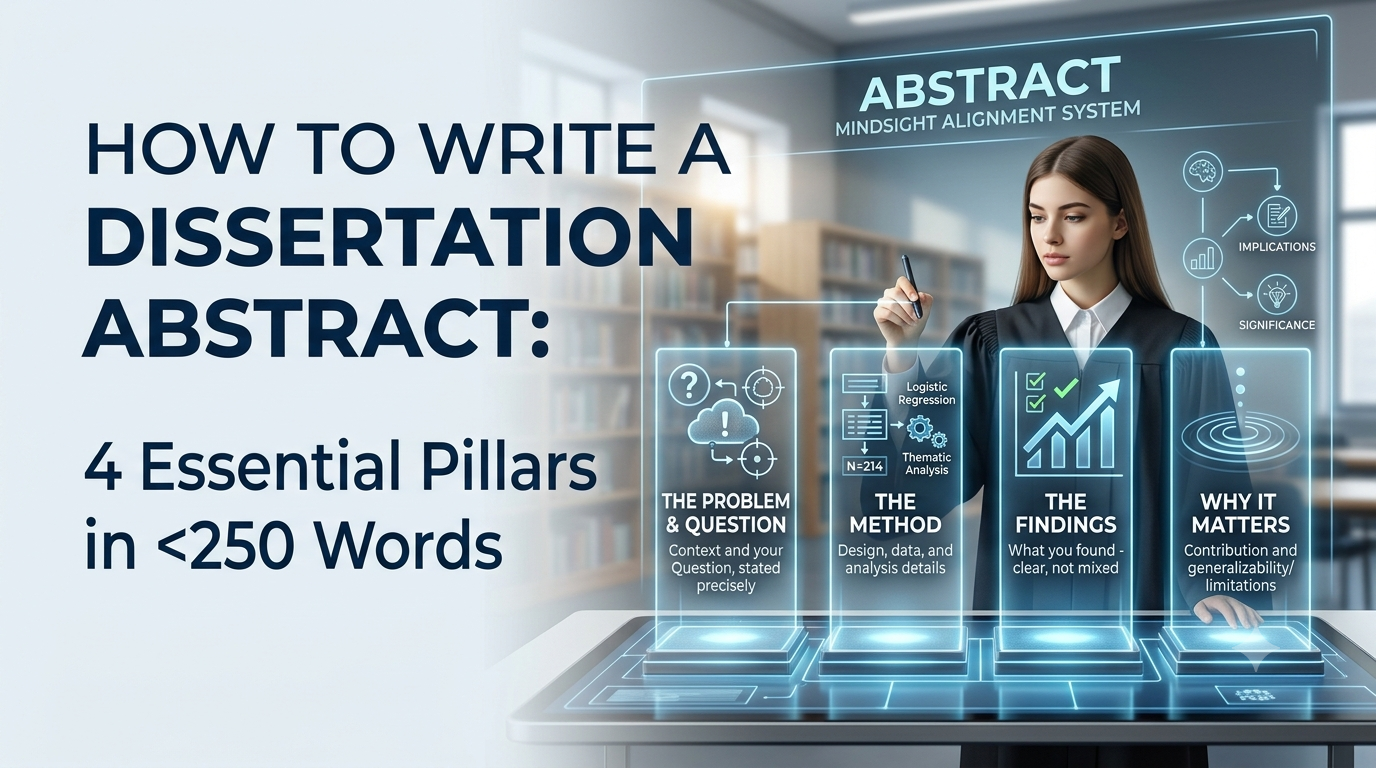
A dissertation abstract carries four things in around 150 to 300 words: the problem and question, the method, the main finding, and why it matters. Write it last, once you know what your dissertation actually says, and make every sentence do one of those four jobs.
The abstract is the only part of your dissertation most people will ever read, and the first thing your marker sees. That makes it worth far more care than its length suggests. It has to work on its own, so someone who never opens the full document still knows what you asked, how you answered it, what you found, and why it matters.
What is an abstract for?
It is a complete, standalone summary of your whole dissertation. That standalone requirement is what students miss most. An abstract cannot refer to chapters, cannot use undefined abbreviations, and cannot rely on citations. It has to stand entirely on its own, or it fails at its one job.
How long should it be?
Usually 150 to 300 words, though your department sets the limit and some specify 250 or 500. Check before you write, because an abstract is one of the few places where going over the limit is instantly visible. Whether it counts towards your total word count also varies, which is another thing to confirm rather than assume.
What structure should it follow?
Four parts, roughly equal, each doing one job.
| Part | What it does |
| Context and problem | One or two sentences on why the question matters |
| Aim and question | What you set out to find, stated precisely |
| Method | Your design, data, and analysis, in a sentence or two |
| Findings and significance | What you found and what follows from it |
The most common mistake is spending half the abstract on context and squeezing the findings into a final clause. The findings are the reason anyone is reading. Give them at least a quarter of the space.
Why is the abstract worth extra care?
Because it is read more than any other part of your dissertation and read first. Examiners, and later anyone searching a repository, often decide from the abstract alone whether to read on. A weak abstract can make strong work look thin, while a sharp one sets up a good first impression before the marker reaches page one. For the effort it takes, no other 250 words in your dissertation carry as much weight.
A worked example, quantitative
Loyalty schemes are common in UK fast fashion, but evidence on whether reward structure affects repeat purchase among younger shoppers is limited. This study examined whether frequency based rewards produce different repeat purchase rates from spend based rewards among UK consumers aged 18 to 25. A survey of 214 respondents was analysed using logistic regression.
Frequency based schemes were linked to higher repeat purchase, with the effect strongest among monthly shoppers. Spend based rewards showed no significant link once purchase frequency was accounted for. The findings suggest that reward structure, rather than reward value, drives repeat engagement in this group, with implications for scheme design in a sector where acquisition costs are rising. The single sector sample limits how far the results generalise.
A worked example, qualitative
Hybrid working is now common in UK professional services, but its effect on how junior staff access informal support is not well understood. This study explored how first and second year employees in mid sized accountancy firms experience access to senior colleagues under hybrid arrangements. Semi structured interviews with fourteen junior staff across four firms were analysed thematically.
Three themes emerged: the loss of casual contact, a shift towards scheduled and more formal questions, and a reluctance to interrupt senior colleagues remotely that participants did not feel in person. Participants described holding back questions rather than raising them. The findings indicate that hybrid work may affect early career development through reduced informal learning, which has implications for how firms structure junior support.
How many drafts does an abstract take?
Usually three. The first gets the four parts onto the page in roughly the right proportions. The second cuts it to the word limit, which is where most of the improvement happens, because compression forces you to keep only what matters. The third reads it cold, ideally a day later, checking that it stands alone with no undefined abbreviations and no reference to chapters. A useful final check is to give it to someone outside your subject. If they can tell you what you asked, what you did, and what you found, it works. If they cannot, the problem is almost never their background.
When should you write it?
Last, with the introduction. Both describe what the dissertation says, and you only know that once the other chapters exist. An abstract written early commits you to findings you have not confirmed and almost always has to be rewritten. This is the same reason the conclusion is written at the end too.
Expect it to take longer than its length suggests. Compressing a year of work into 250 words is genuinely hard, and it is worth two or three passes rather than one.
Do you need keywords?
Many departments ask for four to six keywords under the abstract, and they are worth a minute of thought rather than being filled in at random. They exist so your work can be found, so use the terms someone searching for research like yours would actually type. Include the topic, the group or setting, and the method, and avoid words already in your title, since those are indexed anyway.
How do you cut an abstract that has run long?
Almost always from the context. The opening is where students over write, because it is the easiest part to draft and the hardest to feel is finished. Two sentences of context is usually plenty, and one is often better.
After that, cut hedging. Phrases like it could be argued that and the findings appear to suggest add words and remove force. If your evidence supports a claim, state it. What you should not cut is the findings. If the abstract is over the limit and the findings are already brief, something earlier is doing too much work.
How is an abstract different from an introduction?
The abstract reports the whole study, including the findings. The introduction sets up the problem and the question but does not give away what you found. Students most often blur this by writing an abstract that reads like a shortened introduction and stops before the results. The other difference is audience: an introduction assumes the reader will carry on, while an abstract assumes they may not, which is exactly why it has to carry the finding.
What are the common mistakes?
- Writing it first, then never updating it to match the finished dissertation.
- Too much background, not enough findings.
- Vague findings. Results were mixed tells the reader nothing. Say what you found.
- Undefined abbreviations, or references to chapters the reader cannot see.
- Citations, which almost never belong in an abstract.
- Ignoring the word limit, which is unusually visible here. Check it as part of your final checks before submission.
Ready to take your dissertation further? Get specialist support.
From refining your research question and literature review to methodology, analysis and final structure, dissertation work requires careful planning at every stage. Explore our dissertation writing support for your research project.
Frequently asked questions
How long should a dissertation abstract be?
Usually 150 to 300 words, though your department sets the limit and some specify otherwise. Whether it counts towards your total word count also varies, so check both.
What should a dissertation abstract include?
Four things: the context and problem, your aim and question, your method, and your findings with their significance. Each should get roughly equal space, with the findings never squeezed into a final clause.
Should I write the abstract first or last?
Last, alongside the introduction. It describes what the dissertation found, which you only know once the other chapters exist. Writing it early means rewriting it later.
Do I cite sources in an abstract?
Almost never. An abstract must stand alone, so it cannot rely on references, undefined abbreviations, or pointers to sections of the document.
What tense should an abstract use?
Past tense for what you did and found. Present tense is fine for stating what the findings suggest or imply.
Popular posts

Best Student Side Hustles in the UK That Actually Pay in 2026
May 18, 2026

How Student Content Creators Can Get Paid Brand Deals in 2026
March 23, 2026
How to Write a First Class Essay at a UK University: A Complete Guide for Students
May 11, 2026
How Long Does It Take to Write a 2000 Word Assignment?
June 24, 2026
What Is Self-Plagiarism? Definition, Examples and How to Avoid It
July 23, 2026
Want more tips & great deals? Get them sent to your inbox
Please enter a valid E-mail
By clicking "Subscribe" you agree to be contacted via e-mail. You can always unsubscribe from the newsletter


