
Ready by 11:01pm Sep 11, 2026
What Is Self-Plagiarism? Definition, Examples and How to Avoid It
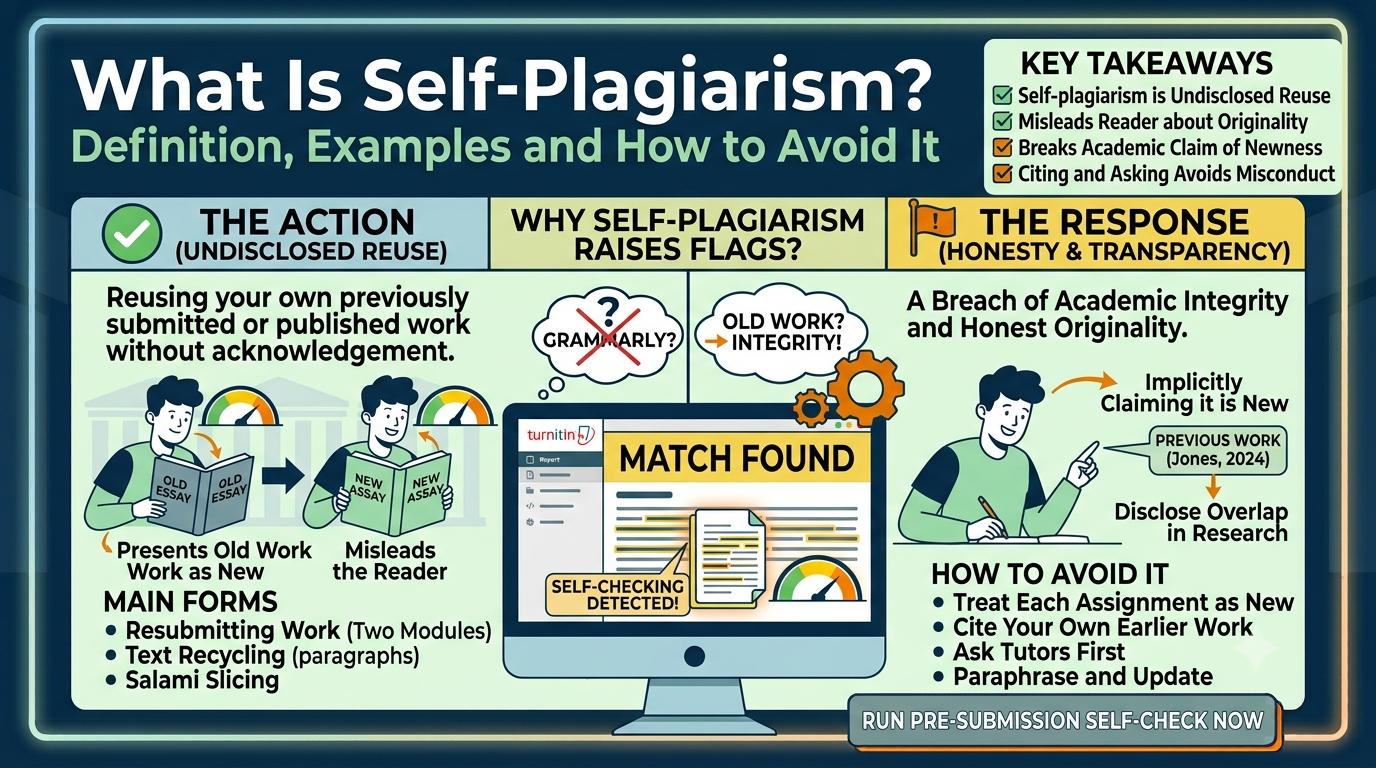
Self-plagiarism is reusing your own previously submitted or published work without acknowledging it. Publication ethics bodies call it text recycling. It counts as an academic integrity breach because it presents old work as new, and text matching software will often flag it against your own earlier submissions.
How can you plagiarise yourself?
It sounds contradictory, because you cannot steal from yourself. The issue is not theft, it is honesty about originality. When you submit a piece of work, you are implicitly claiming it is new and produced for that purpose. Reusing an old essay, or large chunks of one, breaks that claim and misleads the reader about what is original.
The Committee on Publication Ethics (COPE) defines text recycling, also known as self-plagiarism, as reusing one’s own previous writing without being transparent about it or referencing the original appropriately, according to COPE’s published guidance on handling text recycling. The US Office of Research Integrity and major publishers such as Wiley apply the same principle to research writing.
What are the main forms of self-plagiarism?
- Resubmitting work: handing in the same assignment, or most of it, for two different modules.
- Text recycling: reusing paragraphs from an earlier essay in a new one without acknowledgement.
- Duplicate or redundant publication: in research, republishing substantially the same study or data. COPE treats this as a more serious, separate category from text recycling.
- Salami slicing: splitting one study into several thin papers to inflate a publication count.
Is self-plagiarism always misconduct?
Not always, and this is where students and early researchers get caught out. Opinions vary, and context matters. Reusing a standard method description in a research paper is widely seen as more acceptable than recycling parts of an introduction or discussion, because a method that has not changed can only be described in so many ways. COPE’s position is that limited reuse can be legitimate when it is disclosed and referenced, while undisclosed reuse of substantial text misleads the reader about originality.
For students, the rule is usually stricter and simpler. Most universities prohibit submitting the same work twice for credit, even though you wrote it, because each submission is meant to be earned separately. Always check your own institution’s academic integrity policy, which is the standard you will be judged against.
Why does self-plagiarism get detected?
Two reasons. First, universities store submitted work in a repository, so a new submission is checked against your own earlier ones as well as everyone else’s. Turnitin’s similarity check compares against a database that includes previously submitted student papers, which is exactly how recycled text surfaces. Second, markers who taught you before may simply recognise the work.
One caveat worth knowing: similarity software only catches recycled text if the earlier work is in the database it searches. Research tools built for publication, such as iThenticate, deliberately do not archive submissions, so pre-submission self-checks do not create a match against your own draft. Our comparison of iThenticate and Turnitin explains how their databases differ.
How do you avoid self-plagiarism?
- Treat each assignment as new. Do not reuse an old essay for a fresh brief, even on a similar topic.
- Cite your own earlier work. If you genuinely need to build on something you wrote before, reference it as you would any other source.
- Ask first. If two modules invite overlapping work, ask both tutors before you reuse anything.
- Paraphrase and update. Rather than lifting old passages, rewrite the idea for the new context. Our guide to quoting, paraphrasing and summarising shows how.
- Declare overlap in research. If you are publishing and some text or data overlaps with earlier work, disclose it to the editor and cite the original, in line with COPE guidance.
Frequently asked questions
Can I reuse my own essay for a different class?
Usually not. Most universities treat resubmitting the same work for credit in two modules as an academic offence, even though you wrote it. Check your institution’s policy and ask your tutor if you are unsure.
Is self-plagiarism as serious as copying someone else?
It is generally viewed as less serious than copying another person’s work, but it is still an integrity breach and can carry real penalties, from a capped mark to a formal misconduct finding.
Can Turnitin detect self-plagiarism?
Yes, where your earlier work sits in a repository it searches. Turnitin compares new submissions against previously submitted student papers, so recycled text from a past assignment can match.
Is reusing my methods section self-plagiarism?
In research writing, limited reuse of a method’s description is often accepted, provided you disclose it and cite the original. Recycling parts of the introduction, results or discussion is treated more strictly. When in doubt, disclose and reference.

Want more tips & great deals? Get them sent to your inbox
Please enter a valid E-mail
By clicking "Subscribe" you agree to be contacted via e-mail. You can always unsubscribe from the newsletter


