
Ready by 11:01pm Sep 11, 2026
Personal Statement Examples and How to Write Your Own (2026)
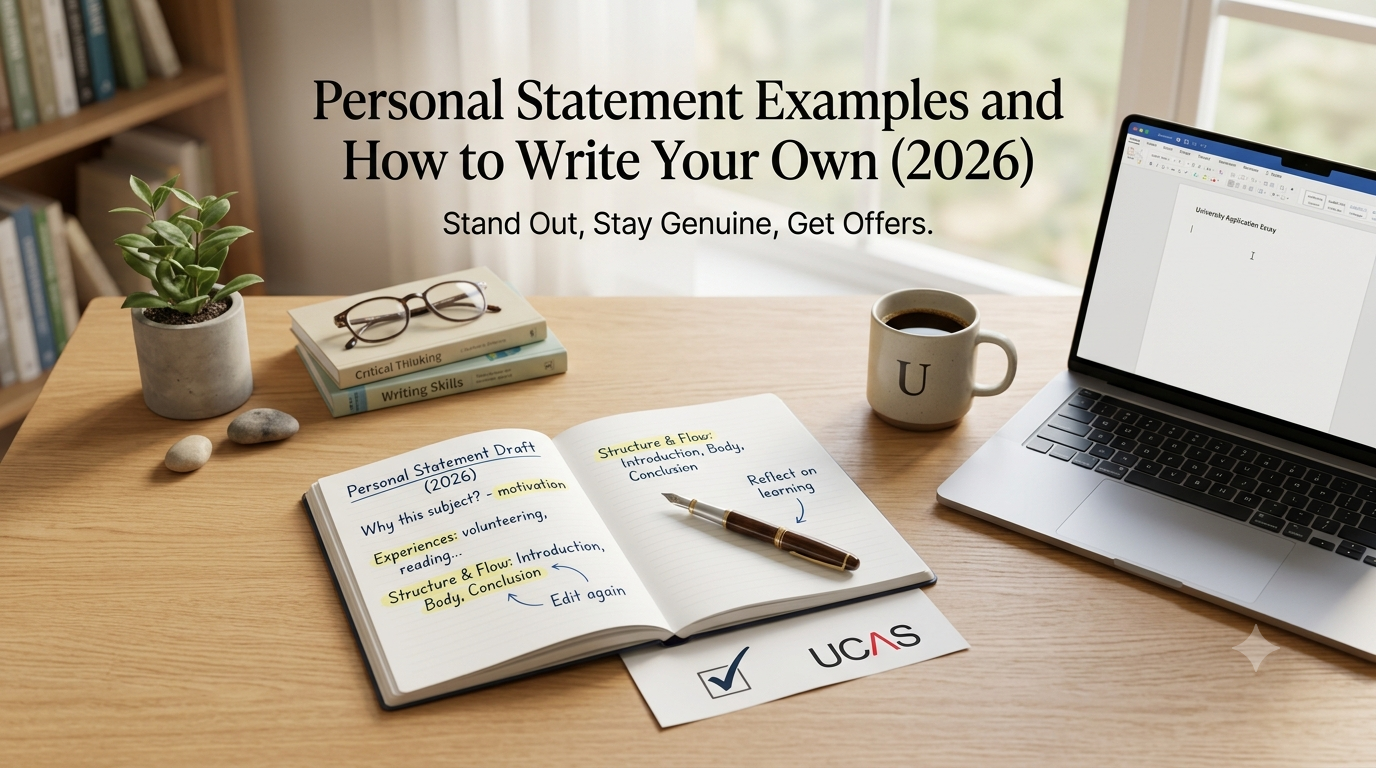
A personal statement is a short essay for a university application that explains why you want to study a subject and why you are suited to it. A strong statement opens with genuine motivation, gives evidence of your interest and skills, and connects them to the course. Write your own, since admissions systems check for similarity.
A personal statement is one of the few parts of a university application you fully control, and it can make the difference between offers when grades are similar. It is also one of the hardest things to write, because you have to sound genuine, specific and mature in a few hundred words, without slipping into cliche. This guide explains what admissions tutors actually look for, walks through a workable structure, and shows illustrative examples of strong and weak approaches. One thing to be clear about from the start: use examples for inspiration only and write your own statement, because admissions systems run similarity checks and a copied statement can cost you a place.
What is a personal statement?
A personal statement is a short piece of writing submitted as part of a university application, most often through UCAS in the UK, in which you explain why you want to study your chosen subject and why you would be a good student of it. Its purpose is to let admissions tutors see the person behind the grades: your motivation, your understanding of the subject, and the experiences and skills that have prepared you for it. Because many applicants have similar predicted grades, the statement is often where a tutor decides between candidates, which is why it repays real thought. It is not a list of achievements; it is an argument that you belong on the course, built from evidence.
Admissions processes evolve, and the exact format can change, so always check the current UCAS guidance for how statements are submitted and what is asked for in the year you apply. Whatever the format, the underlying question a tutor is asking stays the same: why this subject, and why you.
What do admissions tutors look for?
Tutors are reading for a handful of things, and knowing them tells you what to put in and what to cut. The table sets out what they value and what weakens a statement.
| Tutors want to see | What weakens a statement |
| Genuine motivation for the subject | Generic reasons that could apply to anyone |
| Evidence of interest beyond the syllabus | Vague claims with no examples to back them |
| Relevant skills and experiences | A list of achievements with no reflection |
| Reflection on what you learned | Cliches and empty opening lines |
| A clear link to the course | Copied phrasing that fails similarity checks |
The single most important quality is evidence. Saying you are passionate about a subject means nothing on its own; showing what you read, did or noticed, and what you took from it, proves the passion is real. Every claim in a strong statement is backed by a specific example, which is what separates a memorable statement from the many that blur together.
How do you structure a personal statement?
There is no single required structure, but a reliable shape helps you cover what matters in a logical order.
- Opening: start with genuine motivation for the subject, ideally through a specific moment, idea or question that drew you in. Avoid grand quotes and cliches; specificity is more memorable than drama.
- Academic interest: show your engagement beyond the syllabus, wider reading, projects, or ideas you have explored, and reflect on what you learned, not just what you did.
- Relevant experience: connect work experience, volunteering or extracurricular activities to the skills the course values, again with reflection rather than a bare list.
- Skills and suitability: draw out the qualities that make you a good fit, evidenced by the experiences you have described.
- Conclusion: tie your motivation and evidence together and look forward to studying the subject, leaving the tutor with a clear sense of why you belong on the course.
Throughout, the writing should be clear, specific and reflective. The reflective habit, always saying what an experience taught you or why it mattered, is the same analytical skill that earns marks in academic work, which our how to write critically guide develops. A statement that reflects reads as mature; one that only lists reads as thin.
Personal statement examples
These short illustrative snippets show the difference between a weak, generic opening and a stronger, specific one. They are for guidance only, to be studied rather than copied.
| Weak (generic) | Stronger (specific and reflective) |
| ‘I have always been passionate about science and want to help people, so medicine is the perfect career for me.’ | ‘Volunteering on a hospital ward, I saw how much of a diagnosis depends on listening carefully to a patient, which turned my interest in biology into a specific ambition to study medicine.’ |
| ‘I love reading and have read many books, which is why I want to study English.’ | ‘Reading two very different accounts of the same historical event made me want to understand how narrative shapes truth, a question I want to pursue in an English degree.’ |
In each pair, the stronger version replaces a claim with a concrete experience and a reflection on what it meant. That is the move to aim for in your own statement: for every quality you want to convey, find the specific thing you did and the specific thing you learned. Study examples like these for how they work, then write your own from your own experiences, because a genuine statement in your own voice is both more convincing and safe from similarity checks.
How do you make your statement stand out?
Beyond structure, a few habits lift a statement above the average. Be specific rather than general at every opportunity, since detail is what tutors remember. Reflect on your experiences rather than listing them, because reflection shows maturity and self-awareness. Keep the focus on the subject and your suitability for it, rather than drifting into unrelated personal history. Write in your own natural voice rather than an inflated one, as forced formality reads as insincere. And redraft: strong statements are rewritten many times, tightened and sharpened until every sentence earns its place. Above all, keep it honest, since anything you write may be discussed at interview, and a statement you cannot stand behind is a liability rather than an asset. Reading your statement aloud is a simple way to catch sentences that sound forced or insincere before you submit.
Common personal statement mistakes
- Opening with a cliche or a famous quote instead of genuine, specific motivation.
- Listing achievements without reflecting on what you learned from them.
- Being vague, with claims of passion that have no evidence behind them.
- Drifting away from the subject into unrelated personal detail.
- Copying phrasing from example statements, which risks failing similarity checks.
A statement that is specific, reflective and genuinely yours is the one that works. For related writing skills, see our how to write a first-class essay guide. Check the current UCAS guidance for the exact requirements in your application year.
Frequently asked questions
What is a personal statement?
A personal statement is a short essay in a university application explaining why you want to study a subject and why you are suited to it. It lets admissions tutors see your motivation and evidence beyond your grades.
What should a personal statement include?
Genuine motivation for the subject, evidence of interest beyond the syllabus, relevant experiences and skills, reflection on what you learned, and a clear link to the course, all backed by specific examples.
Can I copy a personal statement example?
No. Admissions systems run similarity checks, so a copied statement can cost you a place. Use examples only for inspiration and write your own from your own experiences and voice.
How do you start a personal statement?
Start with genuine, specific motivation, ideally a moment, idea or question that drew you to the subject. Avoid cliches and famous quotes, since specificity is far more memorable to a tutor.

Want more tips & great deals? Get them sent to your inbox
Please enter a valid E-mail
By clicking "Subscribe" you agree to be contacted via e-mail. You can always unsubscribe from the newsletter


