
Ready by 7:59am Oct 4, 2026
Rebuttal in an Argumentative Essay: A Guide (2026)
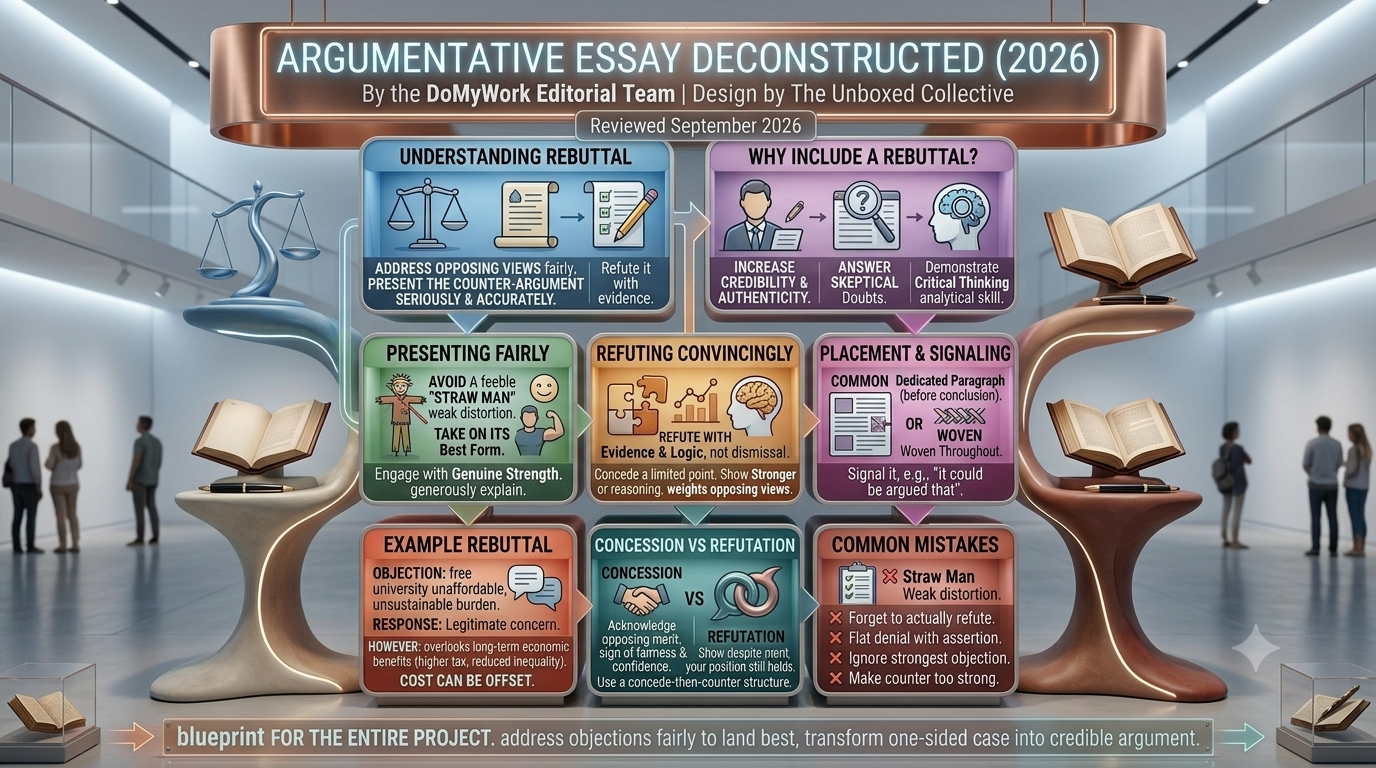
A rebuttal is the part of an argumentative essay where you address the opposing view and explain why your position still holds. You present the counter-argument fairly, then refute it with evidence and reasoning. Including a rebuttal makes your argument stronger, because it shows you have considered the issue fully rather than ignoring the other side.
Many students think the strongest argumentative essay is one that only makes its own case, but the opposite is true: the most convincing essays engage with the other side. The rebuttal, where you acknowledge the opposing view and refute it, is what turns a one-sided essay into a persuasive, well-rounded argument. This guide explains what a rebuttal is, why it strengthens your writing, how to write one, and where to place it, with an example. It is a key technique in persuasive and argumentative writing, and it works alongside our how to write a persuasive essay guide.
What is a rebuttal?
A rebuttal, also called a refutation or counter-argument response, is the part of an argumentative essay where you address an opposing viewpoint and explain why your own position is stronger. It has two parts: first you present the counter-argument, the strongest case against your view, fairly and accurately; then you refute it, using evidence and reasoning to show why it does not overturn your position. A rebuttal is not about ignoring or dismissing the other side; it is about engaging with it seriously and then answering it. This engagement is what distinguishes a mature argument from a one-sided assertion of opinion.
Why include a rebuttal?
Including a rebuttal makes your argument significantly stronger, for several reasons. It shows the reader that you have considered the issue fully, from more than one angle, which makes you a more credible and trustworthy writer. It answers the doubts a sceptical reader is likely to have, rather than leaving them unaddressed, which is far more persuasive. And it demonstrates the critical thinking markers reward, since weighing opposing views is exactly the analytical skill assessed at the higher grades, as our how to write critically guide develops. An essay that ignores the obvious objections looks naive; one that answers them looks authoritative.
How to present the counter-argument fairly
The first part of a rebuttal is presenting the opposing view, and it must be done fairly, which many students get wrong. Present the strongest, most reasonable version of the counter-argument, not a weak or distorted one, since knocking down a feeble version, a straw man, convinces no one and undermines your credibility. Explain the opposing view accurately and even generously, as its supporters would, so the reader trusts that you understand the issue. Only by engaging with the genuine strength of the other side does your refutation carry weight, so resist the temptation to make the counter-argument easy to defeat; take on its best form.
How to refute the counter-argument
Having presented the opposing view fairly, you refute it, showing why your position still holds. There are a few ways to do this. You can challenge the evidence, showing that it is weak, outdated or misinterpreted. You can concede a limited point but show that it does not overturn your overall argument, which is often the most sophisticated approach. Or you can show that your position is supported by stronger evidence or reasoning. Whichever you use, refute with evidence and logic rather than dismissal, since a rebuttal that simply asserts the other side is wrong is no rebuttal at all. A well-reasoned refutation is what actually answers the objection.
Where to place the rebuttal
There are two common places for a rebuttal in an argumentative essay. The most common is a dedicated paragraph, usually placed after you have made your own main arguments and before your conclusion, where you address the main counter-argument in full. The alternative is to weave smaller rebuttals throughout the essay, answering objections to each of your points as you make them. The dedicated paragraph suits a single major counter-argument, while the woven approach suits an essay with several points each facing objections. Either works, so choose the placement that lets you address the opposing view most clearly, and signal it with phrases such as ‘it could be argued that’ before presenting the counter-view.
An example of a rebuttal
Suppose your essay argues that university should be free. A rebuttal might run: ‘It could be argued that free university is unaffordable, placing an unsustainable burden on taxpayers. This is a legitimate concern, and the cost would indeed be significant. However, this objection overlooks the long-term economic benefits of a more educated workforce, including higher tax revenues and reduced inequality, which several studies suggest can offset the initial cost over time. The affordability concern, while real, therefore does not outweigh the wider social and economic case for free university.’ Notice how the rebuttal presents the objection fairly, concedes its legitimacy, and then refutes it with reasoning and evidence, rather than dismissing it.
Concession versus refutation
Within a rebuttal, it helps to understand the difference between concession and refutation, because the most sophisticated rebuttals use both. A concession is where you acknowledge that part of the opposing argument has merit, which is not a weakness but a sign of fairness and confidence. A refutation is where you show why, despite that merit, your position still holds. The strongest rebuttals often concede a limited point before refuting the wider argument, using a structure such as: while it is true that X, this does not outweigh Y. This concede-then-counter approach is more persuasive than flatly denying everything the other side says, because it shows the reader you are reasonable and have weighed the issue honestly, which makes your refutation more credible when it comes. Learning to concede a genuine point gracefully, then explain why your position nonetheless prevails, is a mark of mature argumentative writing, and it disarms a sceptical reader far more effectively than pretending the opposing view has no strengths at all.
Common rebuttal mistakes to avoid
● Attacking a weak or distorted version of the opposing view (a straw man).
● Presenting the counter-argument but forgetting to actually refute it.
● Refuting with dismissal or assertion rather than evidence and reasoning.
● Ignoring the strongest objection to your position and answering only easy ones.
● Making the counter-argument so strong that your refutation cannot answer it.
Mastering the rebuttal is one of the most effective ways to strengthen an argumentative essay, because it transforms a one-sided case into a considered, credible argument. Present the opposing view fairly, refute it with evidence, and place it where it lands best, and your essay will demonstrate exactly the balanced, critical thinking that earns top marks, supported by a clear thesis statement that your rebuttal ultimately defends.
Popular posts

Harvard Referencing Made Simple: The Only Guide You Will Need in 2026
May 12, 2026

How to Complete a Commercial Cookery Logbook (SITHCCC Units Guide)
July 4, 2026
APA Referencing: A Full Guide with Examples (7th Edition, 2026)
September 2, 2026
How to Cost and Plan a Menu for a Cookery Assignment
July 7, 2026

150 History Research Paper Topics (2026)
September 12, 2026

Want more tips & great deals? Get them sent to your inbox
Please enter a valid E-mail
By clicking "Subscribe" you agree to be contacted via e-mail. You can always unsubscribe from the newsletter


