
Ready by 11:02pm Sep 11, 2026
How to Cost and Plan a Menu for a Cookery Assignment
A menu planning and costing assignment asks you to design a menu, then prove it works commercially. You calculate the cost of each dish, set a selling price using a target food cost percentage, then justify your choices against nutrition, balance, then your customer. Accuracy in the numbers is where the marks sit.
This is the assignment where culinary skill meets business sense. A beautiful menu that loses money fails the brief, since real kitchens run on margins. The good news is that the maths is simple once you know the formulas, then the justification follows naturally from your costing. This guide covers the recipe cards, the calculations, then the mistakes that quietly drain marks.
What does a menu planning assignment involve?
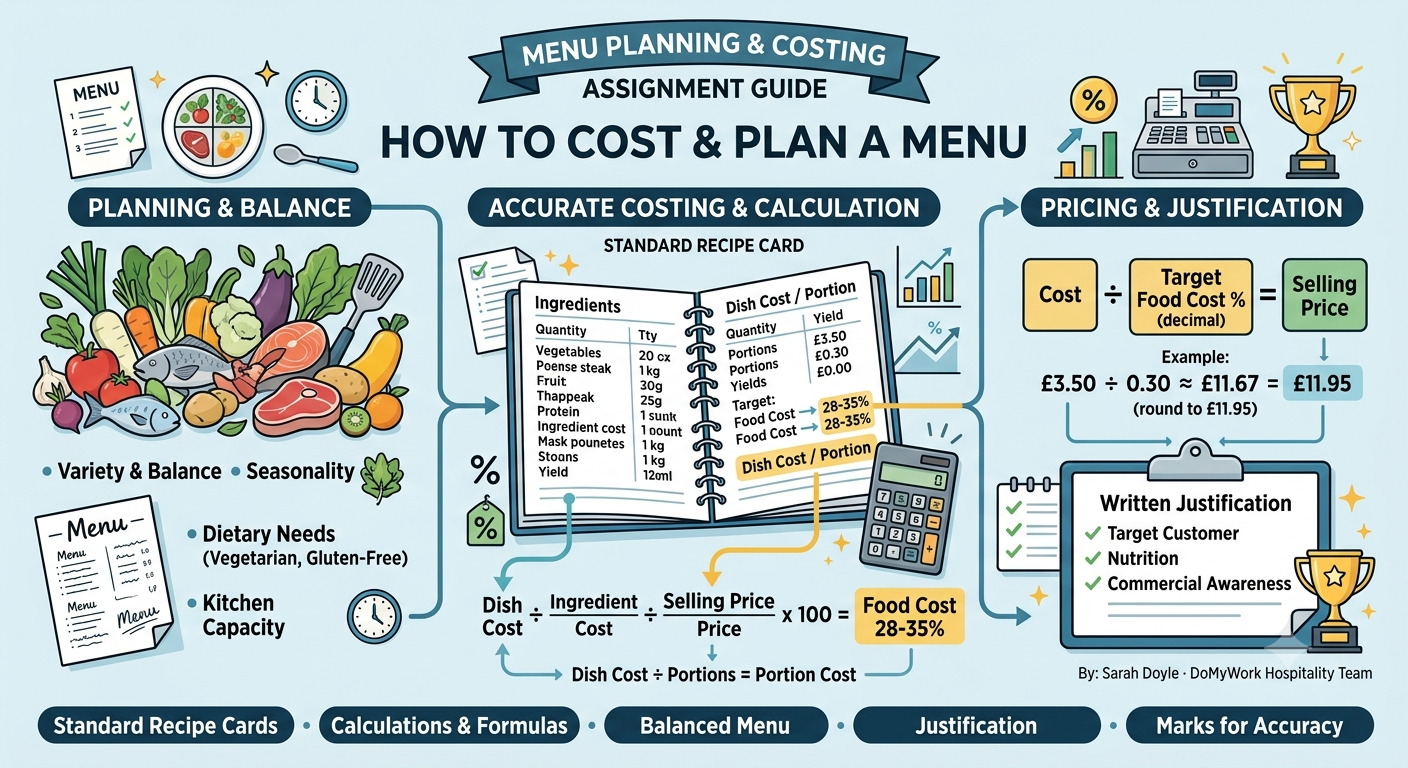
A typical menu assignment has four parts: a designed menu, standard recipe cards for each dish, a full costing with selling prices, then a written justification of your choices. The menu shows creativity, the recipe cards show precision, the costing shows commercial awareness, then the justification ties it together. Marks are spread across all four, so none can be skipped.
How do you build a standard recipe card?
A standard recipe card is the backbone of costing. It lists every ingredient, the exact quantity, the yield, then the number of portions. From this you calculate a cost per portion. Include everything, down to garnish then oil, since small omissions compound across a menu. A precise recipe card also guarantees consistency, which is the point of standardising in the first place.
How do you calculate dish cost and food cost percentage?
Dish cost is the total ingredient cost divided by the number of portions. Food cost percentage then tells you what proportion of the selling price the ingredients consume, calculated as ingredient cost divided by selling price, multiplied by one hundred. Most kitchens target a food cost percentage between roughly 28 then 35 per cent, though this varies by sector. A lower percentage means more margin, but pricing too high risks losing customers, so the target is a balance.
How do you set a selling price?
Work backward from your target food cost percentage. If a dish costs three pounds fifty to produce, then your target food cost is thirty per cent, divide the cost by 0.30, which gives a selling price of around eleven pounds sixty seven. You would then round to a sensible menu price, such as eleven pounds ninety five. Showing this calculation clearly, cost, target percentage, then resulting price, is exactly the working markers want to see.
Need help turning culinary research into an academic assignment?
From food safety and HACCP reports to menu planning, nutrition analysis and hospitality coursework, academic cookery assignments require both subject knowledge and clear academic structure.
How do you plan a balanced menu?
Beyond cost, a strong menu balances variety, dietary needs, seasonality, then kitchen capacity. Offer a spread of proteins, cooking methods, then price points. Include options for common dietary requirements, since a menu that excludes vegetarian or allergen-aware diners loses both marks then customers. Match the menu to what your kitchen can actually produce at volume, rather than designing dishes that would collapse under a busy service.
How do you justify your menu choices?
The justification is where you turn decisions into reasoning. For each major choice, explain it against your target customer, nutrition, cost, then practicality. Why this dish at this price for this diner? Why this protein in this season? A menu without justification reads as a list, while a justified menu reads as a commercial decision, which is what the assignment is really testing.
What are common menu costing mistakes?
Three recur. Forgetting wastage, so the real cost of an ingredient is higher than the purchase price once trimmings are gone. Confusing gross then net quantities, costing the whole item when only part is used. Then leaving small items uncosted, garnish, oil, seasoning, which add up across a full menu. Building wastage then yields into your recipe cards from the start avoids all three.
How do you account for wastage in your costing?
Wastage is the cost that catches students out. When you buy a whole fish, a side of beef, or a box of vegetables, part of it becomes trim, bone, or peel that never reaches the plate. Your costing must use the usable yield, not the purchase weight. If a vegetable yields seventy per cent usable after peeling, then the real cost per usable kilo is higher than the shelf price. Calculate a yield percentage for each main ingredient, then cost on the usable portion, or your numbers will understate the true food cost.
How does gross profit relate to food cost?
Food cost percentage then gross profit are two sides of the same coin. If your food cost is thirty per cent of the selling price, your gross profit is the remaining seventy per cent, before labour then overheads. Showing both in your assignment demonstrates commercial understanding: the food cost shows what the dish consumes, then the gross profit shows what it contributes. Markers reward students who can move between the two, since that is how a real kitchen reads its menu.
How do you present a menu costing assignment?
Presentation carries marks of its own. Lay out each dish with its standard recipe card, then a clear costing table showing ingredient cost, portion cost, food cost percentage, then selling price. Use consistent units then round prices sensibly. A clean, labelled table lets the assessor follow your numbers at a glance, while a messy one hides good work behind confusion. Treat the costing like a document a head chef would actually use, since that professional standard is part of what the assignment tests.
How does portion control affect cost?
Portion control is where costing meets the real kitchen. If your recipe card assumes a 150 gram portion but the kitchen serves 180 grams, your food cost percentage climbs then your margin shrinks on every plate. Strong assignments acknowledge this, then build portion control into the costing through accurate yields then standard serving sizes. Showing you understand how a few grams per plate scale across a busy service is exactly the commercial awareness markers reward.
Need academic support with your cookery coursework?
Practical cookery work often comes with written reflections, reports and supporting academic work. Explore our cookery assignment support for help with the written side of your coursework.
Explore cookery assignment support
Frequently asked questions
How do you calculate food cost percentage?
Divide the ingredient cost of a dish by its selling price, then multiply by one hundred. For example, a dish costing three pounds fifty sold at eleven pounds ninety five has a food cost percentage of about 29 per cent.
What is a good food cost percentage?
Most kitchens target between roughly 28 and 35 per cent, though it varies by sector. A lower percentage means more margin, but pricing too high to chase it risks losing customers, so it is a balance.
How do you set a menu selling price?
Divide the dish cost by your target food cost percentage expressed as a decimal. A dish costing three pounds fifty at a 30 per cent target gives a price of around eleven pounds sixty seven, which you round to a sensible menu figure.
What is a standard recipe card?
A document listing every ingredient, exact quantities, yield, then portions for a dish, used to calculate cost per portion and guarantee consistency. It is the foundation of accurate menu costing.



Want more tips & great deals? Get them sent to your inbox
Please enter a valid E-mail
By clicking "Subscribe" you agree to be contacted via e-mail. You can always unsubscribe from the newsletter


