
Ready by 11:01pm Sep 11, 2026
Harvard Referencing Made Simple: The Only Guide You Will Need in 2026
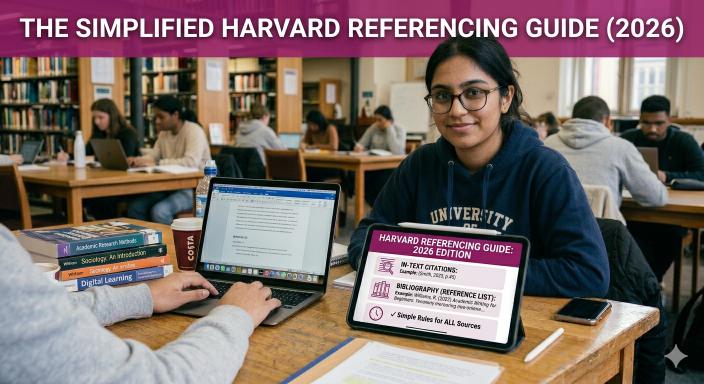
Harvard referencing uses the author and year. You put the surname and year in the text, then give the full details in an alphabetical reference list at the end. Harvard changes slightly between universities, so the main rule is to check your department guide, then keep it the same everywhere.
Nobody enjoys referencing, but getting Harvard right is one of the easiest ways to pick up marks that many students give away. It is the most common style across UK universities, so whether you study business, nursing, sociology, or education, there is a good chance your department expects it.
How does Harvard referencing work?
Every time you use someone else’s work, you name them and the year in brackets, and a full entry goes in a reference list at the end. The two must match. If a source is in your text, it must be in your list, and the other way round.
There is no single Harvard. Universities publish their own versions that differ on small things, like whether page ranges use pp., how many authors trigger et al., and how brackets are punctuated. Markers check referencing against your department guide, not a general one, so keep your chosen pattern the same everywhere, including in figure captions and appendices.
How do in-text citations work?
There are two shapes and you need both.
- Idea first: Repeat purchase rises when schemes reward frequency rather than spend (Ahmed, 2024).
- Author first: Ahmed (2024) found that repeat purchase rises when schemes reward frequency rather than spend.
Use the author first when the person matters, for example when you contrast two researchers. Use idea first when the finding matters and the source is just support. Switching between them also stops a literature review reading like a list.
| Situation | How to cite |
|---|---|
| One author | (Smith, 2024) |
| Two authors | (Smith and Jones, 2024) |
| Three or more | (Smith et al., 2024), though the threshold varies |
| A direct quote | (Smith, 2024, p.45) |
| Several sources at once | (Smith, 2023; Jones, 2024), oldest first |
One common slip is the full stop. The citation is part of the sentence, so the full stop comes after the closing bracket, not before it.
How do you build the reference list?
One list, in alphabetical order by surname, on its own page at the end. Not numbered, not split by type, and not one list per chapter unless your department asks. Where an author has two works in the same year, add a, b, c after the year and use the same letters in your citations. Each entry uses a hanging indent, so the first line is flush left and the rest is indented.
| Source type | Pattern |
|---|---|
| Book | Surname, Initial. (Year) Title. Edition if not first. Place: Publisher. |
| Chapter in edited book | Surname, Initial. (Year) Title of chapter, in Editor (ed.) Title. Place: Publisher, pp. range. |
| Journal article | Surname, Initial. (Year) Title of article, Journal Name, volume(issue), pp. range. |
| Website | Author or group (Year) Title of page. Available at: URL (Accessed: date). |
| Report | Group (Year) Title of report. Place: Publisher. |
| Dissertation or thesis | Surname, Initial. (Year) Title. Level. University name. |
| Lecture slides | Surname, Initial. (Year) Title, Module code: Module title. University. Date. |
Check each pattern against your own department guide. The parts will match. The punctuation may not.
How do you handle secondary sources?
A secondary source is one you read about in someone else’s work, not one you read yourself. The honest way to show this is cited in: (Bourdieu, 1984, cited in Ahmed, 2024). Your reference list then holds Ahmed, the work you actually read, not Bourdieu. Skipping this and citing the original directly is risky. A marker who checks one and finds you did not read it has a reason to check the rest.
What changes when you reference a dissertation?
The rules stay the same, but three things get harder over a long document.
- Staying consistent across chapters written months apart. The way you formatted a journal in October drifts by March. A reference manager from month one, or one master list you add to as you read, fixes this.
- Figures and tables. Anything taken from a source needs a caption crediting it, and that source goes in your reference list too. A table you built from someone else’s data needs a note saying adapted from, then the citation.
- Appendices. They cite normally. The thing people get wrong is direction: your main text points to the appendix, and every appendix is referred to at least once in the body.
This all sits inside the presentation marks a UK rubric assesses, so it is worth an afternoon at the end.
When do you need a page number?
Always for a direct quote, without exception. For a paraphrase, page numbers are optional in most Harvard versions but genuinely useful in a long piece of work, because they let a marker check a single claim without reading the whole source. In a dissertation, adding them is worth the effort. Where a source has no page numbers, such as a web page, use a section heading or a paragraph number instead.
How many references should a piece of work have?
There is no fixed number, and any figure you find online is just someone else’s department guidance. The useful test is coverage, not count. Does every claim that needs support have it, and does your list show you read the key work in your field rather than the first thing a search returned?
If you want a rough guide, a 2,000 word essay often cites 10 to 15 sources, while a dissertation cites many more. Better still, look at two or three recent pieces of work from your own department. That shows you what your markers are used to seeing, which is worth more than a general number.
Which mistakes actually cost marks?
- A citation with no matching reference entry, or an entry with no citation. Markers check both ways.
- Drifting between formats across a long document.
- Missing page numbers on direct quotes.
- Citing a source you only read about, without cited in.
- Small errors that trigger a similarity flag. Before you submit, run a quick plagiarism and formatting check.
How do you set up referencing for a long document?
Referencing a dissertation is harder than an essay for one simple reason: it is assembled over months, so it drifts. The fix is to build a system in the first week rather than repair the damage in the last one.
- Choose a reference manager, or one master document, before you write a word.
- Capture the full details of every source the moment you read it, not later from memory.
- Use one style throughout, and check the whole list against the same pattern at the end.
- Credit every figure and table in its caption, and add those sources to your list too.
An afternoon spent setting this up at the start saves a frantic day at the end, and it protects the presentation marks that are the easiest in the whole assignment to keep.
Frequently asked questions
Is Harvard the same at every university?
No. It is a family of authors and year styles, and UK universities publish their own versions. Follow your department guide and keep it consistent, because consistency is what is marked.
Do I need a page number for a paraphrase?
Usually optional, but useful. In a dissertation, page numbers let a marker check a claim quickly, which counts in your favour.
How do I reference a figure or table?
Give it a numbered caption that credits the source, and put that source in your reference list. If you built it from someone else’s data, say adapted from and cite it.
Reference list or bibliography?
A reference list holds only what you cited. A bibliography can include background reading you did not cite. Most UK courses want a reference list, so check first.
Does the reference list count in the word count?
Usually not, and appendices are often excluded too. Your department sets this, so confirm it in writing.


Want more tips & great deals? Get them sent to your inbox
Please enter a valid E-mail
By clicking "Subscribe" you agree to be contacted via e-mail. You can always unsubscribe from the newsletter


