
Ready by 11:02pm Sep 11, 2026
Plagiarism Checker for Researchers: How to Screen Your Manuscript
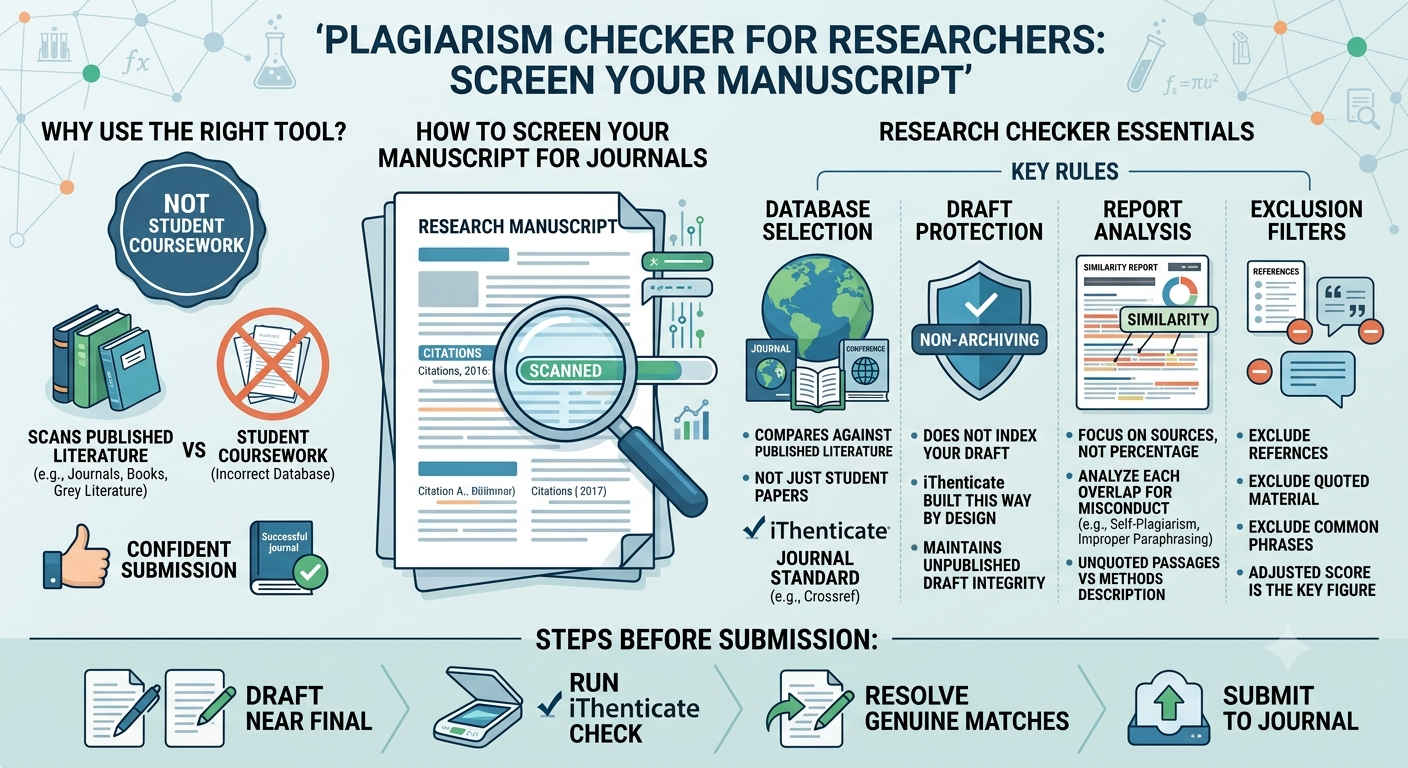
Researchers need a checker built for published literature, not student coursework. The standard is iThenticate, which powers the Crossref Similarity Check that journals run before peer review. The key rules are to check against research databases, use a tool that does not archive your unpublished draft, and read the report rather than the headline percentage.
Why can’t researchers just use a student checker?
Because the wrong database gives a false sense of security. A tool aimed at students is strongest at matching against previously submitted coursework, which is largely irrelevant to a journal article. A research manuscript needs to be compared against published journals, conference proceedings, books and grey literature, since that is what an editor’s system will check it against. Clearing a student-oriented tool tells you little about how a journal will see your paper.
Which tool do journals actually use?
Most reputable journals screen submissions with iThenticate, delivered through the Crossref Similarity Check programme, which has more than 1,500 publisher members according to Crossref. When you self-check with iThenticate before submitting, you are running the same software the editorial office will use, which is why it is the professional standard for pre-submission screening. For a full breakdown of how it differs from the classroom tool, see our comparison of iThenticate and Turnitin.
What should a researcher’s checker do?
- Search research literature. It must be compared against published journals and books, not mainly student papers.
- Protect your draft. It should not archive your submission, so an unpublished manuscript is not indexed before you are ready. iThenticate is built this way by design.
- Show sources, not just a number. You need a match breakdown so you can judge each overlap, since a single figure hides where the matches sit.
- Exclude the right elements. Reference lists, quoted material and short common phrases inflate the raw figure, so the adjusted score after exclusions is the one that matters.
How do you read a research similarity report?
Do not stop at the percentage. Open the report and judge the largest single match first. Overlap concentrated in one unquoted passage of your discussion is a real problem. The same total spread thinly across your reference list and a standard methods description usually is not. A methods section will always match other papers describing the same standard procedure, which is expected rather than misconduct.
Two matches deserve particular attention. First, overlap with your own earlier publications, which is self-plagiarism or text recycling, and which publishers expect you to disclose and cite. Second, any passage where you have paraphrased too closely, which our guide to quoting, paraphrasing and summarising helps you fix.
When should you run the check?
Before submission, not after. The value of a self-check is that you can still rewrite while the work is yours. Run a check once your draft is near final, resolve the genuine matches, then submit. Leaving it until the editor’s check is too late to fix anything, and a high similarity flag at that stage can delay or sink the submission.
What similarity level is acceptable for a manuscript?
There is no universal threshold, and it varies by journal and field. Many editors look at the adjusted score after excluding references and quotations, and at how the matches are distributed, rather than a fixed cut-off. A low overall figure with one large unattributed match can be more concerning to an editor than a slightly higher figure made up of many small, legitimate overlaps. Always check the specific journal’s author guidelines, which take precedence.
How can you reduce genuine overlap before submitting?
- Quote sparingly and paraphrase properly, rewriting both the words and the structure.
- Cite every source you draw on, including your own prior work.
- Rewrite recycled passages from your earlier papers rather than pasting them, and disclose any necessary overlap to the editor.
- Keep quotations and standard method descriptions clearly attributed so an editor can see they are legitimate.
- Follow the target journal’s declaration and originality requirements, which often ask you to flag any overlapping work in preparation.
Frequently asked questions
Is there a free plagiarism checker good enough for research?
Free tools are fine for a quick early pass, but they rarely index the published literature a journal checks against, so they should not be your final screen. For a submission-grade check, use iThenticate or the tool your institution provides.
Will checking my manuscript put it in a database?
Not with iThenticate, which does not archive submissions. Avoid tools that store your draft, since an indexed draft can later match against your own published version.
Does a plagiarism checker also detect AI writing?
Some do, as a separate feature. iThenticate added AI writing detection for institutional subscribers with its 2.0 release. Treat any AI result as advisory, because false positives are a known risk.
My university uses a different mandated tool. Which do I trust?
For official evaluation, use whatever your institution mandates, since that is the result on record. Use iThenticate as an additional pre-submission check when you are heading to a journal, because it reflects what the journal will run.

Want more tips & great deals? Get them sent to your inbox
Please enter a valid E-mail
By clicking "Subscribe" you agree to be contacted via e-mail. You can always unsubscribe from the newsletter


