
Ready by 2:31am Sep 17, 2026
How Turnitin Works and What Your Score Means
Turnitin is a text matching tool, not a plagiarism judge. It compares your writing against student papers, journals, and web pages, then shows a similarity score as a percentage. The score points out overlap so a person can review it. A high number is not proof of cheating, and a low number is not a free pass.
If your university uses Turnitin, your work goes through it the moment you submit, and for many students that is a nervous moment. The score can feel like a verdict. The good news is that Turnitin is simpler than it looks. Once you know what it measures, the report becomes a tool you can use.
What is Turnitin?
Turnitin is the similarity checking service most universities use to review submitted work. It holds one of the largest databases of academic writing in the world, made of student submissions, published articles, and web pages. The key point is that it does not decide whether you cheated. It finds text that matches something it has seen before and shows it to your tutor. A person makes the judgement, in the context of your assignment.
How does Turnitin work, step by step?
- You submit your file, or your tutor uploads it.
- Turnitin turns it into plain text and breaks it into small chunks.
- It compares each chunk against student papers, published sources, and the web.
- Where a chunk matches, it records the match and its source.
- It builds a report that highlights each match and links it to its source.
- It works out an overall similarity score.
- Your tutor reads the matches in context and decides what they mean.
Only the matching is automatic. The judgement is human, which is why two students can have the same score and very different outcomes.
What does the similarity score mean?
It is the share of your writing that matches other sources. A score of 18 per cent means about 18 of every 100 words sit inside a matched passage. It does not mean 18 per cent is copied. Some overlap is almost always honest.
Picture two essays that both score 20 per cent. In the first, matches spread across 30 sources, none above 2 per cent, which is what citing widely looks like. In the second, one source is behind 18 of the 20 points. The first is healthy, the second needs work, and the number is the same. We explain this fully in what counts as a good Turnitin score.
What does Turnitin compare your work against?
Three pools. Its store of past student papers, which grows every time a student submits with archiving on. A large set of licensed published work. And the open web. It does not check everything. It cannot see inside paywalled content it has not licensed, it cannot read text inside images, and it does not understand meaning, so it will not catch an idea you reworded heavily unless the wording matches. That is why a low score is never proof of originality.
How does Turnitin handle a dissertation?
It works the same way as for an essay. What changes is the report. A dissertation creates many matches across many sources, which makes the headline number nearly useless and the source list the only view worth opening.
One point matters more than the mechanics. When work is submitted through a university, it may be added to Turnitin’s store of student papers. For an essay that does not matter. For a dissertation it can. If a chapter goes through a practice check with archiving on, and the finished document goes through again at submission, the second check can match against the first. Students see a scary percentage and think something went wrong, when they are matching their own earlier draft. Your university can usually fix this once you flag it.
Storage is the other point. If your dissertation holds work heading to a journal, having it sit in a shared database matters. Check how any check you run stores your file, and prefer one that deletes it after the report. The $5 report returns your figure without adding your document to a shared store.
Does Turnitin detect AI writing?
Yes, through a separate feature. Next to the similarity report, Turnitin has an AI writing indicator that estimates how much of your text reads as machine written. This answers a different question. The similarity score asks whether your words match other sources. The AI indicator asks whether your words read like machine writing.
The indicator is not perfect. It can flag genuine human writing, especially from students who write in a very even style or in a second language, and it can miss AI text that was edited heavily. Treat any AI flag as a reason to review a section, not as proof.
How do you read your report?
Start with the source list, not the headline. Sort by size and look at the biggest match first. For each one, ask a simple question: is this a quote I marked and cited, part of my reference list, or a passage I wrote that sits too close to its source? Quotes and references are usually fine and can often be excluded. A passage too close to its source is the one to fix, by rewriting it in your own words while keeping the citation.
What are the common myths about Turnitin?
Much of the fear around Turnitin comes from myths that pass between students until they sound true. Clearing them up takes most of the stress out of the process.
| The myth | The reality |
|---|---|
| Turnitin decides if you cheated | It only reports matches. A person makes the judgement, every time. |
| There is a safe percentage | There is not. A low score can hide a problem and a high one can be innocent. |
| You can trick it with tricks | Hidden white text and swapped characters are well known and treated as deliberate cheating. |
| Quoting gets you in trouble | A marked, cited quote is honest work, and many universities exclude quotes from the score. |
| It checks the whole internet | It checks a large but limited set of sources, so a clean report is reassuring, not absolute proof. |
Can you check your work in Turnitin before you submit?
Usually not on your own. Turnitin sits behind your university login, so most students cannot run their own work through it whenever they like. Some tutors open a draft submission point that lets you check once or twice before the real deadline, but this is not guaranteed and varies by course.
That gap is why students look for another way to see the result. You can run a private check while you draft to catch obvious problems, and when you want the exact figure your marker will see, you can get the official Turnitin report for $5 with no university login. Checking your own work before submission is good practice and is allowed everywhere.
Frequently asked questions
Is Turnitin always accurate?
It is accurate at finding matching text, but it cannot read intent. Quotes, references, and standard phrases all create matches that are not plagiarism, which is why a person reads the report.
Does Turnitin keep a copy of my paper?
It can add your work to its database, depending on your university settings. For unpublished dissertation work this is worth checking. A check that deletes your file after the report avoids the issue.
Why did my dissertation match my own draft?
Because that draft was stored when it was submitted. Your university can usually exclude the self match once you flag it, so raise it as soon as you see it.
Will a quote raise my score?
It can, because a quote is matching text by definition. Many universities let you exclude quotes. A properly marked and cited quote is not a problem even if it shows as a match.
How long does a check take?
Usually a few minutes, though a large document or a busy period can take longer. A resubmission sometimes has a delay of about 24 hours.
Popular posts
Best Student Side Hustles in the UK That Actually Pay in 2026
May 18, 2026
How Student Content Creators Can Get Paid Brand Deals in 2026
March 23, 2026
How to Check Your Turnitin Score Before Submitting
April 7, 2026
How to Write a First Class Essay at a UK University: A Complete Guide for Students
May 11, 2026
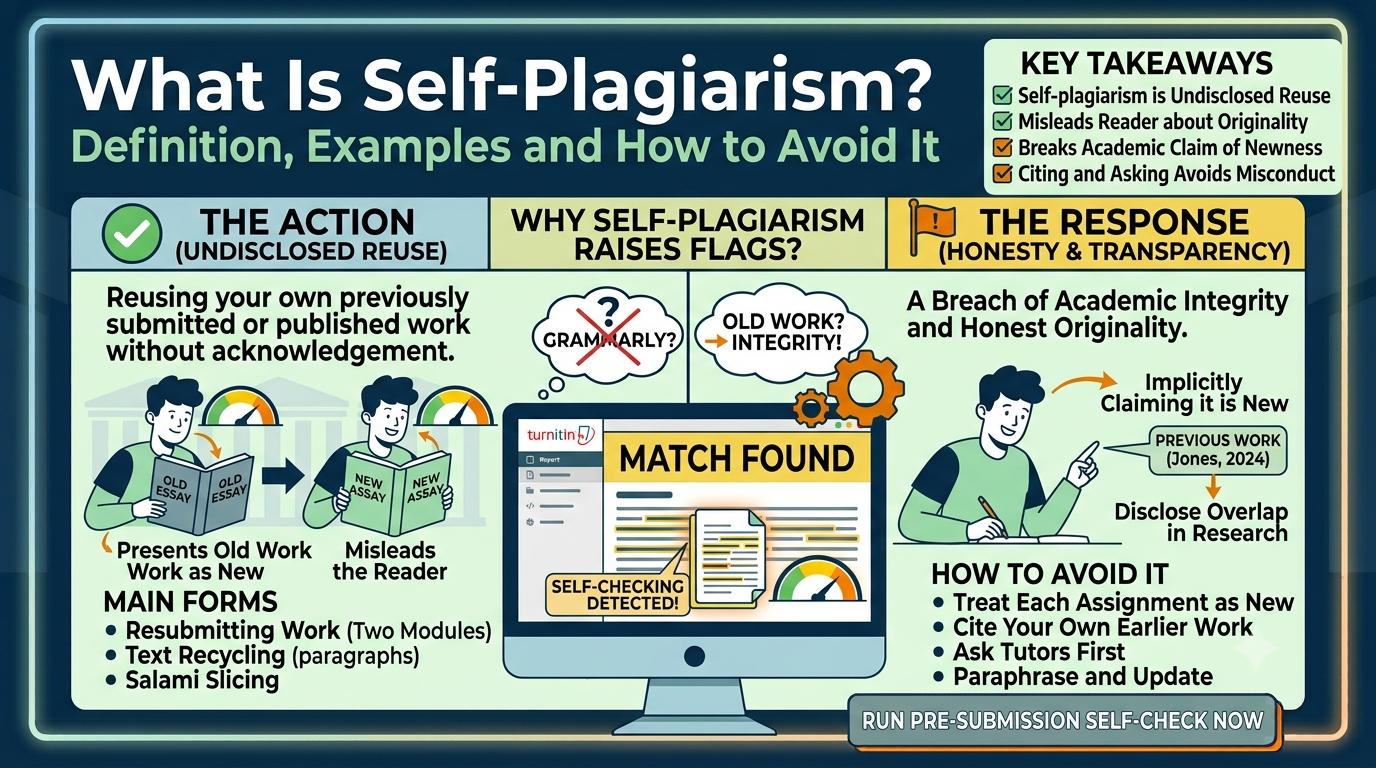
What Is Self-Plagiarism? Definition, Examples and How to Avoid It
July 23, 2026
Want more tips & great deals? Get them sent to your inbox
Please enter a valid E-mail
By clicking "Subscribe" you agree to be contacted via e-mail. You can always unsubscribe from the newsletter


