
Ready by 11:01am Sep 16, 2026
How to Write a Dissertation Literature Review
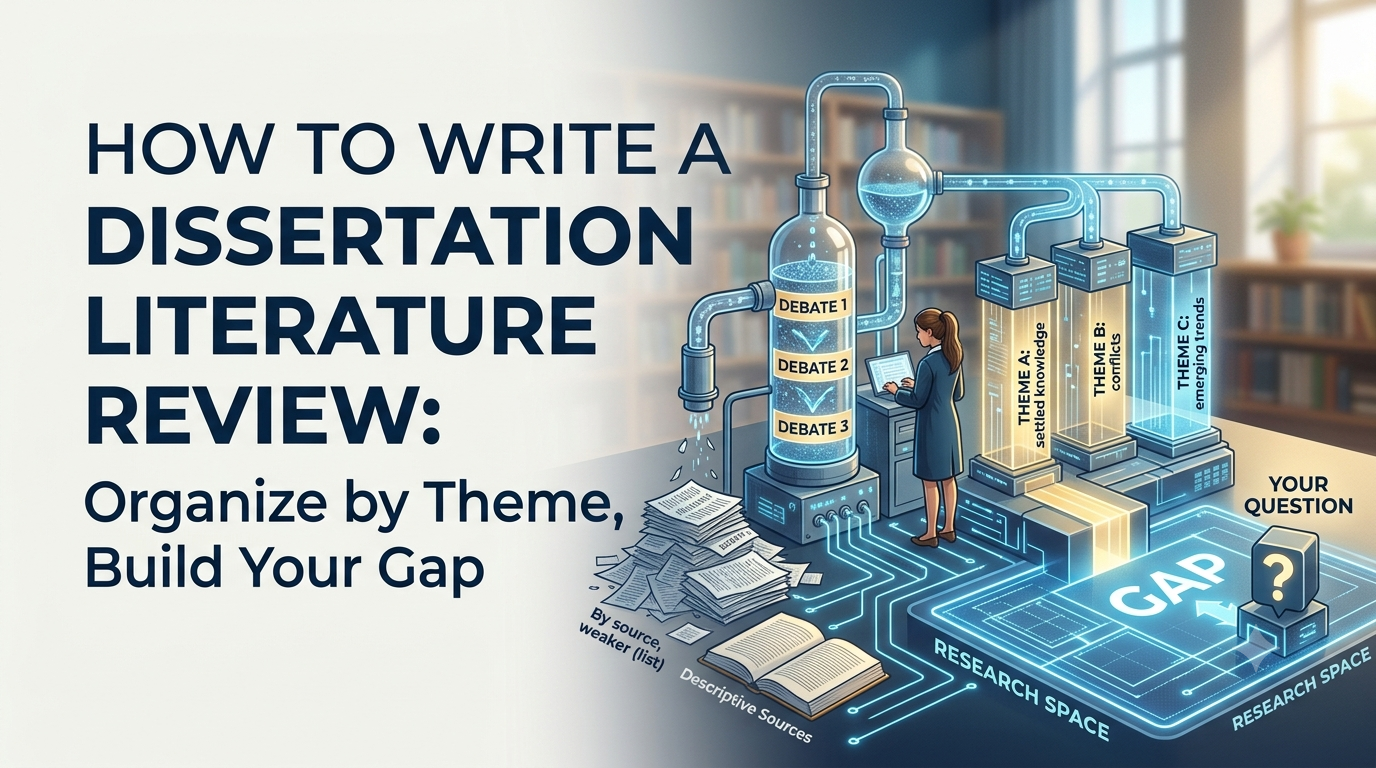
A literature review is not a summary of everything written on your topic. Its job is to show that a specific gap exists, so your research question becomes the obvious next step. Organise it by theme, not by source, and expect it to take around a quarter of your total word count.
The literature review is the longest chapter in most dissertations and the one that swallows the most time, because reading always feels productive. It is also the chapter most students misunderstand. It is not a reading list with your notes attached. It is an argument about what is known, built to make your question look necessary.
What is a literature review for?
It has one main job: to make your research question look inevitable. By the end, a reader who has never seen your project should be able to guess what you are about to ask, because you have shown the gap rather than just claimed it exists.
This changes what belongs in it. You are not proving you read a lot, though it will show that. You are building a case: here is what is settled, here is where the research disagrees or runs out, and that is where my question fits.
How should a literature review be structured?
By theme, not by source. This is the single most important decision, and the one most students get wrong on the first draft.
A source by source review walks through one study after another: Smith found this, then Jones found that. It reads as a list and marks as one. A thematic review organises around three or four debates in your field, with sources appearing inside them as evidence. Same material, but now it reads as analysis, and it is usually shorter too.
| By source, weaker | By theme, stronger |
| One paragraph per study, in a row | One section per debate or theme |
| Reader does the synthesis | You do the synthesis |
| Reads as a reading list | Reads as an argument |
| Repeats context for each source | Groups sources, so it is tighter |
How long should a literature review be?
Around a quarter to thirty per cent of your total, so roughly 3,750 to 4,500 words in a 15,000 word dissertation. It is the longest chapter because it does the most structural work, not because it should hold the most sources. If yours has run long, the cause is almost always organisation by source, and switching to themes usually shortens it while making it better.
What is the difference between describing and analysing sources?
This is the distinction that decides your mark, so it is worth being concrete. Describing a source tells the reader what it said. Analysing it tells the reader what that means for your argument.
Take an example. Writing that one study found a link between price and loyalty is description. Asking whether that link would hold in a different market, what the study’s sample could not show, and whether a rival study contradicts it, is analysis. A strong literature review is mostly analysis, with just enough description to support it. A weak one is mostly description with a little analysis added at the end. If you want to lift a review, the fastest route is to cut a paragraph that only reports and replace it with one that judges.
How do you avoid the most common trap?
The most common trap is reading forever because it feels like progress. There is always another paper, and stopping feels risky, so students keep reading and never start writing. This is how the literature review swallows a whole timeline.
The fix is to set a boundary before you begin, in both weeks and words, and to trust the saturation test. Once new papers stop changing your argument, you have read enough. More reading past that point adds time without adding value, and the review does not get better, it just gets later. Writing is where the synthesis actually happens, so the sooner you start shaping what you have, the sooner the chapter takes form.
How do you find and choose sources?
Start with recent review articles in your field, because someone has already mapped the area and their reference lists are a curated starting point. Then follow the citations that keep reappearing, which leads you to the foundational work everyone argues with.
Choosing is harder than finding. Not everything you read belongs in the review. The test is whether a source does a job: does it establish a position, complicate one, or show the gap. If it does none of those, leave it out. And record full citation details as you read, because rebuilding a reference list from memory at the end is where marks are lost.
How do you write critically, not just describe?
The test that works on any paragraph: if you deleted the author names, would anything of your own remain? If not, you are reporting, not analysing.
Critical writing compares rather than lists. Where two studies disagree, ask what in their methods explains it. Where a finding is widely cited, ask what it was actually based on. A quick signal of a critical review is that your paragraphs open with your own point and use sources as evidence, which is the same skill that markers reward across the whole dissertation.
When should you write it?
After your methodology in most cases. The review needs a settled research question to organise around, and writing the methodology first often sharpens that question. Give the review a hard limit in both weeks and words before you start, because it is the chapter most likely to take over your whole timeline.
How does the literature review connect to your other chapters?
The review is not a standalone chapter. It sets up your research question, which your methodology then answers, and it gives you the studies your discussion later argues with. A review that never connects to the rest of the dissertation reads as background reading rather than as part of the argument, which is why every theme in it should point towards the gap your question fills.
What are the common mistakes?
- Organising by source instead of by theme.
- Summarising accurately without evaluating anything.
- Stating the gap rather than showing it.
- Including every source you read, whether or not it does a job.
- Reviewing work that never connects to your question, which reads as padding.
- Leaving citation details to reconstruct later.
Ready to take your dissertation further? Get specialist support.
From refining your research question and literature review to methodology, analysis and final structure, dissertation work requires careful planning at every stage. Explore our dissertation writing support for your research project.
Frequently asked questions
How long should a literature review be?
Around a quarter to thirty per cent of your total, so roughly 3,750 to 4,500 words in a 15,000 word dissertation. It is usually the longest chapter because it does the most structural work.
Should a literature review be organised by theme or source?
By theme, always. Source by source reviews read as reading lists and mark as such. Organising around three or four debates, with sources inside them, reads as analysis and is usually shorter.
How many sources should a literature review have?
There is no fixed number. The test is coverage, not count: does the review show you engaged with the key work in your field, and does every source do a job in the argument.
What is the difference between a literature review and a summary?
A summary describes each source in turn. A review synthesises them into an argument about what is known and where the gap is. The second is what is marked.
When should I write my literature review?
After your methodology in most cases, because the review needs a settled research question to organise around. Give it a firm word and time limit before you start.
Can I use sources that disagree with my argument?
Yes, and you should. Engaging with sources that complicate your position shows genuine analysis, and answering the strongest opposing work is exactly what lifts a review into the top band.
Should every source in my review be recent?
Not necessarily. Use recent work to show the current state of the field, but include the foundational studies everyone cites too, because leaving them out signals you have not read the key work.
Popular posts
What Is Self-Plagiarism? Definition, Examples and How to Avoid It
July 23, 2026

How Student Content Creators Can Get Paid Brand Deals in 2026
March 23, 2026
How to Write a Capstone Project Proposal (with Example)
August 13, 2026

How to Check Your Turnitin Score Before Submitting
April 7, 2026

How to Write a First Class Essay at a UK University: A Complete Guide for Students
May 11, 2026
Want more tips & great deals? Get them sent to your inbox
Please enter a valid E-mail
By clicking "Subscribe" you agree to be contacted via e-mail. You can always unsubscribe from the newsletter


