
Ready by 11:00am Sep 16, 2026
How to Write a Dissertation Conclusion
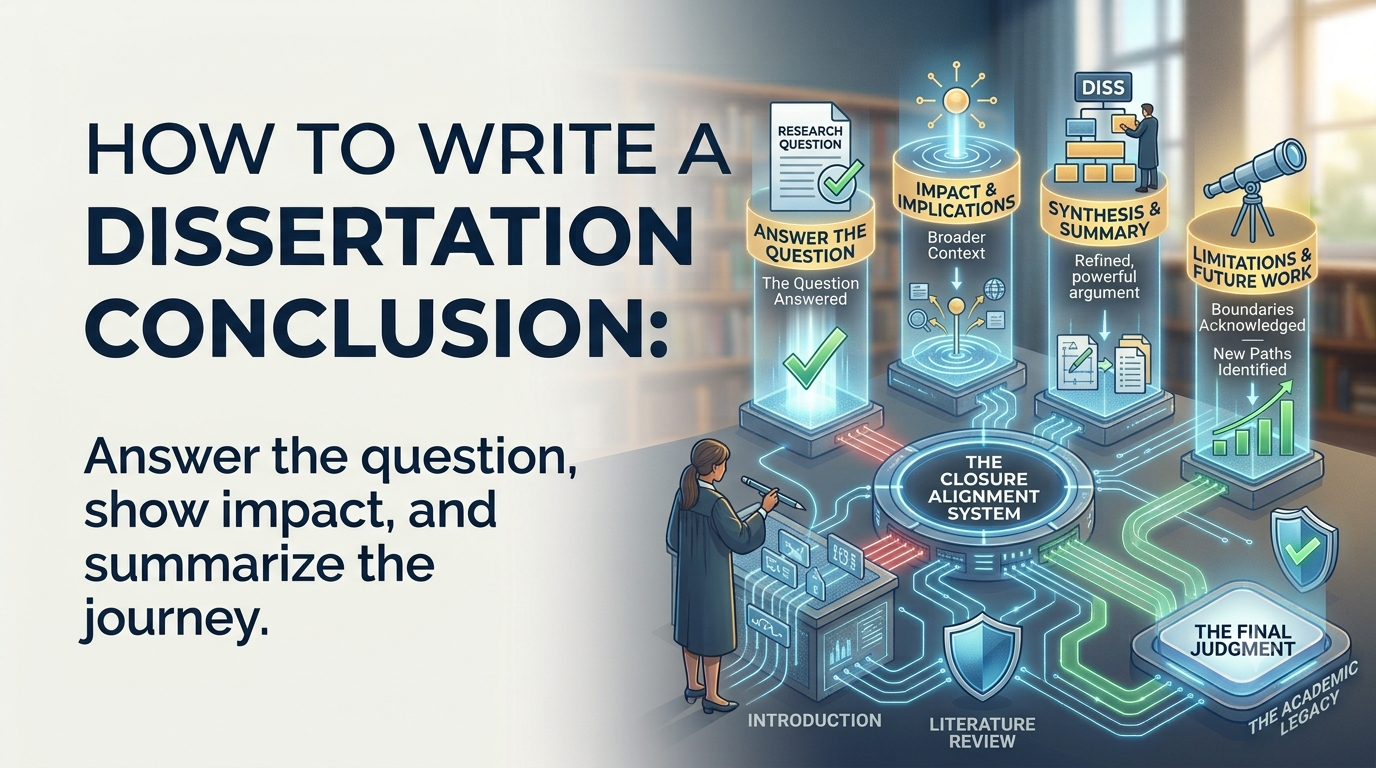
A dissertation conclusion answers your research question directly, states what your work contributes, admits its limits, and says what should happen next. It is not a summary. If your conclusion could be swapped into another dissertation on the same topic, it is not doing its job.
The conclusion is the last thing your marker reads before deciding your grade, which makes it far more important than its length suggests. Yet it is often written last, in a rush, and treated as a summary. Done properly, it is where you state plainly what your whole dissertation achieved.
What should a conclusion actually do?
Answer the question you asked in chapter one, in plain words, in the first paragraph. A surprising number of dissertations never do this directly. They discuss findings at length and leave the reader to assemble the answer, which is work you should have done for them.
After that, it does three more things: states what your work contributes, admits honestly what it cannot claim, and points to what would be worth doing next. That is the whole chapter.
What is the difference between summarising and concluding?
This distinction decides whether your conclusion works. Summarising repeats what each chapter said. Concluding tells the reader what it all adds up to. A summary looks backward and lists. A conclusion looks at the whole and answers.
A quick test: if a sentence in your conclusion could have been written before you did the research, it is summary, not conclusion. In this dissertation I reviewed the literature and collected data is summary, because it was true from the start. My findings show that reward structure matters more than reward value is a conclusion, because only your research could have produced it. A strong conclusion is full of the second kind of sentence.
Why is the conclusion so important?
Because it is the last thing your marker reads before deciding your grade, it shapes their final impression of the whole dissertation. A sharp conclusion that answers the question cleanly leaves the marker confident you understood your own work. A vague one that trails off in summary leaves doubt, even after a strong middle. The conclusion cannot rescue a weak dissertation, but it can lift or sink a borderline one, which is why it deserves proper time rather than the leftover hours of the final night.
How is it different from the discussion?
The discussion interprets your findings one by one and engages with the literature in detail. The conclusion steps back and pulls it all together: given everything, what is the answer, and what does it add.
The practical difference is scope. The discussion works at the level of individual findings. The conclusion works at the level of the whole dissertation, and it introduces no new evidence, no new citations, and no new arguments. Anything that needs a source belongs back in the discussion.
What structure works?
- A direct answer to the research question, in the opening paragraph.
- The contribution: what is now known, or better understood, because of your work.
- Limitations, stated honestly and specifically.
- Recommendations, if your subject expects them.
- Further research, framed as what your findings make worth asking next.
A short closing that returns to why the question mattered.
How long should it be?
Five to ten per cent of the total, so roughly 750 to 1,500 words in a 15,000 word dissertation. It is the shortest substantive chapter and it should feel tight. A conclusion running to three thousand words is almost always repeating the discussion.
How do you write limitations well?
Specifically, and about your own design rather than about research in general. Time and resource limits apply to every student project, so saying so tells a marker nothing. What earns credit is naming the actual consequence: a single organisation sample means the findings cannot be extended to the sector, self reported data may overstate behaviour, a snapshot design cannot show cause and effect.
Students often feel that admitting limits weakens the work. The opposite is true. A limitations section that names a real weakness before the marker does shows exactly the judgement the top band rewards, and a dissertation with no limitations reads as though the writer did not understand their own design.
How do you state your contribution?
Your contribution is what is known now that was not known before you started. It does not have to be a big discovery. For most dissertations it is modest and specific, such as showing that an established idea holds, or does not hold, in a new setting or for a new group.
State it plainly and honestly, matched to what your evidence can support. This study provides evidence that reward structure affects repeat purchase among younger shoppers in one UK sector is a defensible contribution. This study proves that reward structure drives loyalty is not, from the same data. Markers respect a modest, accurate claim far more than a grand one your findings cannot carry, so keep the wording precise and let the specifics do the work.
How do you write recommendations that are worth something?
They have to follow from your findings and be specific enough to act on. Organisations should improve communication is not a recommendation. It follows from nothing in particular and nobody can do it.
Tie each recommendation to a specific finding and say who should do what. If your data showed junior staff hold back questions under remote working, the recommendation is a specific low cost way to invite those questions, aimed at team leaders, and the finding it rests on is named.
How do you avoid ending too abruptly?
Many conclusions stop dead after the last recommendation, which leaves the dissertation feeling unfinished. A short closing paragraph fixes this. Return briefly to why the question mattered in the first place, and place your contribution in that wider frame. Two or three sentences are enough. This is not a summary, it is a final reminder of the point of the whole project, and it gives the marker a clean, deliberate ending rather than a sentence that simply runs out. The last impression should feel intended, not accidental.
What are the common mistakes?
- Summarising the dissertation instead of concluding it.
- Never stating the answer to the research question in plain words.
- Introducing new evidence, citations, or arguments.
- Generic limitations that could apply to any student project.
- Recommendations that do not follow from the findings.
- Ending abruptly on the last point, with no closing that returns to why the question mattered.
- Overclaiming, especially stretching a small sample to a whole population, which is exactly what markers watch for.
Ready to take your dissertation further? Get specialist support.
From refining your research question and literature review to methodology, analysis and final structure, dissertation work requires careful planning at every stage. Explore our dissertation writing support for your research project.
Frequently asked questions
How long should a dissertation conclusion be?
Five to ten per cent of your total, so roughly 750 to 1,500 words in a 15,000 word dissertation. If yours is much longer, it is probably repeating the discussion.
What is the difference between a discussion and a conclusion?
The discussion interprets findings individually and engages with the literature. The conclusion steps back to answer the research question overall, state the contribution, and say what follows. No new evidence belongs in it.
Should I include limitations in the conclusion?
Yes, unless your department places them in the discussion. Make them specific to your design. Naming a real weakness before the marker does shows judgement, not failure.
Do I need recommendations?
It depends on your subject. Applied fields usually expect them. Where they are expected, tie each one to a specific finding and name who should act on it.
Can I add new ideas in a conclusion?
No. Anything that needs a citation or new evidence belongs in the discussion. The conclusion pulls together what is already established in the dissertation.
Popular posts
What Is Self-Plagiarism? Definition, Examples and How to Avoid It
July 23, 2026

How Student Content Creators Can Get Paid Brand Deals in 2026
March 23, 2026
How to Write a Capstone Project Proposal (with Example)
August 13, 2026

How to Check Your Turnitin Score Before Submitting
April 7, 2026

How to Write a First Class Essay at a UK University: A Complete Guide for Students
May 11, 2026

Want more tips & great deals? Get them sent to your inbox
Please enter a valid E-mail
By clicking "Subscribe" you agree to be contacted via e-mail. You can always unsubscribe from the newsletter


