
Ready by 12:39pm Sep 24, 2026
How to Write Dissertation Acknowledgements
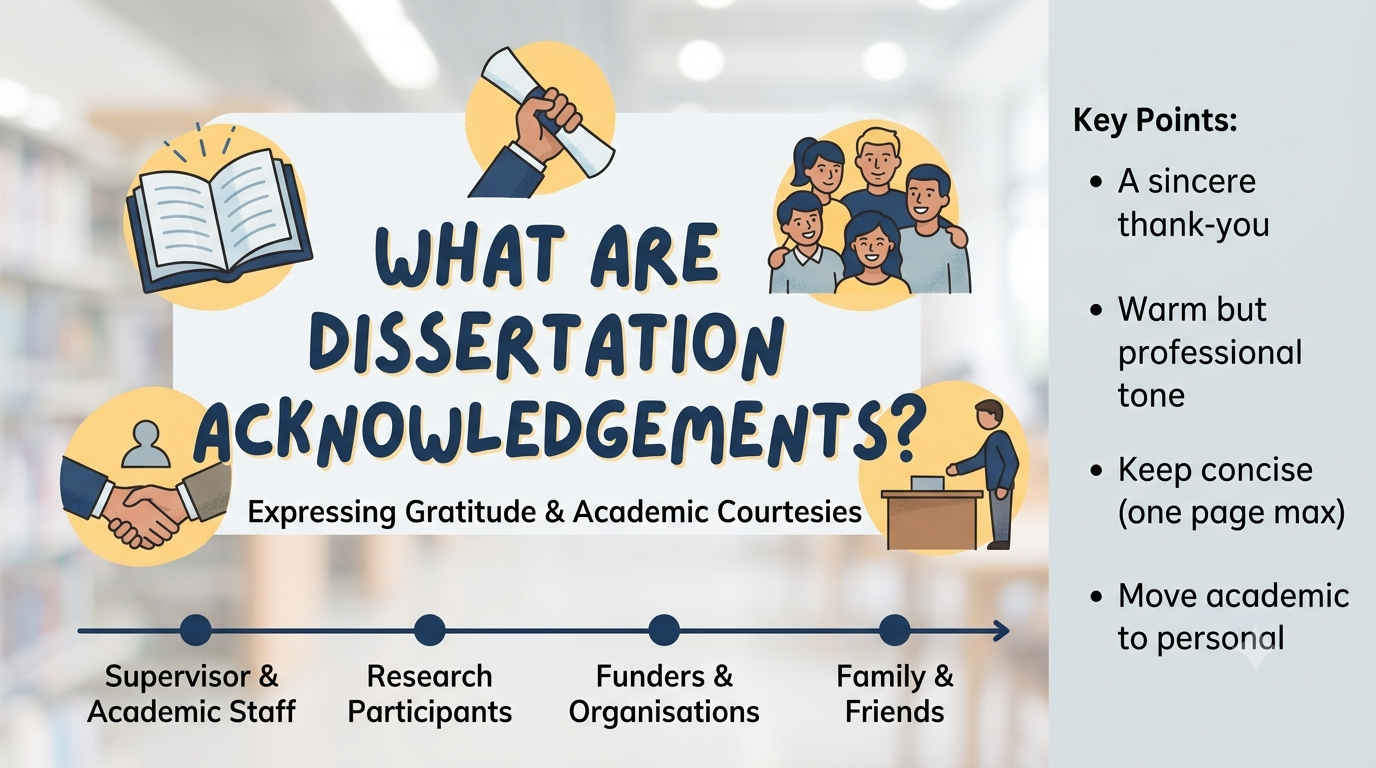
Dissertation acknowledgements are a short section, usually under a page, where you thank the people who helped with your research. Thank your supervisor first, then others who contributed academically, such as participants and funders, and finally personal support such as family and friends. The tone can be warmer than the rest of the dissertation.
After months of work, the acknowledgements are one of the more pleasant parts of a dissertation to write, but students are often unsure who to thank, in what order, and how personal to be. The acknowledgements section is a short, gracious note recognising the people who helped you complete your research. This guide explains what to include, who to thank and in what order, how long and how formal it should be, with an example and common mistakes. It sits within the wider dissertation structure our how to structure a dissertation guide covers.
What are dissertation acknowledgements?
The acknowledgements are a short section in which you thank the people and organisations who supported you during your dissertation. It is a place to express genuine gratitude, both to those who helped academically, such as your supervisor and participants, and to those who supported you personally, such as family and friends. It is one of the few parts of a dissertation where a warmer, more personal tone is acceptable, since it is about thanks rather than research. The acknowledgements are usually placed after the abstract and before the table of contents, and while they are not assessed, they are a courteous and expected part of the finished dissertation.
Who should you thank, and in what order?
There is a conventional order, moving from the most academically significant to the more personal. Start with your supervisor and any academic staff who guided your research, since their contribution is the most directly relevant to the work. Next, thank anyone who contributed to the research itself: participants who gave their time, colleagues or experts who advised you, and any funders or organisations that supported the project. Finally, thank those who supported you personally, such as family, friends and partners. This order, academic first, personal last, is the usual convention, though it is a guide rather than a strict rule, and the balance can reflect who genuinely helped you most.
How long should the acknowledgements be?
Acknowledgements should be concise, usually no more than a single page and often just a few short paragraphs. This is not a place for lengthy tributes; a sincere, focused thank-you to those who genuinely helped is far more effective than a long list that thanks everyone you have ever met. Keeping it short also keeps it professional, since an overlong or overly effusive acknowledgements section can read as self-indulgent in an academic document. Aim to recognise the people who really contributed, warmly but briefly, and resist the urge to turn the section into an extended personal narrative.
How formal should the tone be?
The acknowledgements allow a warmer, more personal tone than the rest of the dissertation, which is otherwise formal and objective, but they should still remain professional. It is fine to express genuine warmth and gratitude, and to be a little more personal when thanking family and friends, but avoid overly casual language, private jokes that only a few people would understand, or anything that would look unprofessional in a formal academic document that others may read. Striking a tone that is sincere and warm but still appropriate to an academic work is the goal, so write from genuine gratitude while keeping the register suitable for a dissertation.
An example of dissertation acknowledgements
Here is a short example of the style and structure. ‘I would like to express my sincere gratitude to my supervisor, Dr [Name], for their invaluable guidance, patience and support throughout this research. I am also grateful to the participants who generously gave their time to take part in this study, without whom this work would not have been possible. My thanks go to [organisation] for supporting the project. Finally, I would like to thank my family and friends for their constant encouragement and support during my studies.’ Notice how it moves from supervisor to participants to funders to personal support, thanks each briefly and sincerely, and keeps a warm but professional tone throughout.
Where do acknowledgements go, and what comes before?
In the standard dissertation order, the acknowledgements usually appear near the front matter, after the abstract and before the table of contents, though the exact placement can vary by institution, so check your guidelines. Because they come so early, they are often among the last things written, once the dissertation is complete and you can see the whole journey and everyone who helped. If you are writing your acknowledgements, your dissertation is nearly done, so it is also worth turning to the final checks, and our dissertation submission checklist guide covers everything to confirm before you hand in.
Do acknowledgements count towards your word count?
A practical question students often ask is whether the acknowledgements count towards the dissertation word limit, and in most cases they do not. Like the title page, abstract, contents page, reference list and appendices, the acknowledgements are usually part of the front matter or supporting material that sits outside the main word count, which is calculated from the introduction to the conclusion. This is another reason to keep them concise and focused rather than padding them out, since their length is not a way to add words to a short dissertation. That said, word-count rules vary between institutions, so check your own guidelines to confirm exactly what is included and excluded. Knowing this also reassures you that a warm, genuine acknowledgment section will not eat into the words you need for your actual research, so you can write it sincerely without worrying about length in relation to your limit.
One last piece of advice: write your acknowledgements when you have finished the dissertation and can look back on the whole process, since that is when you will remember most clearly everyone who genuinely helped. Jotting down names as you go, whenever someone offers useful support, means no one is forgotten when you come to write the section. A sincere, well-judged acknowledgements page is a gracious way to close months of hard work, and taking a few minutes to write it thoughtfully, rather than dashing it off at the last moment, gives it the warmth the section is meant to carry.
Common acknowledgements mistakes to avoid
Making them too long, when a page or less is the norm.
● Being too informal, with private jokes or overly casual language.
● Forgetting to thank your supervisor, who should usually come first.
● Listing so many people that the genuine thanks are diluted.
● Adding academic content, when acknowledgements are for thanks, not research.
Written well, the acknowledgements are a gracious, sincere close to the front matter of your dissertation, recognising the people who helped you reach the finish line. Keep them short, warm and professional, thank those who genuinely contributed, and enjoy writing one of the few parts of a dissertation that is purely about gratitude.
Popular posts

Dissertation Topics 2026: How to Choose the Best Topic + 150 Ideas
February 21, 2026
What Is Self-Plagiarism? Definition, Examples and How to Avoid It
July 23, 2026
APA Referencing: A Full Guide with Examples (7th Edition, 2026)
September 2, 2026

How Student Content Creators Can Get Paid Brand Deals in 2026
March 23, 2026
Capital Budgeting: NPV, IRR and Payback Period Made Simple
July 12, 2026

Want more tips & great deals? Get them sent to your inbox
Please enter a valid E-mail
By clicking "Subscribe" you agree to be contacted via e-mail. You can always unsubscribe from the newsletter


