
Ready by 11:02pm Sep 11, 2026
Capital Budgeting: NPV, IRR and Payback Period Made Simple
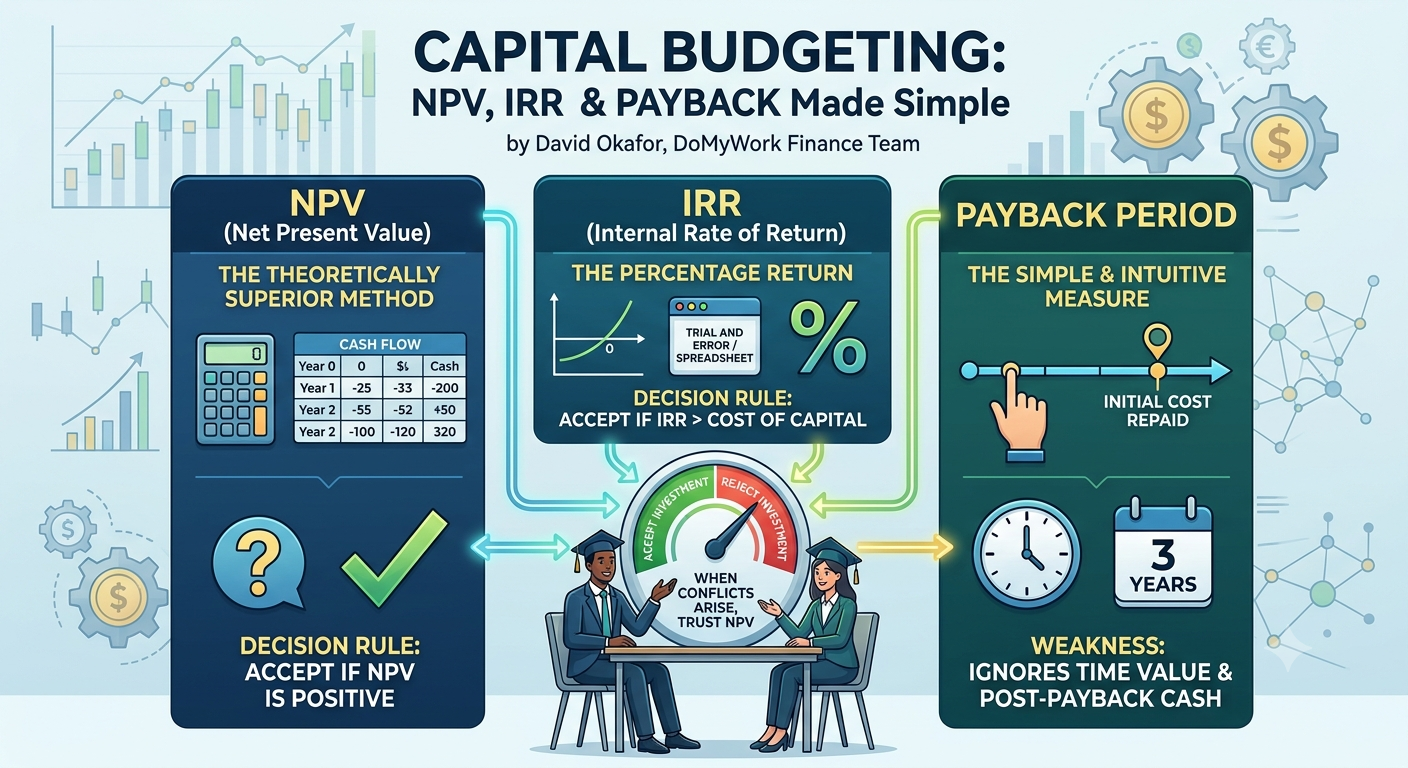
Capital budgeting decides whether an investment is worth making. The three core tools are payback period, net present value (NPV), then internal rate of return (IRR). NPV is the one examiners weigh most, since it accounts for the time value of money then gives a clear accept-or-reject rule.
These calculations look intimidating, yet each follows a fixed recipe. Once you can build a cash flow table then apply a discount factor, capital budgeting becomes mechanical. This guide works through all three tools with examples, shows the decision rule for each, then flags the mistakes that cost marks.
What is capital budgeting?
Capital budgeting is the process of evaluating a long-term investment, a new machine, a project, or an acquisition, to decide whether the future cash it generates justifies the cost today. Because money has a time value, a pound received in five years is worth less than a pound today, the better methods discount future cash flows back to their present worth before comparing.
What is the payback period?
Payback period is the time it takes for an investment to repay its initial cost from its cash flows. If a project costs one hundred thousand pounds then returns twenty-five thousand a year, the payback period is four years. It is simple then intuitive, which is why it is popular. Its weakness is that it ignores the time value of money, then ignores any cash flows after payback, so it is best used alongside NPV rather than alone.
What is net present value (NPV)?
NPV discounts every future cash flow back to today, then subtracts the initial cost. Each year’s cash flow is multiplied by a discount factor, one divided by one plus the discount rate, raised to the power of the year. Add the discounted inflows, subtract the outlay, then you have the NPV. If a project costs one hundred thousand pounds then returns forty thousand a year for three years, discounted at ten per cent, the discounted inflows come to roughly ninety-nine thousand, giving an NPV of about minus one thousand pounds. The decision rule is simple: accept if NPV is positive, reject if negative. A negative NPV, as here, means the project does not quite cover its cost of capital.
What is the internal rate of return (IRR)?
IRR is the discount rate at which a project’s NPV equals zero. It represents the return the project itself earns. The decision rule is to accept if the IRR exceeds your cost of capital, then reject if it falls below. IRR is popular because it gives a single percentage that is easy to compare, though it is found by trial and error or a spreadsheet function rather than a neat formula.
→ Working through an appraisal question? A model capital budgeting solution lays out the cash flow table, discount factors, then NPV step by step, as a reference for your own working.
NPV vs IRR: which should you use?
When the two disagree, trust NPV. IRR can mislead on projects of different sizes, or ones with unusual cash flow patterns, and can even produce more than one value. NPV always points to the option that adds the most absolute value, which is the goal. Examiners expect you to know that NPV is the theoretically superior measure, then to explain why when a question sets the two against each other.
How do you lay out a capital budgeting answer?
Build a table with a row for each year, starting at year zero for the initial outlay. List the cash flow, the discount factor, then the discounted cash flow for each year. Sum the discounted figures to reach NPV. A clear table earns method marks even if one number is off, since the examiner can follow your logic. Label the discount rate then state your decision explicitly at the end.
What are common capital budgeting mistakes?
Three recur. Forgetting year zero, so the initial cost is left out of the discounting. Using accounting profit instead of cash flow, when capital budgeting works on cash. Then applying the wrong discount rate, or forgetting to discount at all. Reading the question carefully for the cost of capital, then building a clean year-by-year table, avoids all three.
What discount rate should you use?
The discount rate reflects the return the investment must beat, usually the company’s cost of capital. Questions often give it to you directly, so read carefully. Where you must reason about it, a higher rate reflects higher risk, which lowers the present value of future cash flows, then makes a project harder to justify. Using the wrong rate is one of the most common ways to reach a correct-looking but wrong NPV, so always state the rate you used then why.
How do you handle uneven cash flows?
Real projects rarely return the same amount each year, then that is where a clear table earns its keep. List each year’s specific cash flow, apply the correct discount factor for that year, then sum the discounted figures. For payback with uneven flows, accumulate the inflows year by year until they cover the initial cost, noting the point within the year where payback occurs. Laying this out in rows keeps uneven cash flows from becoming a source of error.
How do you choose between competing projects?
When a question gives two projects a limited budget, rank them by NPV, since the goal is to add the most value. Where the projects differ greatly in size, a profitability index, NPV divided by initial outlay, helps compare value per pound invested. Do not rank on IRR alone, since a smaller project can show a higher IRR yet add less total value than a larger one. State your ranking rule clearly, then apply it consistently across the options the question gives you.
Watch for projects with different lifespans too. A three-year project then a six-year project are not directly comparable on raw NPV, since one runs twice as long. Where a question raises this, mention the equivalent annual method as the fair way to compare them, even if the full calculation is beyond the assignment’s scope.
→ Nail your investment appraisal. See pricing for a model NPV and IRR solution, then check any written analysis with a fast Turnitin report.
Frequently asked questions
What is the difference between NPV and IRR?
NPV gives the value in money terms that a project adds after discounting future cash flows, while IRR gives the percentage return at which NPV equals zero. When they conflict, NPV is the more reliable measure because it points to the option adding the most absolute value.
How do you calculate payback period?
Divide the initial investment by the annual cash inflow when inflows are even. A one hundred thousand pound project returning twenty-five thousand a year has a four-year payback. For uneven cash flows, accumulate the inflows until they cover the cost.
What does a positive NPV mean?
A positive NPV means the project’s discounted cash inflows exceed its cost, so it adds value and should be accepted. A negative NPV means it does not cover its cost of capital and should be rejected.
Why is NPV preferred over payback period?
Because NPV accounts for the time value of money and considers all cash flows across the project’s life, while payback ignores both the timing of money and any cash received after the payback point.




Want more tips & great deals? Get them sent to your inbox
Please enter a valid E-mail
By clicking "Subscribe" you agree to be contacted via e-mail. You can always unsubscribe from the newsletter


