
Ready by 11:01pm Sep 11, 2026
How to Write a Reflective Commentary for Culinary Coursework
A reflective commentary in culinary coursework asks you to analyse your own kitchen performance, not just describe it. Using a model such as Gibbs, you move from what happened, to how it went, to what you would change. Strong reflection shows honest self-evaluation, then a clear plan to improve.
Reflection feels strange to many cooks, since the kitchen rewards action over analysis. Yet reflective writing is where you prove you can learn from a service, which is exactly what employers then assessors want to see. This guide explains the model to use, how to write each stage, then how to push your reflection from descriptive into critical, where the marks are.
What is a reflective commentary in cookery?
A reflective commentary is a structured written account of an experience, such as a service or a dish, where you evaluate what happened then draw out lessons. It is personal, written in the first person, then focused on your own performance rather than the recipe. The point is not to confess mistakes, but to show you can analyse practice then improve it.
Why do culinary courses use reflection?
Professional kitchens run on continuous improvement, so courses build the habit early. Reflection develops self-awareness, helps you spot patterns in your own performance, then feeds your professional development. It also gives assessors a window into your thinking, showing whether you understand why a service went the way it did, not just that it happened.
Which reflective model should you use?
The Gibbs reflective cycle is the most widely taught, then it suits culinary work well. It moves through six stages: description of what happened, your feelings at the time, an evaluation of what went well or badly, an analysis of why, a conclusion on what you learned, then an action plan for next time. Following the stages stops reflection collapsing into a simple story of the shift.
How do you write each stage?
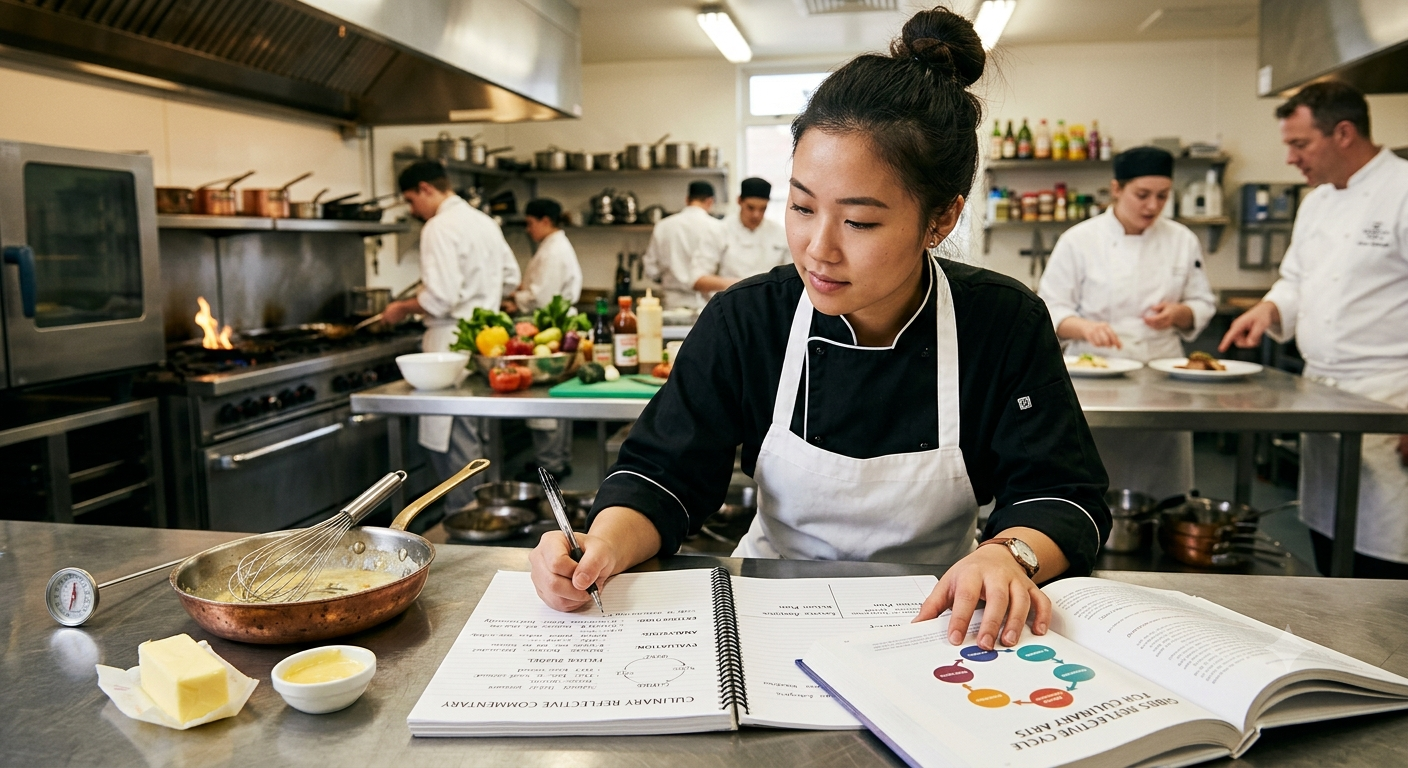
Take a service where a hollandaise split during a busy lunch. A Gibbs reflection might run: description, the sauce split under pressure as orders stacked up; feelings, stressed then rushed; evaluation, the dish was delayed though the rest of the plate held; analysis, the butter was added too fast then the emulsion broke as the pan overheated; conclusion, temperature control matters more under pressure; action plan, prepare the sauce earlier then hold it correctly during peak service.
Notice the weight sits on analysis then action, not description. Beginners spend most of their words retelling what happened. Strong reflection spends most of them on why, then on what changes next time.
Need help turning culinary research into an academic assignment?
From food safety and HACCP reports to menu planning, nutrition analysis and hospitality coursework, academic cookery assignments require both subject knowledge and clear academic structure.
What makes reflection critical rather than descriptive?
Descriptive reflection says what happened. Critical reflection asks why, then so what. The shift comes from interrogating your own performance: not “the sauce split”, but “the sauce split because I rushed the emulsion under pressure, which tells me my prep timing fails at peak”. That honest analysis, then the concrete change it leads to, is what lifts a reflection into the top band.
Can you write reflection in the first person?
Yes, then you should. Reflection is one of the few academic pieces where the first person is expected, since it is about your own experience. Write “I noticed” then “I would change”, rather than forcing it into a detached third person that drains the personal insight the task is designed to capture.
How do you reference theory in a reflection?
Strong reflections connect practice to knowledge. When your analysis touches a technique or a safety point, cite the underlying source: a food science text on emulsions, or a food safety standard. Linking your lived experience to established theory shows you understand the why behind the kitchen, which markers reward. Keep it light, since the reflection is still about your performance, not a literature review. Before submitting, a quick originality check confirms the writing is genuinely yours.
How long should a reflective commentary be?
Length depends on your brief, but most culinary reflections run a few hundred to around a thousand words per entry. The number matters less than the balance: keep description short, then spend the bulk on analysis then action. A common mistake is a thousand-word reflection where eight hundred words retell the shift, leaving only a line of actual learning. Flip that ratio, then even a shorter reflection scores well.
What are common reflective writing mistakes?
Three recur. The first is staying descriptive, narrating the service without asking why it went that way. The second is only reflecting on failures, when reflecting on what went well, then why, is just as valuable. The third is reflection with no action plan, which leaves the cycle unfinished. A reflection that ends without a concrete change for next time has not really been reflected; it has only been described. Always close on what you will do differently.
How do you choose what to reflect on?
Choose moments that taught you something, not just moments that went wrong. A dish that worked perfectly under pressure is as worth reflecting on as one that failed, since understanding why something succeeded helps you repeat it. Pick events with a clear turning point: a service that nearly fell apart then recovered, a technique you finally mastered, or a decision you would now make differently. Those moments give your reflection something real to analyse, rather than a flat account where nothing changed.
What theory can you link to culinary reflection?
The strongest reflections connect experience to knowledge. When you analyse why a sauce split, you can reference the food science of emulsions. When you reflect on a hygiene slip, you can cite the relevant food safety standard. When you evaluate teamwork during service, you can draw on kitchen brigade theory. This linking shows you understand the principles behind your practice, which lifts the reflection from a personal diary into academic work. Keep the theory light then relevant, since the focus stays on your performance.
Need academic support with your cookery coursework?
Practical cookery work often comes with written reflections, reports and supporting academic work. Explore our cookery assignment support for help with the written side of your coursework.
Frequently asked questions
What is a reflective commentary in cookery?
A structured written account where you analyse your own kitchen performance, evaluating what happened during a service or dish, then drawing out lessons and an action plan. It is written in the first person and focuses on your performance, not the recipe.
What reflective model should I use for culinary work?
The Gibbs reflective cycle is the most widely used: description, feelings, evaluation, analysis, conclusion, then action plan. It keeps reflection structured rather than collapsing into a simple retelling of the shift.
Can I write a reflective commentary in the first person?
Yes. Reflection is one of the few academic tasks where the first person is expected, since it is about your own experience. Write ‘I noticed’ and ‘I would change’ rather than a detached third person.
How do I make my reflection critical, not descriptive?
Spend most of your words on why something happened and what you would change, not on retelling events. Ask ‘so what’ after each point, then link your analysis to a concrete action for next time.



Want more tips & great deals? Get them sent to your inbox
Please enter a valid E-mail
By clicking "Subscribe" you agree to be contacted via e-mail. You can always unsubscribe from the newsletter


