
Ready by 9:46am Aug 26, 2026
How to Write Critically: Descriptive vs Critical Writing (with Examples, 2026)
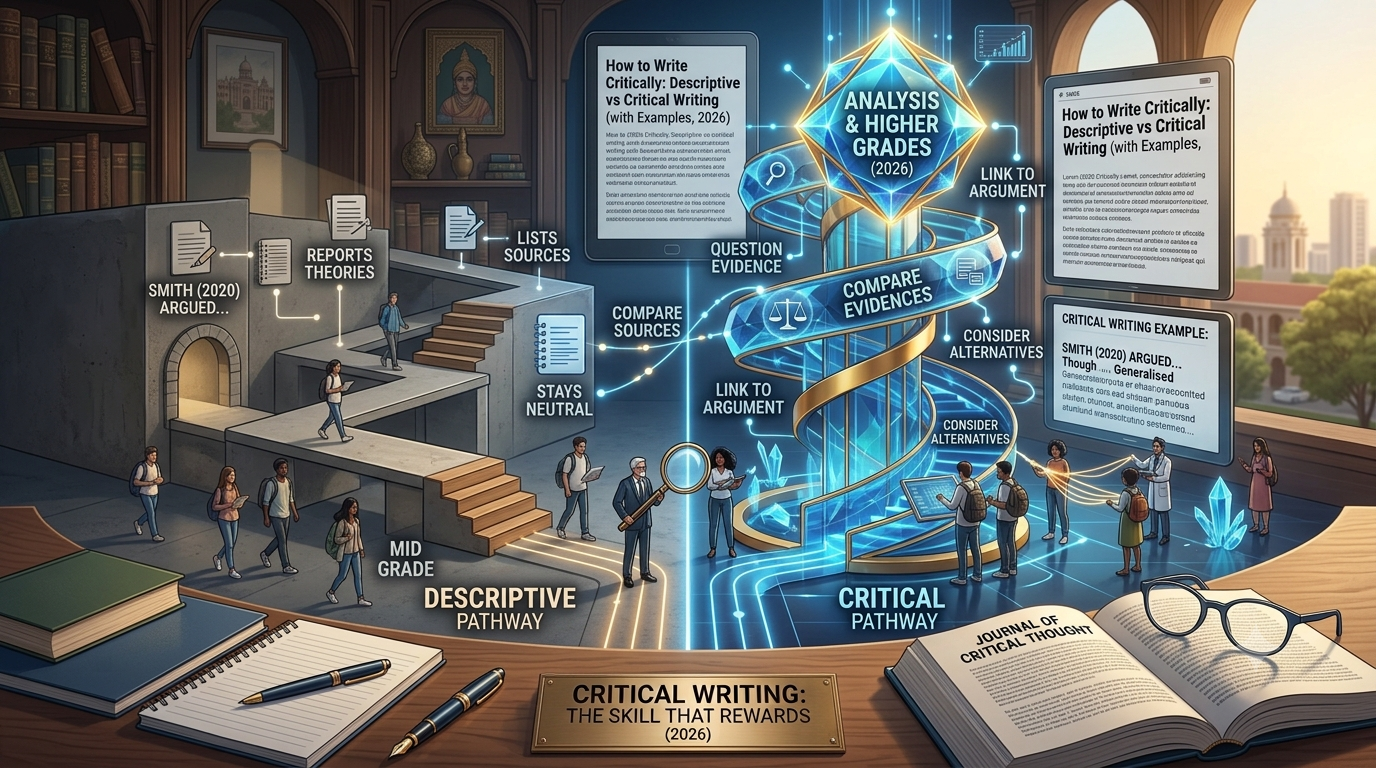
Critical writing means evaluating information rather than just reporting it. Where descriptive writing states what a source says, critical writing weighs the evidence, compares viewpoints, considers limitations, and links each point back to your argument. Moving from description to analysis is the single biggest step up in most grade bands.
If your feedback keeps saying too descriptive or be more critical, this guide is the fix. Critical writing is the skill markers reward most, and the gap between a mid and a high grade is almost always analysis rather than more content. Below is what critical writing is, how it differs from description, and how to turn descriptive sentences into critical ones, with examples. It pairs directly with what we cover in understanding the marking rubric.
What is critical writing?
Critical writing is writing that does something with information rather than simply presenting it. It asks questions of the evidence: how strong is it, who says so, does it agree with other sources, what are its limits, and what does it mean for your argument. Description is necessary, you have to tell the reader what a source says, but on its own it stays at the lower grade bands. Critical writing takes that description and evaluates it, and that evaluation is where the marks are.
Descriptive vs critical writing
The table below shows the difference in what each does.
| Descriptive writing | Critical writing |
| States what happened or what a source says | Evaluates how strong or convincing it is |
| Lists sources or facts | Compares and weighs them against each other |
| Reports a theory | Assesses the theory’s strengths and limitations |
| Describes a method or result | Judges what the result means and how reliable it is |
| Stays neutral and general | Builds and supports a specific argument |
Most assignments need some description to set the scene, but the balance should tip firmly towards analysis. A useful check: for every point you describe, add a sentence that evaluates it or connects it to your argument.
How do you write more critically?
Critical writing comes from asking the right questions of your material. Build these habits into every paragraph.
- Question the evidence: how strong, recent and relevant is it, and who produced it?
- Compare sources: where do they agree or disagree, and why?
- Weigh strengths and limitations: what does a theory or study explain well, and what does it miss?
- Consider alternatives: is there another interpretation of the same evidence?
- Link back to your argument: end each point by saying what it means for your overall answer.
A simple structure for a critical paragraph is: make a point, give the evidence, evaluate it, and link it to your argument. That final evaluate-and-link step is what turns description into critical writing, and it maps straight onto what markers reward, as our how UK universities mark essays guide explains.
Critical writing examples
The examples below show the same idea written descriptively, then critically.
| Descriptive | Critical |
| Smith (2020) argues that remote work increases productivity. | Smith (2020) argues that remote work increases productivity, though the study relies on self-reported data from one sector, which limits how far the finding can be generalised. |
| The company’s profits rose in 2024. | The company’s profits rose in 2024, but this was driven largely by a one-off asset sale, so it may overstate the underlying performance. |
| There are several leadership theories. | While trait and situational theories both explain aspects of leadership, situational models better account for how effective leaders adapt, which is more useful for this case. |
In each case, the critical version adds an evaluation: a limitation, a cause, or a judgement that serves the argument. That is the move to practise.
Words and phrases that signal critical writing
Certain phrasing naturally pushes you from describing to evaluating. Use these to prompt analysis, not as filler.
- However, in contrast, on the other hand: for weighing viewpoints.
- This suggests, this implies, this indicates: for drawing out meaning.
- A limitation of this is, this is less convincing because: for evaluating.
- More significantly, the stronger argument is: for prioritising evidence.
Common mistakes to avoid
- Describing at length, then adding a short conclusion, instead of analysing throughout.
- Listing what every source says without comparing or judging them.
- Giving opinions without evidence, which is not the same as critical analysis.
- Never stating your own argument, so the writing has nothing to build towards.
Sharpening this skill lifts every assignment. For structure, see our how to structure an assignment guide, and for the top-band standard, our how to write a first-class essay guide. If you would like expert feedback on how critical your writing is, our essay writing help and assignment writing help services can review your work.
Frequently asked questions
What is critical writing?
Critical writing evaluates information rather than just reporting it: it weighs evidence, compares viewpoints, considers limitations, and links each point to your argument. It is the skill markers reward most.
What is the difference between descriptive and critical writing?
Descriptive writing states what happened or what a source says; critical writing evaluates how strong or convincing it is and what it means for your argument. Most marks come from the critical part.
How do I write more critically?
Question the evidence, compare sources, weigh strengths and limitations, consider alternatives, and link each point back to your argument. Follow point, evidence, evaluation, then link in each paragraph.
Why does my feedback say I am too descriptive?
It means you are reporting information without evaluating it. Add analysis: after describing a source, assess how convincing it is and connect it to your argument to move up the grade bands.




Want more tips & great deals? Get them sent to your inbox
Please enter a valid E-mail
By clicking "Subscribe" you agree to be contacted via e-mail. You can always unsubscribe from the newsletter