
Ready by 11:01pm Sep 11, 2026
Capstone Project vs Dissertation vs Thesis: Key Differences
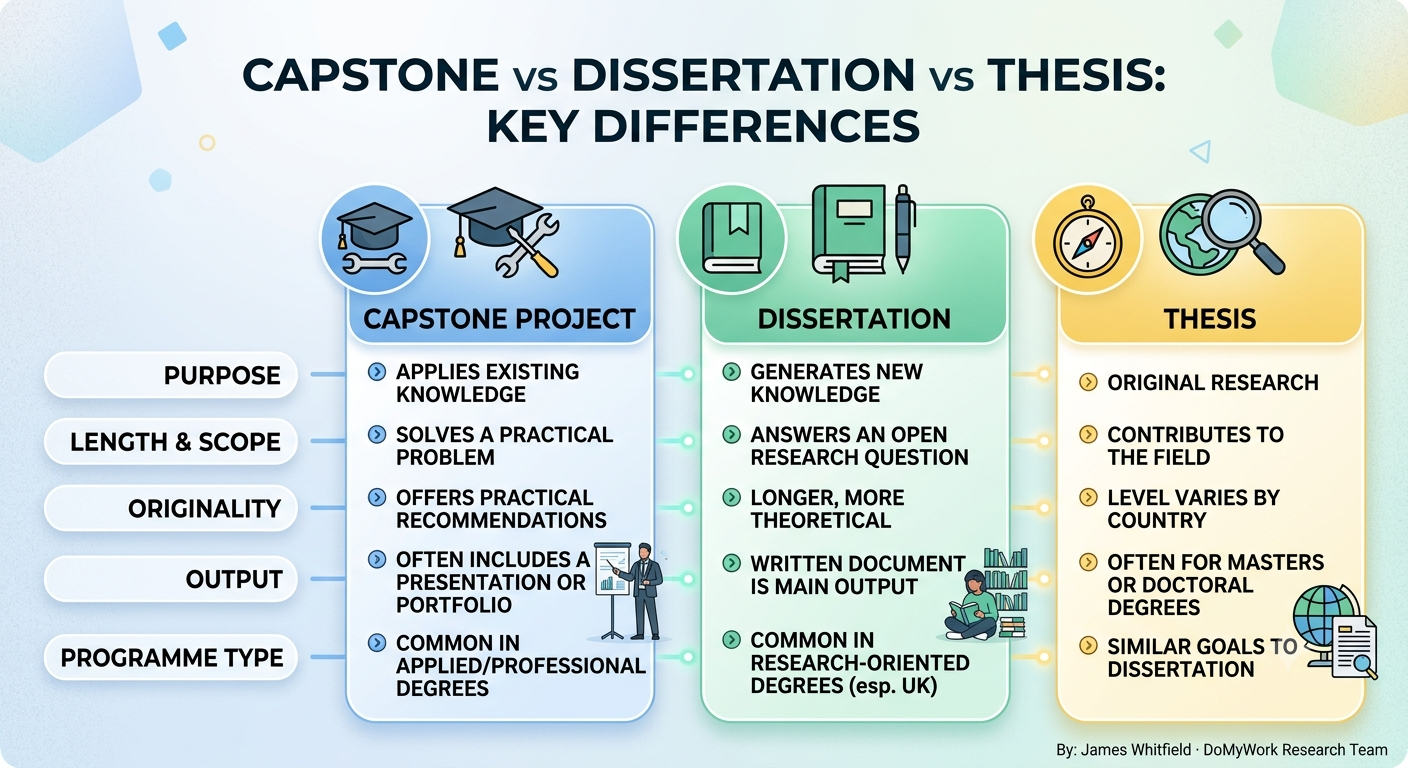
A capstone project applies existing knowledge to solve a practical problem, while a dissertation or thesis generates new knowledge through original research. The capstone is usually shorter, more applied, then often includes a presentation; the dissertation is longer, more theoretical, then examined in writing.
Students often use these three words as if they mean the same thing. They overlap, but the differences matter, since they change what your examiner expects. This guide sets out how each one differs, then helps you choose if your programme lets you pick.
What is the difference between a capstone and a dissertation?
The core difference is purpose. A capstone applies what you already know to a real problem, then often delivers a practical recommendation. A dissertation contributes new knowledge by answering a research question nobody has settled. From that one difference, the others follow.
- Purpose: capstone applies knowledge; dissertation creates it.
- Length: a capstone is often shorter, while dissertations run longer, frequently 10,000 words or more.
- Originality: a dissertation must be original research; a capstone can use established methods on a practical problem.
- Output: a capstone often adds a presentation, portfolio, or recommendation; a dissertation is usually a written document examined on its own.
Is a capstone easier than a dissertation?
Not easier, different. A dissertation demands original contribution then deep engagement with theory, which is its own challenge. A capstone demands that you integrate across your whole programme then apply it under real-world constraints, which is harder than it sounds. Each rewards a different strength, so neither is a soft option.
Dissertation vs thesis: where does each sit?
The terms also shift by country. In the United Kingdom, a dissertation is usually the major project at undergraduate or masters level, while a thesis is the doctoral piece. In the United States, the labels often reverse, with a thesis at masters level then a dissertation at doctoral level. Always follow your own institution’s language, since the marking criteria are written around it.
When would you do a capstone instead of a dissertation?
Often the choice is made for you by your programme. Applied and professional degrees, in nursing, business, or IT, tend to set a capstone, since the goal is workplace readiness. Research-oriented degrees set a dissertation or thesis, since the goal is contributing to the field. Where you have a choice, pick the capstone if you want to solve a practical problem, the dissertation if you want to research an open question in depth.
Ready to develop your capstone project? Let our experts help.
Once you’ve chosen your topic, the next step is turning your idea into a structured project with clear research, analysis and presentation. Explore our capstone project writing support for guidance throughout your project.
Do capstone and dissertation share a structure?
Largely, yes. Both move through an introduction, literature review, methodology, findings, then discussion. The capstone often compresses these, then adds an applied recommendation, while the dissertation expands the literature review then the discussion. If you understand one structure, you understand the other. Our chapter by chapter guide to dissertation structure maps the longer version, which a capstone scales down.
Which should you choose if your programme offers both?
This comes up most on MBA programmes, where you may choose between an MBA capstone then an MBA dissertation. Choose the capstone if you want to produce something close to consulting work, a strategy or business plan grounded in real data. Choose the dissertation if you want to research a business question in depth then engage with academic theory. Our MBA assignment guide covers both routes, then for topic inspiration our 150 topic ideas works for either.
Does a capstone or dissertation carry more weight with employers?
For most graduate roles, neither outranks the other; what matters is what you can say about it. A capstone often translates more directly into interview talk, since it solves a practical problem an employer recognises. A dissertation signals research depth then independence, which matters for further study or research roles. Choose based on where you want to go, then learn to describe whichever you do in terms of the skills it built.
Do referencing and academic standards differ?
The standards are the same. Both demand accurate referencing in your required style, honest use of sources, then original writing that is your own. A capstone being shorter or more applied does not lower the integrity bar. Whichever you write, run the finished draft through an originality check, since a practical capstone built on real organisational data can still pick up matches you did not expect.
A quick comparison at a glance
To summarise: a capstone applies knowledge, runs shorter, uses established methods, then often adds a presentation. A dissertation creates knowledge, runs longer, demands original research, then stands as a written document examined on its own. A thesis sits at the research end too, with the exact level depending on your country. Hold those distinctions in mind, then read your programme handbook, since the marking criteria are written around whichever term your institution uses.
Can you turn a capstone into a dissertation later?
Sometimes. If your capstone surfaces a question worth deeper research, it can seed a later dissertation or thesis, particularly if you move from an applied programme into a research degree. The shift means changing the goal: from applying knowledge to a practical problem, to generating new knowledge through original research. You would keep the topic area, then rebuild the question, method, then literature review around contribution rather than application.
How do you decide quickly which one fits your goal?
Ask one question: do you want to solve a problem or answer one? If you want to deliver a practical recommendation an organisation could act on, the capstone fits. If you want to investigate an open question then contribute to your field’s knowledge, the dissertation fits. Your career direction usually points to one. When it does not, the evidence you can realistically gather breaks the tie.
Whichever route you take, the work that earns top marks looks similar: a sharp question, evidence handled honestly, then a conclusion that actually answers what you asked. The label on the cover matters less than whether the argument inside holds together from the first page to the last.
Ready to take your dissertation further? Get specialist support.
From refining your research question and literature review to methodology, analysis and final structure, dissertation work requires careful planning at every stage. Explore our dissertation writing support for your research project.
Frequently asked questions
What is the main difference between a capstone and a dissertation?
A capstone applies existing knowledge to solve a practical problem, while a dissertation generates new knowledge through original research. The capstone is usually shorter and more applied, often with a presentation, while the dissertation is longer and more theoretical.
Is a capstone the same as a thesis?
No. A thesis generates original research, usually at masters or doctoral level, while a capstone applies learning to a practical problem. The terms vary by country, so check your institution’s definitions.
Which is harder, a capstone or a dissertation?
Neither is simply harder. A dissertation demands original contribution and theory, while a capstone demands integration across your whole programme and real-world application. Each rewards a different strength.
Should I do a capstone or a dissertation for my MBA?
Choose a capstone if you want to produce consulting-style work such as a strategy or business plan, or a dissertation if you want to research a business question in depth. Many MBA programmes let you pick based on your career goals.


Want more tips & great deals? Get them sent to your inbox
Please enter a valid E-mail
By clicking "Subscribe" you agree to be contacted via e-mail. You can always unsubscribe from the newsletter


