
Ready by 11:01pm Sep 11, 2026
Dissertation Structure Explained Chapter by Chapter
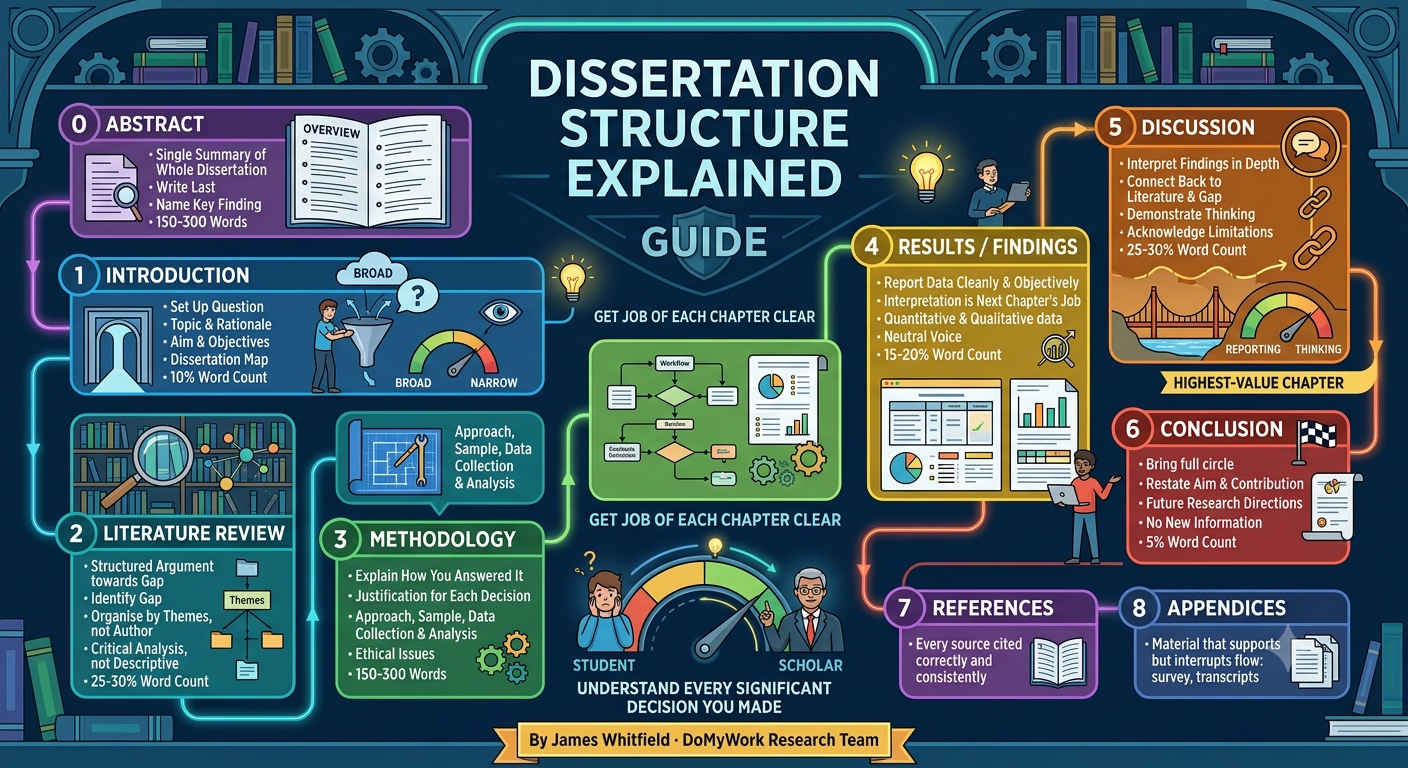
A standard UK dissertation has five core chapters: introduction, literature review, methodology, results, and discussion, wrapped by an abstract at the front and references plus appendices at the back. The introduction sets up the question, the literature review shows the gap, the methodology explains how you answered it, the results present what you found, and the discussion explains what it means. Get the job of each chapter clear and the writing gets far easier.
Most students lose marks not because their research is weak, but because they put the right material in the wrong chapter. Findings drift into the discussion, method creeps into the results, and the introduction tries to do the literature review’s job. This guide walks through every section in order, explains exactly what belongs there, tells you roughly how many words to spend on it, and points out the specific mistake that costs marks in each one.
What is the standard dissertation structure?
The five-chapter model is the default across most UK undergraduate and master’s programmes in the social sciences, business, and health subjects. In order, the document runs as title page, abstract, acknowledgements, contents page, introduction, literature review, methodology, results, discussion, conclusion, references, and appendices.
That said, this is a convention, not a law. Some subjects merge results and discussion into one chapter. Some sciences use the IMRaD format, which is introduction, methods, results, and discussion, with a shorter standalone literature section. A few programmes want six or seven chapters, splitting the discussion from the conclusion or giving the theoretical framework its own chapter. Always check your own handbook first, because your marking criteria describe the structure your examiner actually expects. The model below is the most common one and the safest default when your handbook is vague.
How should you split your word count across chapters?
A rough split helps you plan before you write, so you do not spend 4,000 words on the introduction and run out of room for the discussion. For a typical dissertation the introduction takes about 10 percent, the literature review about 25 to 30 percent, the methodology about 15 percent, the results about 15 to 20 percent, and the discussion about 25 to 30 percent, with the conclusion taking the last 5 percent or so.
To make that concrete, here is how a 10,000 word and a 15,000 word dissertation would split under those proportions.
| Chapter | Share | 10,000 words | 15,000 words |
| Introduction | 10% | 1,000 | 1,500 |
| Literature review | 27% | 2,700 | 4,000 |
| Methodology | 15% | 1,500 | 2,250 |
| Results | 18% | 1,800 | 2,700 |
| Discussion | 25% | 2,500 | 3,750 |
| Conclusion | 5% | 500 | 750 |
These are guides, not targets to hit exactly. The two chapters that carry the most marks in most schemes are the literature review and the discussion, which is why they get the largest share. If you are unsure how long your whole dissertation should be for your level, the word count section in our 2026 dissertation topics guide sets out the usual ranges for undergraduate, master’s, and PhD work.
The abstract
The abstract is a single summary of the whole dissertation, usually 150 to 300 words, written last even though it sits first. Its job is to let a reader understand your entire project without reading further, so it needs one or two sentences on each of the following: the problem and why it matters, your aim, your method, your key finding, and your main conclusion.
Write it after everything else is finished, because you cannot summarise findings you have not yet written. The most common mistake here is treating the abstract like an introduction and describing what you set out to do without stating what you actually found. An abstract that never mentions a result is not doing its job. Name at least one concrete finding, even briefly.
Chapter 1: Introduction
The introduction sets up the whole dissertation. It answers four questions for the reader in order: what is the topic, why does it matter, what specifically are you investigating, and how is the dissertation structured. By the end of it, a reader should know your research question, understand why it is worth asking, and have a map of what is coming.
A strong introduction moves from broad to narrow. It opens with the wider context, funnels down to the specific problem, states the aim and objectives or research questions clearly, and closes with a short outline of the chapters. Keep the literature light here. You are motivating the question, not reviewing the field yet. The mistake that costs marks is starting too wide, spending three paragraphs on the general importance of the topic before ever naming what this particular dissertation is about. Get to your specific question quickly. If your aim and objectives still feel loose, our guide on how to write a dissertation proposal covers how to sharpen them, since the proposal aim usually becomes the introduction aim.
Chapter 2: Literature review
The literature review is not a summary of everything written on your topic. It is a structured argument that builds towards the gap your research fills. Its job is to show you know the field, to organise what is already known into themes, and to identify the specific space where your question sits.
Organise it by theme or debate, not by author. A review that goes “Smith said this, then Jones said that, then Brown said the other” reads as a list. A review organised around two or three themes, showing how different researchers agree and disagree within each, reads as analysis. End the chapter by naming the gap explicitly, because that gap is the bridge into your own study. The most common mistake is being descriptive rather than critical, reporting what each source said without ever evaluating it or connecting it to the others. Every paragraph should be doing comparative work, not just reporting. It also helps to be clear on whether your study rests on existing sources or new data, a distinction our guide on primary versus secondary research explains in full.
Chapter 3: Methodology
The methodology explains how you answered your research question, in enough detail that another researcher could repeat your study. It covers your overall approach, your specific methods, your sample, how you collected data, how you analysed it, and the ethical considerations involved.
The key word running through this chapter is justification. It is not enough to say what you did. You have to say why, and why it was the right choice over the alternatives. Every decision, your research design, your sampling strategy, your analysis method, needs a reason attached. Examiners probe the methodology harder than any other chapter, so this is where careful justification earns the most. The mistake that costs marks is describing your method without defending it, stating that you used interviews without explaining why interviews suited your question better than a survey would have. For any study involving people, this is also the chapter where you set out your ethical approval and how you protected participants.
Chapter 4: Results or findings
The results chapter presents what you found, and nothing more. This is the discipline that trips students up. In this chapter you report the data cleanly and objectively, using tables, charts, or themes, without yet interpreting what it means. Interpretation is the next chapter’s job.
For quantitative work, present your statistics clearly, with each table or figure labelled and referred to in the text. For qualitative work, organise your findings by theme, using short quotes as evidence. Keep your own voice neutral here. You are showing the reader the evidence, letting the data speak before you explain it. The most common mistake is blending results and discussion, so that findings arrive already wrapped in interpretation. If you find yourself writing “this suggests” or “this is because” in the results chapter, that sentence belongs in the discussion instead. Some programmes deliberately merge these two chapters, so check your handbook, but if they are separate, keep the wall between them clean.
Chapter 5: Discussion
The discussion is where you explain what your findings mean, and it is usually the highest-value chapter in the whole dissertation. Its job is to interpret your results, connect them back to the literature you reviewed in chapter two, answer your research question, and acknowledge your limitations.
This is where your dissertation earns its best marks, because it is where you demonstrate thinking rather than reporting. Take each key finding and explain what it means, whether it matches or contradicts previous research, and why. Return to the gap you identified in the literature review and show how your work has addressed it. Be honest about limitations, because acknowledging them shows maturity rather than weakness, and every study has them. The mistake that costs marks is simply restating the results again in different words without interpreting them, or ignoring findings that do not fit your expectations. A finding that contradicts your hypothesis is not a failure. It is often the most interesting thing in the dissertation, and examiners reward you for engaging with it honestly.
Conclusion, references and appendices
The conclusion is short, usually around 5 percent of the total, and it brings the dissertation full circle. It restates what you set out to do, summarises what you found, states your contribution, and suggests directions for future research. It introduces no new information and no new evidence. Everything in the conclusion should already have appeared earlier. The common mistake is using the conclusion to raise fresh points or new data, which belongs in the discussion, not here.
The references list every source you cited, in your required style, with total consistency between the in-text citations and the list. The appendices hold material that supports the dissertation but would interrupt its flow, such as your full survey, interview transcripts, or detailed data tables. Anything a reader might want to check but does not need in the main text goes here.
Does the structure change for a qualitative dissertation?
The five chapters stay the same, but the emphasis shifts. In a qualitative dissertation the methodology chapter usually grows, because qualitative choices need more explanation and justification than plugging numbers into a standard test does, and because your role as researcher and your reflexivity need discussing. The results chapter is organised by theme rather than by statistic, built around your coding of interviews or texts, with participant quotes as evidence.
The biggest practical difference is that qualitative results and discussion are harder to keep apart, since interpretation is woven into how themes are presented. Many qualitative dissertations therefore merge the two into a combined findings and discussion chapter. Whether you should depend on your programme, so check your handbook, but if you do merge them, be even more deliberate about presenting evidence before interpreting it within each theme, so the reader can still see the data behind your reading of it.
How do you keep the whole thing consistent?
A dissertation is long enough that consistency becomes its own challenge. The aim you state in the introduction must be the aim you answer in the discussion. The themes in your literature review should map onto the themes in your findings. The research questions you pose at the start must each be addressed by the end. Before you submit, read the introduction and the conclusion back to back, because if they do not line up, a reader will notice immediately.
Referencing consistency matters just as much. Every source cited in the text must appear in the reference list and vice versa, in one consistent style throughout. Because a document this long reuses standard phrasing, definitions, and methodology language that appears in thousands of other student papers, it can pick up a higher similarity score for entirely innocent reasons, so plan your originality checks chapter by chapter rather than leaving them to the final week. Our guide on what counts as a good Turnitin score explains why a long dissertation often scores higher than a short essay without any wrongdoing, and you can check each chapter as you finish it with our plagiarism checker, then confirm the full document with the official Turnitin report for $5 before submission.
Once your structure and content are complete, the final hurdle for many postgraduate students is defending it out loud, which is where our guide to dissertation viva questions takes over.
Frequently asked questions
How many chapters should a dissertation have?
Most UK dissertations have five core chapters: introduction, literature review, methodology, results, and discussion, plus a conclusion. Some programmes split or merge these, so always check your handbook, but five is the standard default.
Which chapter is worth the most marks?
In most marking schemes the literature review and the discussion carry the most weight, because they show critical thinking rather than description. This is why they usually get the largest share of your word count.
Should results and discussion be separate chapters?
It depends on your programme and your method. Quantitative dissertations usually keep them separate, presenting data first and interpreting it second. Qualitative dissertations often merge them, since interpretation is woven into how themes are presented. Check your handbook.
How long should each dissertation chapter be?
As a rough guide, the introduction takes about 10 percent, the literature review 25 to 30 percent, the methodology 15 percent, the results 15 to 20 percent, the discussion 25 to 30 percent, and the conclusion around 5 percent. Adjust to your own material rather than hitting these exactly.
Do I write the abstract first or last?
Last. The abstract summarises your findings and conclusions, which you cannot do until they are written. Writing it first is one of the most common structural mistakes, because it usually ends up describing intentions rather than results.
What is the difference between the discussion and the conclusion?
The discussion interprets your findings in depth, connecting them to the literature and to your research question. The conclusion is short and brings everything full circle without introducing anything new. If you are adding fresh interpretation, it belongs in the discussion, not the conclusion.
Building your dissertation chapter by chapter? Check each section as you finish it with the official Turnitin report for $5, and get structured dissertation writing support if you need a hand at any stage.
Ready to take your dissertation further? Get specialist support.
From refining your research question and literature review to methodology, analysis and final structure, dissertation work requires careful planning at every stage. Explore our dissertation writing support for your research project.


Want more tips & great deals? Get them sent to your inbox
Please enter a valid E-mail
By clicking "Subscribe" you agree to be contacted via e-mail. You can always unsubscribe from the newsletter


