
Ready by 11:02pm Sep 11, 2026
How to Write a Dissertation in Four Weeks: A Realistic Week by Week Plan
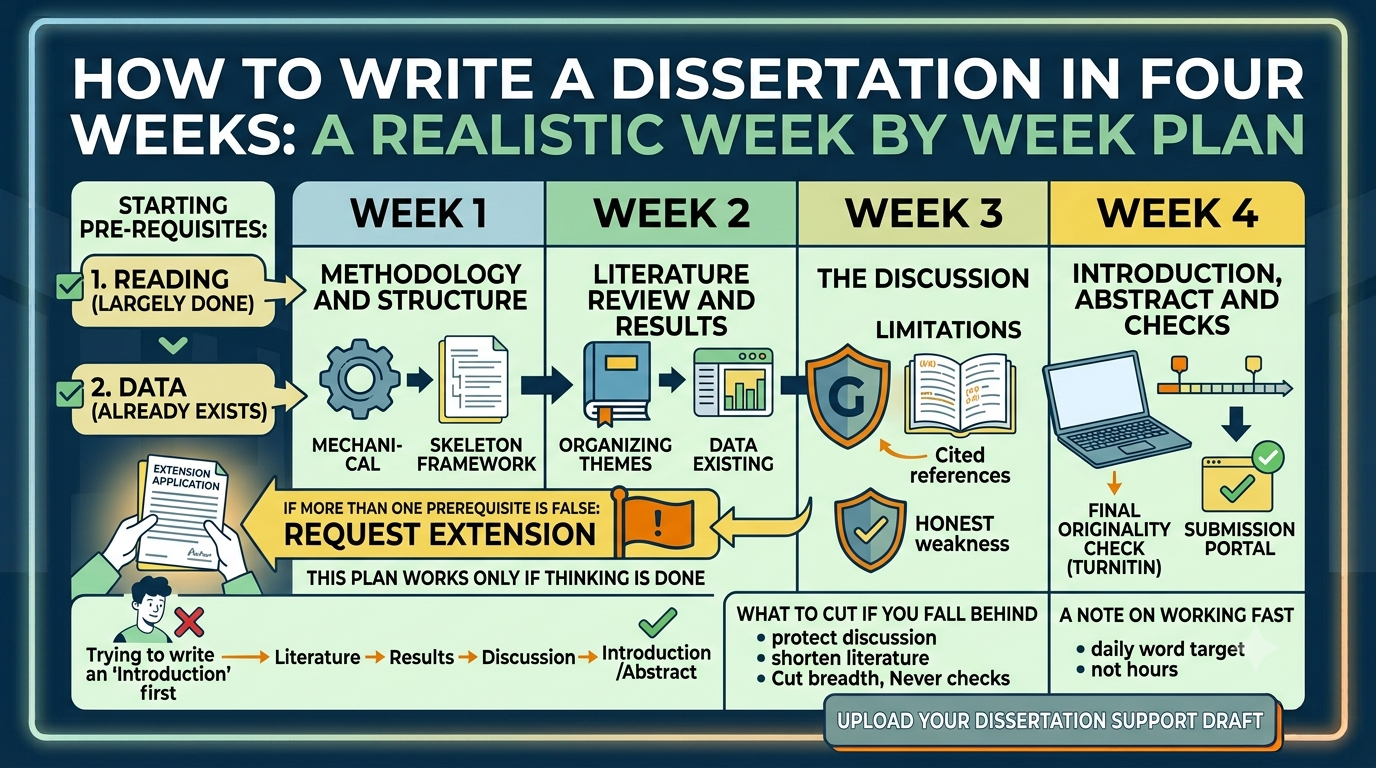
Four weeks is enough to write a dissertation only if your reading is largely done and your data already exists. If both are true, the working sequence is methodology first, then literature review and results, then discussion, then introduction and abstract last. Writing chapters in the order they appear is the mistake that costs people the deadline.
Can you actually write a dissertation in four weeks?
You can finish one. Starting one from nothing is a different question, and the honest answer is that four weeks is not enough to choose a topic, get ethics approval, collect data, read a field and write 15,000 words to a standard you would want marked.
What four weeks genuinely allows is the writing itself, provided the thinking is already done. Most students in this position are not starting from zero. They have a supervised topic, months of reading in notes and half-read PDFs, and data sitting in a spreadsheet. What they do not have is a single chapter finished, which feels identical to having nothing and is not.
So the first thing to do is separate those two states honestly, because the plan below only works for one of them.
What has to be true before you start
Run through this before you commit to the timeline. If more than one of these is false, your realistic move is an extension conversation rather than a sprint, and that conversation goes better before the deadline than after it.
- Your research question is settled and your supervisor has seen it. Changing the question in week two invalidates work you have already done.
- Your data exists. Not analysed, but collected. If you are still waiting on survey responses or interview slots, your timeline is set by other people, not by you.
- Ethics approval is granted, if your project needs it. This is a hard blocker with no workaround.
- You have read enough to write a literature review without starting a new reading programme. Reading during the writing weeks is fine. Beginning your reading is not.
- You know your word count and your department’s formatting requirements. Discovering a binding or formatting rule in week four wastes a day you do not have.
Week one: methodology and structure
Start with methodology, which is counterintuitive and is the single most useful thing in this plan. Everyone wants to start with the introduction, and the introduction is the worst possible first chapter because you do not yet know what you are introducing.
Methodology is the right opening move for three reasons. It is the most mechanical chapter, so it is the easiest to write when you are not yet warmed up. Its content is already fixed by decisions you made months ago, so there is nothing to invent. And it is where dissertations quietly lose grade bands, because most students write what they did without ever writing why they chose it over the obvious alternative, or what it could not tell them as a result. Give it the week and write it properly.
Alongside it, build the skeleton of the whole document. Every chapter heading, every subheading, and a target word count against each one. This takes an afternoon and it changes the next three weeks, because you stop writing to a vague total and start writing to a specific number that tells you when to stop.
End the week with a methodology chapter you would show your supervisor and a full outline. If you have those, you are ahead of where most people are at this point.
Week two: literature review and results
The literature review is the longest chapter and the one most likely to swallow the whole timeline, so it gets a hard boundary rather than an open week. You are not reading the field. You are organising what you have already read into an argument that makes your research question look inevitable.
The structural trick is to organise by theme rather than by source. A review that walks through one paper after another reads as a reading list and marks like one. A review organised around three or four debates, with sources grouped inside them, reads as analysis. It is the same material rearranged, and it is worth a grade band.
Results go in the same week because they are fast if your analysis is done. Present what you found, cleanly, with your tables and figures numbered and captioned as you go rather than at the end. Do not interpret anything here. Interpretation is next week, and mixing the two is the commonest structural error in the whole document.
Week three: the discussion
This is the chapter that decides your grade, so protect the week. Discussion is where a competent dissertation becomes a good one, and it is also where most students under time pressure simply restate their results in prose and lose twenty marks without understanding why.
For every finding, answer three questions in writing. What does this mean. Does it agree with the literature you reviewed in week two, and if not, what could explain the gap. What follows from it. If a paragraph in your discussion does not do at least one of those three things, it belongs in the results chapter instead.
Write your limitations honestly in the same week. Naming a real weakness in your own design reads as judgement, not failure, and markers reward it. The student who admits their sample was too small to generalise from has demonstrated exactly the awareness the top grade band asks for. The student who hopes nobody notices has not.
Week four: introduction, abstract and checks
Now write the introduction, because now you know what the dissertation actually says. It sets up the problem, states the question, and tells the reader what is coming, and all three are easy to write once the document exists. Written in week one, it commits you to an argument you had not tested.
The abstract comes last and takes longer than people expect. It has to carry the question, the method, the finding and the significance in a couple of hundred words, and it is the first thing your marker reads.
Then stop writing and start checking. Contents page against actual headings, figure and table captions, referencing consistency across four weeks of writing, word count against the limit, and the originality check on the full document. Our final 48 hours checklist covers the sequence, and running the full document through an official Turnitin report at this stage means you are confirming a figure rather than discovering one.
Leave three days between finishing and submitting. Not to improve anything, but because something will go wrong with a file, a portal or a formatting requirement, and those three days are the difference between an inconvenience and a missed deadline.
What to cut if you fall behind
Something will slip, so decide the priority order now rather than at 2am in week four.
- Protect the discussion above everything. It carries the most marks per hour of work.
- Shorten the literature review before you shorten anything else. A tight thematic review is often better than a long one anyway.
- Cut breadth in results, not depth. Three findings discussed properly beat seven listed.
- Never cut the checking week. An unchecked dissertation with a formatting failure or an unnoticed similarity issue costs more than a thinner chapter.
https://www.domywork.co/blogs/dissertation-extension-request If you reach the end of week two and the plan has already broken, that is information rather than failure, and it is worth acting on while you still have options. Read what actually happens if you miss the deadline before you assume the worst, and look at whether your circumstances qualify for an extension. Both are better decisions made in week three than in the final 48 hours.
A note on working this fast
Four weeks of dissertation writing is sustainable. Four weeks of fourteen hour days is not, and the work produced in hour twelve is usually deleted in the morning. Fix a daily word target instead of a daily hour target, stop when you hit it, and take one full day off in the middle. The people who finish these sprints are almost never the ones who worked the longest hours.
If you get to a point where a specific chapter is the blocker rather than the whole document, that is worth solving directly. Our dissertation support works at chapter level, so a methodology or discussion that has stalled can be looked at on its own without restarting anything else.
Ready to take your dissertation further? Get specialist support.
From refining your research question and literature review to methodology, analysis and final structure, dissertation work requires careful planning at every stage. Explore our dissertation writing support for your research project.
Frequently asked questions
Can you write a 15,000 word dissertation in a month?
You can write it in a month if your reading is done, your data is collected and your research question is settled. Starting from nothing in four weeks is not realistic for a document of that length and standard.
What should I write first in a dissertation?
Methodology. It is the most mechanical chapter, its content is already fixed by decisions you have made, and writing it first stops you stalling on an introduction you cannot yet write accurately.
Should I write the introduction first or last?
Last, with the abstract. Both describe what the dissertation says, and you only know that once the other chapters exist. Writing the introduction early commits you to an argument you have not tested.
How many words a day do I need to write?
For a 15,000 word dissertation across four weeks, roughly 750 to 1,000 words on writing days once you allow time for checking and formatting. Set a word target rather than an hour target.
What if I fall behind in week two?
Act in week three rather than week four. Shorten the literature review, protect the discussion, and find out whether your circumstances qualify for an extension while applying before the deadline is still an option.



Want more tips & great deals? Get them sent to your inbox
Please enter a valid E-mail
By clicking "Subscribe" you agree to be contacted via e-mail. You can always unsubscribe from the newsletter


