
Ready by 11:02pm Sep 11, 2026
Quoting, Paraphrasing and Summarising: How to Use Sources Well
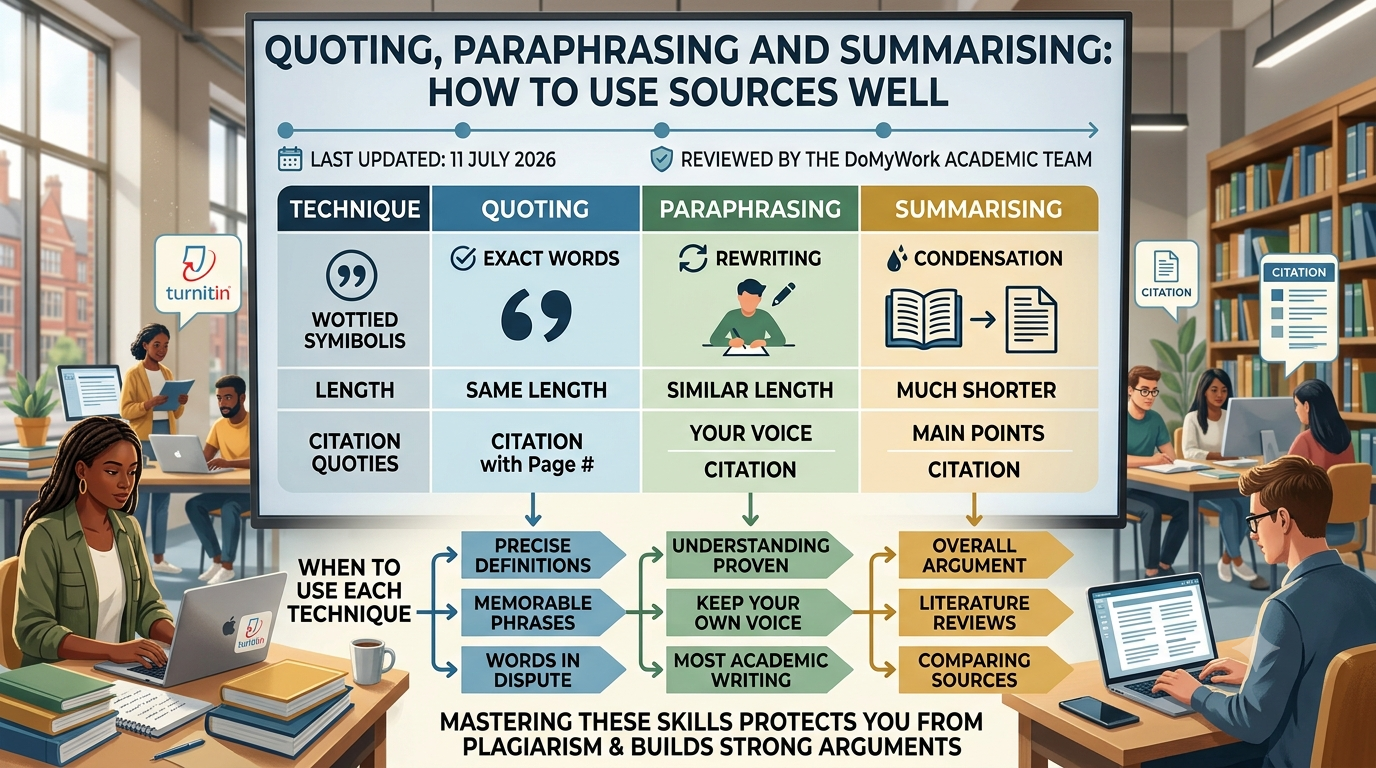
Quoting reproduces a source’s exact words inside quotation marks. Paraphrasing restates one passage in your own words at a similar length. Summarising condenses a longer passage or whole work into its main points. All three require a citation, and most strong academic writing leans on paraphrasing, with quotation kept for when the exact wording matters.
What is the difference between the three?
There are three ways of bringing a source into your writing, and choosing the right one is a marked skill in its own right.
| Technique | What it does | Length vs original | Quotation marks | Citation needed |
| Quoting | Reproduces exact words | Same | Yes | Yes, with page number |
| Paraphrasing | Restates one point in your words | Similar | No | Yes |
| Summarising | Condenses the main ideas | Much shorter | No | Yes |
When should you quote?
Quote sparingly, and only when the exact words carry weight that a restatement would lose. Good reasons to quote include a precise legal or technical definition, a memorable phrase you intend to analyse, or wording under dispute where the exact language is the point. A piece stuffed with quotations reads as though the writer is hiding behind sources rather than making an argument.
Keep quotations short, integrate them into your own sentence, and always add a page number. A long quotation, usually more than about forty words, is set as an indented block without quotation marks, following your style guide’s rule.
Example, original: “Assessment shapes how students learn far more than teaching does.”
Quoted: As Brown (2020, p. 15) puts it, “assessment shapes how students learn far more than teaching does.”
When should you paraphrase?
Paraphrasing is the workhorse of academic writing. Use it when you want the idea rather than the wording, which is most of the time. A good paraphrase proves you have understood the source, and it lets you keep your own voice and flow across a paragraph.
The test of a real paraphrase is that you have changed both the vocabulary and the sentence structure, not just swapped a few words for synonyms. Read the passage, look away, write the idea from memory, then check you have not drifted back into the original phrasing.
Weak paraphrase (too close): Assessment shapes the way students learn much more than teaching does (Brown, 2020).
Strong paraphrase: Brown (2020) argues that the design of assessment influences student learning behaviour more powerfully than classroom teaching.
The weak version keeps the source’s structure and most of its words, so it would likely be flagged even with a citation. The strong version rebuilds the sentence around the writer’s own understanding.
When should you summarise?
Summarise when you need the overall argument of a long passage, a chapter or a whole study, rather than one specific point. Summaries are essential in a literature review, where you compare what several sources say without quoting each one at length.
Example: Brown’s (2020) study of first year modules concluded that changing assessment format shifted how students prioritised their study time, with continuous assessment encouraging steadier engagement than a single final exam.
Why do paraphrasing and summarising still need a citation?
Because the idea is still someone else’s, even when the words are yours. A common and costly misunderstanding is that dropping the quotation marks removes the need to cite. It does not. Presenting another person’s idea as if it were your own, whether word for word or reworded, is plagiarism. For a fuller picture of how to reference the sources you draw on, see our guide to how to cite sources.
The same principle applies to your own earlier work. Reusing a paragraph from a past assignment without acknowledging it is self-plagiarism, and text matching software will often catch it.
How does this affect your similarity score?
Quotations legitimately match sources, so a report full of properly cited quotations can show a higher percentage without any wrongdoing. Weak paraphrasing, on the other hand, produces matches that look like copying. The aim is never to trick the software into a lower number, but to make the work genuinely your own, which brings the figure down honestly. Our guide to a good Turnitin similarity score explains how markers read the report behind the percentage.
Frequently asked questions
Is paraphrasing better than quoting?
In most cases, yes. Paraphrasing shows you have understood and processed the source, which markers reward. Reserve quotation for when the exact words genuinely matter.
How much do I need to change for a paraphrase?
Change both the words and the sentence structure so the passage reads as your own writing. Swapping a few words for synonyms while keeping the original shape is not a paraphrase and can be flagged as plagiarism.
Do I need a page number when I paraphrase?
Author and year are required in every style. A page number is compulsory for quotations and recommended for paraphrases of a specific passage, since it helps the reader locate the point.
Can a paraphrasing tool do this for me?
Automated rewriting tools tend to produce awkward, near-identical text that still matches the source and can trigger AI flags. They also skip the understanding that paraphrasing is meant to demonstrate. Write the paraphrase yourself, then edit for clarity.

Want more tips & great deals? Get them sent to your inbox
Please enter a valid E-mail
By clicking "Subscribe" you agree to be contacted via e-mail. You can always unsubscribe from the newsletter


