
Ready by 11:02pm Sep 11, 2026
Paraphrasing vs Plagiarism: Where the Line Is
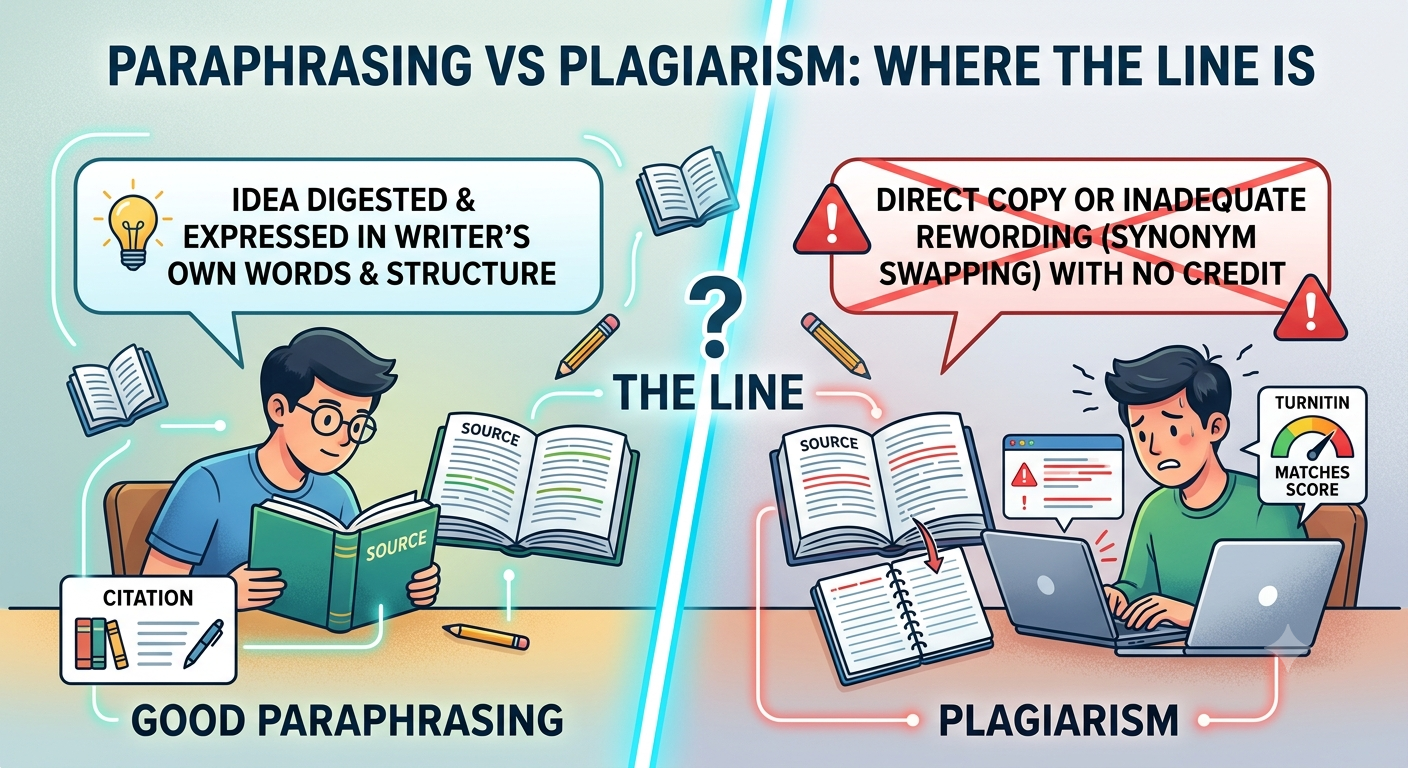
Paraphrasing is fine when you express an idea fully in your own words and your own structure, and credit the source. It becomes plagiarism when the wording stays too close to the original, or when you reword well but leave out the citation. Good paraphrasing needs both genuinely new wording and a clear credit.
Paraphrasing is one of the most useful skills in academic writing, and one of the easiest to get wrong. Done well, it shows you understood a source well enough to rebuild it in your own voice. Done badly, it tips into plagiarism even when you meant no harm. The line is clearer than most students think, and once you see it, you can stay on the right side of it without much effort.
Is paraphrasing plagiarism?
No, not when you do it properly. Proper paraphrasing means taking an idea, understanding it, and expressing it in your own words and your own sentence structure, then crediting the source it came from. That is exactly what tutors want, because it demonstrates comprehension rather than copying. Paraphrasing only becomes plagiarism in two specific situations, which are worth knowing precisely.
What does proper paraphrasing look like?
Good paraphrasing changes both the words and the structure while keeping the meaning, and it keeps the citation. The test is whether someone could read your version and the original side by side and see two genuinely different pieces of writing that happen to make the same point. If your version just tracks the original sentence by sentence with synonyms swapped in, it is not really a paraphrase, it is a disguised copy. Understanding the idea is what lets you rebuild it freshly, which is why paraphrasing well usually means reading, looking away, and writing from your own understanding.
When does paraphrasing cross the line?
There are two ways it goes wrong. The first is staying too close to the source, keeping its structure and most of its phrasing while changing a few words, which counts as inadequate paraphrasing even if you cite it. The second is the opposite mistake, rewording perfectly but forgetting the citation, so the idea reads as your own original thought. Both are forms of plagiarism. The first borrows the wording, the second borrows the idea, and proper paraphrasing avoids both at once.
A worked example, good and bad
Imagine a source that explains that regular feedback improves student performance because it lets learners correct mistakes early. A bad paraphrase keeps the shape and swaps words, producing something like consistent feedback boosts learner results because it allows students to fix errors early, which mirrors the original too closely. A good paraphrase rebuilds it from understanding, for example, students tend to do better when they receive feedback often, since catching and addressing errors as they happen prevents them from becoming habits. Both versions credit the source, but only the second is genuinely the writer’s own expression.
How do I paraphrase and still credit the source?
- Read the passage, then look away and write the point from memory in your own words.
- Compare your version to the original and rewrite anything that is still too close.
- Keep the citation, because crediting the idea is required even when the words are yours.
- Use quotation marks for any phrase you decide to keep word for word.
For the referencing mechanics behind the credit, see how to cite sources correctly, and if your score is high because of close paraphrasing, how to lower your Turnitin score shows you how to fix it.
Does Turnitin catch paraphrasing?
Partly. Turnitin matches wording, so a close paraphrase that keeps much of the original phrasing can still be flagged, while a thorough rewrite that genuinely changes the words may not match at all, even if the idea was borrowed. This is the key reason citing ideas matters as much as avoiding copied wording. A clean similarity score does not prove you credited every idea, so good practice is about honesty, not just about beating the checker. For the bigger picture, see what counts as plagiarism.
Why paraphrasing matters so much at university
Paraphrasing is not just a way to avoid copying, it is a core academic skill that tutors actively look for. When you paraphrase well, you show that you understood a source deeply enough to rebuild its meaning in your own words, which is far more impressive than quoting it. A piece that paraphrases skilfully and cites carefully reads as the work of someone who has digested their reading, while a piece stuffed with quotes reads as someone who has collected it. Learning to paraphrase well improves your marks, not just your similarity score.
The two halves of good paraphrasing
Every proper paraphrase has two parts that must both be present. The first is a genuinely new expression, your own words and your own sentence structure, not the original with synonyms swapped. The second is the citation, because the idea still belongs to the source even when the wording is yours. Miss the first and you have inadequate paraphrasing, which borrows the wording. Miss the second and you have uncredited paraphrasing, which borrows the idea. Both are forms of plagiarism, and good paraphrasing simply means keeping both halves in place at once.
A simple method that works
The most reliable way to paraphrase is also the simplest. Read the passage until the point is clear in your head. Then close the source completely and write the idea from memory, in whatever words come naturally to you. Because you are writing from understanding rather than editing the original in front of you, the result comes out in your own voice. Finally, reopen the source to check you kept the meaning accurate, fix anything you got wrong, and add the citation. The act of closing the source is what makes the difference, since it stops you tracking the original sentence by sentence.
When to quote instead of paraphrase
Paraphrasing is the default, but sometimes a quote is the right choice. Quote when the exact wording matters, such as a precise legal definition, a memorable phrase you want to analyse, or a claim so specific that rewording it would change the meaning. Keep quotes short, mark them clearly with quotation marks, and cite them. The mistake is quoting out of laziness, dropping in long passages because rewording feels like effort, which inflates your similarity score and shows less understanding than a good paraphrase would. For the full set of skills, see quoting, paraphrasing and summarising.
How tutors spot weak paraphrasing
Experienced markers recognise inadequate paraphrasing easily, often before any checker flags it. It has a tell, a slightly awkward quality where the sentence structure feels borrowed and the word choices are subtly off, as though the writer reached for unusual synonyms to seem different. Genuine paraphrasing reads smoothly because it came from the writer’s own understanding. So the goal is not to fool the eye or the checker, it is to actually understand the material well enough that your version is naturally your own. For how the checker handles it, see how to lower your Turnitin score.
Paraphrasing in a literature review
Literature reviews are where paraphrasing skill is tested most, because you are summarising and synthesising many sources at once. The trap is slipping into a string of close paraphrases, one per source, that each track their original too closely. The stronger approach is synthesis, where you combine what several sources say into your own argument, in your own words, and cite them together. That reads as your own thinking rather than a relay of other people’s, it scores lower on similarity, and it earns better marks. If your review is matching heavily, that is usually the signal to synthesise more and track sources less.
Frequently asked questions
How different does a paraphrase need to be?
Different enough that the wording and structure are genuinely yours, not just synonyms over the original shape. If it reads like the source with words swapped, rewrite it further.
Do I still cite a paraphrase?
Yes, always. The idea belongs to the source even when the words are yours, so a paraphrase needs a citation just as a quote does.
Is changing a few words enough?
No. That is inadequate paraphrasing and can count as plagiarism. Rebuild the point from your own understanding instead.
Is it enough to change every few words?
No. Changing individual words while keeping the structure is inadequate paraphrasing and can count as plagiarism. Rebuild the point from your own understanding instead.
Can I paraphrase without citing if I really changed the words?
No. The idea still belongs to the source, so a citation is required even when every word is yours.
Is summarising the same as paraphrasing?
Not quite. Paraphrasing restates a specific point in your own words, while summarising condenses a larger passage into its key idea. Both need a citation, and both must be in your own words to be safe.
Worried a paraphrase is too close? Check your draft free and see exactly what matches.

Want more tips & great deals? Get them sent to your inbox
Please enter a valid E-mail
By clicking "Subscribe" you agree to be contacted via e-mail. You can always unsubscribe from the newsletter


