
Ready by 11:01pm Sep 11, 2026
MBA Assignment Help: How to Write MBA Assignments That Actually Score
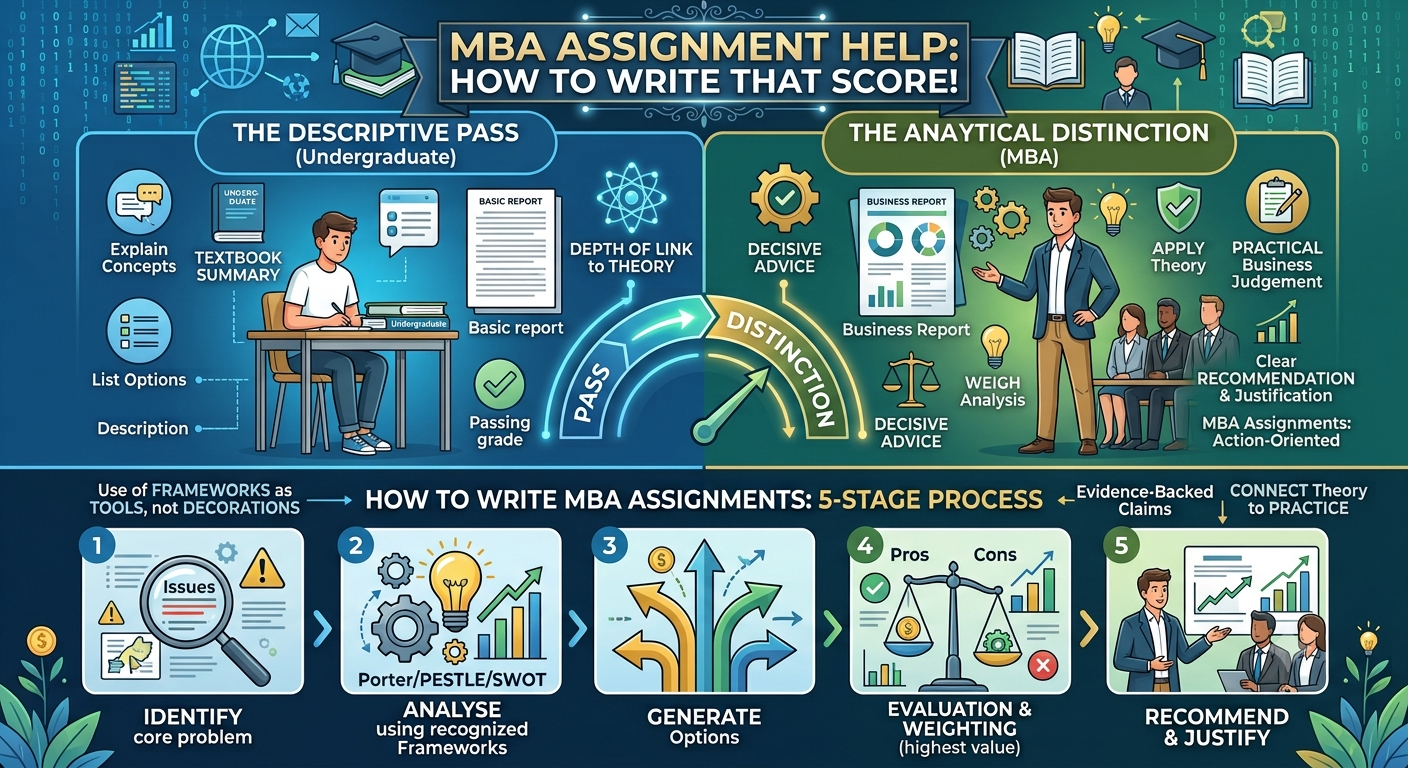
MBA assignments are marked differently from undergraduate work. Examiners want practical business judgement backed by theory, not description. A strong MBA assignment takes a real business problem, applies a recognised framework to analyse it, weighs the options, and makes a clear, justified recommendation. Getting the balance between theory and practical decision-making right is what separates a distinction from a pass.
Most MBA students are capable people, often working full time, who lose marks not through lack of ability but through writing that stays descriptive when it should be analytical, or academic when it should be decisive. This guide breaks down the main types of MBA assignment, shows how to structure the most common one, explains the analytical depth examiners are looking for, and points to where sensible help fits in.
What makes MBA assignments different?
An MBA assignment is judged on business judgement, not just knowledge. Where an undergraduate essay might reward a clear explanation of a concept, an MBA assignment rewards applying that concept to a real situation and reaching a defensible decision. Examiners are training future managers, so they want to see how you think when a business problem has no perfect answer.
In practice this means three things run through almost every MBA task. The work has to connect theory to practice, using a framework to illuminate a real business rather than describing the framework for its own sake. It has to be analytical and evaluative, weighing options rather than listing them. And it has to end somewhere, with a clear recommendation you are willing to defend, because managers make decisions. If your assignment reads like a textbook summary, it will pass at best. If it reads like advice a business could act on, it scores.
What types of MBA assignments will you face?
MBA programmes use a handful of recurring formats, and knowing what each one is really testing helps you pitch it correctly.
The case study analysis is the most common and asks you to diagnose a real or fictional company’s problem and recommend a course of action. The business report applies theory to a live organisation, often your own employer, and reads like something you would hand to a leadership team. The reflective assignment asks you to connect your own experience to leadership or management theory, which sounds soft but is marked on the depth of the link, not the anecdote.
The strategic analysis asks you to assess a company’s position and future options using structured frameworks. And the research-based assignment, often the dissertation, requires original investigation and is a much larger undertaking, which our guide on dissertation structure covers in full. Each rewards the same core skill, applying theory to a real decision, but the framing differs, so read the brief carefully to see which one you are being asked for.
How do you write an MBA case study analysis?
Because the case study is the most common MBA format, it is worth having a reliable structure. A strong case analysis moves through five stages in order, and skipping any of them is where marks leak away.
- Identify the core problem. Read the case twice and state the central issue in one sentence. Most weak answers solve a symptom rather than the real problem, so spend real effort here.
- Analyse the situation. Apply one or two relevant frameworks to the facts of the case, using the framework to surface insights rather than just filling in its boxes.
- Generate options. Set out the realistic courses of action, not just the obvious one, because examiners want to see you considered alternatives.
- Evaluate the options. Weigh each against clear criteria such as cost, feasibility, risk, and fit with the company’s position. This is the highest-value part of the analysis.
- Recommend and justify. Choose one option and defend it, explaining why it beats the alternatives and how the company should implement it.
The discipline that scores well is spending most of your words on stages four and five. Weaker assignments spend most of their length describing the case and applying frameworks, then rush the recommendation at the end. The recommendation is the point of the whole exercise, so give it room.
Which frameworks should you actually use?
Frameworks are tools, not decorations, and the mistake that costs marks is applying one for the sake of it. Use a framework only when it genuinely helps you analyse the problem in front of you, and use it to reach an insight rather than to fill in a template.
The workhorses across MBA programmes are SWOT for a quick strategic snapshot, PESTLE for the external environment, and Porter’s Five Forces for industry competitiveness. For internal capability, the resource-based view and value chain analysis are common. For strategic choice, Ansoff’s matrix and the BCG matrix appear often.
The key is selection and depth over breadth. One framework applied properly, with its output actually feeding your recommendation, beats four frameworks each filled in shallowly and then ignored. When you finish a SWOT, the next paragraph should use what the SWOT revealed. If it does not, the SWOT was decoration, and examiners notice.
How do you show analysis instead of description?
This is the single biggest divider between MBA grades, so it is worth being precise about what analysis actually looks like. Description tells the reader what is happening. Analysis tells the reader what it means and what follows from it.
A simple test is to look at your sentences and ask whether they are doing the word “because” or “therefore” any work. “The company operates in a competitive market” is description. “Because the company operates in a market with low switching costs, its pricing power is limited, which means a differentiation strategy will protect margins better than competing on price” is analysis. The second sentence takes a fact, explains its consequence, and points towards a decision. Every key paragraph in an MBA assignment should be doing that kind of work, moving from fact to implication to consequence. If a paragraph only reports, it is not earning marks, however accurate it is.
How do you reference and use evidence properly?
MBA assignments still demand academic rigour underneath the practical framing. Claims need support, whether from academic theory, industry data, or the facts of the case itself. A recommendation asserted with no evidence is just an opinion, and examiners mark opinions harshly.
Cite recognised management theory to ground your frameworks, and use real data where you can, since specific figures make an argument far stronger than vague assertions. For a business report on a real company, filings and published reports give you citable evidence rather than guesswork, and if you are handling financial analysis, our guide on finance and accounting dissertation topics points to the data sources that also work for MBA finance assignments.
Keep your referencing consistent throughout in your required style. Because MBA cohorts often work from the same cases and cite the same core theories, assignments can pick up similarity matches for entirely legitimate reasons, so it is worth understanding what a healthy score looks like, which our guide on what counts as a good Turnitin score explains.
Common mistakes that cost MBA marks
A few recurring errors pull down otherwise capable MBA work. The most common is staying descriptive, summarising the case and the theory without analysing either. Close behind is applying frameworks mechanically, filling in a SWOT or a PESTLE and then never using its output. Others include failing to make a clear recommendation, hedging endlessly instead of deciding, ignoring the alternatives so the recommendation looks unconsidered, and asserting claims without evidence.
A subtler one is misjudging the audience. An MBA report is usually pitched as advice to decision-makers, so writing it as a detached academic essay misses the register. Write as though a leadership team will read it and act on it. Being decisive, specific, and evidence-backed is exactly what the format rewards, and it is what most hesitant assignments lack.
Managing MBA assignments alongside a full-time job
Most MBA students are juggling the degree with demanding jobs, and time pressure, not ability, is the usual reason work slips. The students who cope best treat assignments like projects, breaking each one into stages with their own deadlines rather than facing it as one large task the week before it is due.
A workable rhythm is to read the brief and the case early, then draft the analysis in stages, the problem and frameworks first, the options and recommendation second, leaving a clear day before the deadline for editing and referencing. Front-loading the reading is what saves you, because a case you understood two weeks ago is far easier to write about than one you are meeting for the first time the night before. When workload genuinely overwhelms the time available, structured support on the parts you are stuck on is a sensible option, which is where legitimate help comes in.
Where does legitimate MBA assignment help fit?
Legitimate help is support that improves your understanding and your work, not a shortcut that replaces your own thinking. Guidance on structuring a case analysis, feedback on a draft, help understanding a framework, or coaching on how to turn description into analysis all make you a stronger student. That is different from submitting work you did not produce, which leaves you unable to defend it and puts your standing at risk.
Our MBA assignment writing support is built around that principle, helping with structure, analysis, and academic rigour on the parts of an assignment you are finding hardest, while keeping the work and the learning yours. For broader coursework beyond MBA-specific tasks, our assignment writing service covers the same ground across other subjects. Whatever support you use, check your finished work before you submit it, using our plagiarism checker as you draft and confirming the exact figure with the official Turnitin report for $5, so you submit with confidence.
Frequently asked questions
How is an MBA assignment different from an undergraduate one?
MBA assignments reward business judgement and practical decision-making, not just knowledge. Where an undergraduate essay might explain a concept, an MBA assignment applies it to a real business problem and reaches a clear, defensible recommendation. Description alone scores poorly at MBA level.
How do I make my MBA assignment more analytical?
Move every key sentence from fact to implication to consequence. Instead of stating what is happening, explain what it means and what should follow. A quick test is whether your paragraphs do the words “because” and “therefore” any real work, since that is where analysis lives.
Which frameworks are best for MBA assignments?
The common ones are SWOT, PESTLE, and Porter’s Five Forces, with the resource-based view, value chain, and Ansoff’s matrix for specific tasks. Depth beats breadth. One framework applied properly and feeding your recommendation scores better than several filled in shallowly.
Do MBA assignments get checked for plagiarism and AI?
Yes, almost always through Turnitin, which checks both similarity and AI writing. Because MBA cohorts share cases and cite the same theories, some similarity is normal. Understanding what a healthy score looks like, and checking your own work first, avoids nasty surprises.
Is getting MBA assignment help allowed?
Legitimate help that improves your understanding, such as structure guidance, draft feedback, or framework coaching, is a normal part of study. What crosses the line is submitting work you did not produce, since you then cannot defend it. The distinction is whether the help builds your learning or replaces it.
How long should an MBA assignment take to write?
It varies by length and type, but the students who score well start early, especially the reading. Breaking the task into stages, analysis first and recommendation second, with a day left for editing, works far better than a single push before the deadline, particularly when you are working full time.
Working on an MBA assignment right now? Get targeted MBA assignment writing support on the parts you are stuck on, and confirm your final work with the official Turnitin report for $5 before you submit.


Want more tips & great deals? Get them sent to your inbox
Please enter a valid E-mail
By clicking "Subscribe" you agree to be contacted via e-mail. You can always unsubscribe from the newsletter


