
Ready by 1:45am Aug 25, 2026
Is Using ChatGPT for Essays Plagiarism?
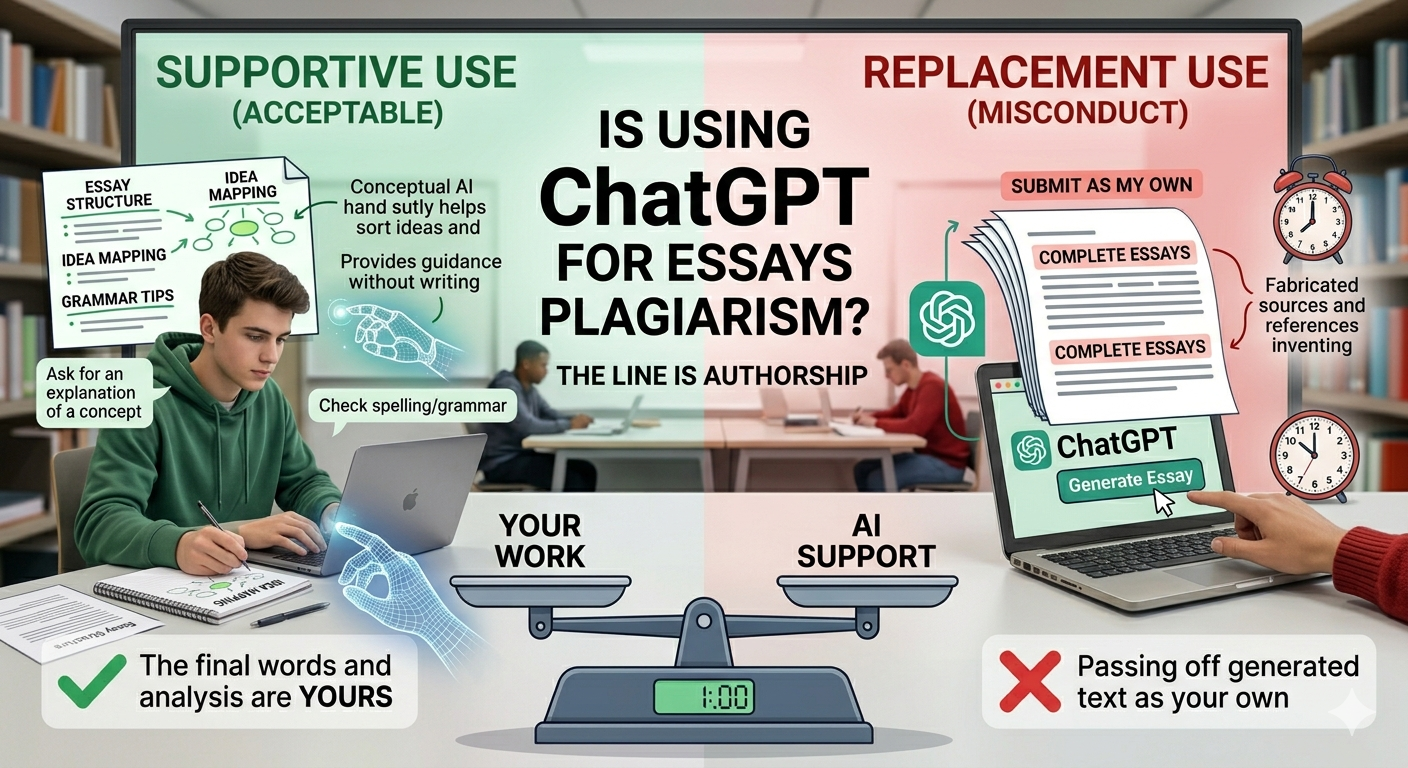
Using ChatGPT is not automatically plagiarism, but submitting AI written work as your own usually breaks academic integrity rules. Most universities now treat undisclosed AI use as misconduct. Using it to brainstorm or check grammar is generally fine. Passing off generated text as your own writing is the line most institutions draw.
The rules around AI moved fast, and they are not the same at every university, which leaves a lot of students genuinely unsure where the line sits. This is the practical version, without the scare tactics and without pretending the answer is simpler than it is. The short version is that the problem is rarely the tool itself. It is what you do with what it produces.
Is using ChatGPT plagiarism?
Plagiarism, in the traditional sense, is presenting someone else’s words or ideas as your own without credit. AI muddies this because the text does not come from a person you could cite. So most universities have stopped trying to squeeze AI into the old definition and instead treat undisclosed AI writing as its own category of academic misconduct. The practical effect is the same. If you hand in AI generated text as if you wrote it, you are likely breaking the rules, whether your institution calls it plagiarism or something else.
The useful distinction is between using AI to support your own work and using it to do the work for you. Support is generally acceptable. Replacement generally is not. For the wider context on what counts as misconduct, see what counts as plagiarism.
When is AI use acceptable?
Many universities are comfortable with AI as a study aid, as long as the final work is yours and you follow any disclosure rules. Common acceptable uses include:
- Brainstorming angles or structuring your thoughts before you write.
- Explaining a difficult concept so you understand it well enough to write about it yourself.
- Light grammar and spelling checks on text you wrote.
- Generating practice questions to test your own understanding.
The common thread is that you remain the author. The AI helps you think, but the words and the analysis are yours. Always check your own course rules, because some allow more than others and a growing number ask you to declare any AI use, however minor.
When does AI use break the rules?
The line is usually crossed when AI stops supporting your work and starts producing it. That includes:
- Generating whole paragraphs or entire essays and submitting them as your own.
- Using AI on an assessment where your brief specifically forbids it.
- Using it and not disclosing it when your university requires you to.
- Having AI invent sources or references, which is both misconduct and factually risky.
That last point catches people out. AI tools can fabricate convincing references that do not exist, and submitting those is a serious problem on top of the AI question, because it looks like you cited work you never read.
Can teachers tell you used AI?
Often, yes, through a combination of detection tools and simple familiarity with your writing. Many institutions run AI detection, and while it is imperfect, it flags work for a closer look. Just as importantly, tutors notice when a student’s style changes suddenly, when the writing is fluent but oddly empty of real argument, or when references do not check out. See does Turnitin detect AI for how the detection side works and where it falls short.
How do I check my work for AI flags?
If you used AI anywhere, or even if you did not and just want to be safe, run your work through our AI content detector before you submit. Look at the flagged sections and rework anything that reads as generated, adding your own examples and analysis so the writing is clearly yours. This matters even for fully human work, because AI detectors produce false positives and honest writing sometimes gets flagged, so it is worth catching before it reaches your tutor.
What should I do if I already used AI?
If you leaned on AI more than you should have, the fix is to make the work genuinely yours. Rewrite the generated parts in your own voice, add your own analysis, examples and reading, and check that every reference is real and that you have actually read it. Then check the result for AI flags, and follow your university disclosure rules if it asks you to declare AI use. The goal is to end up with work you understand and can stand behind, because that is what an assessment is for in the first place.
What counts as disclosing AI use?
As more universities ask students to declare how they used AI, it helps to know what a good disclosure looks like, because a vague line at the end of an essay is not really disclosure. The point is to be specific about what the tool did and what you did, so your tutor can see that the thinking and the writing are yours.
A useful disclosure names the tool, describes the task you used it for, and makes clear that the final work is your own. For example, stating that you used an AI tool to suggest an essay structure, or to explain a concept you then wrote about yourself, or to check grammar on text you had written, is clear and honest. What does not count is implying you wrote everything when a tool generated parts of it, or burying heavy AI use under a token mention. If your course provides a disclosure format, use it exactly. If it does not, a short, specific statement is far safer than silence, and silence about significant AI use is what most often turns an allowed activity into misconduct.
A simple rule of thumb for staying safe
If you want one principle to keep you clear of trouble, it is this. You must be the author of your work, in both the words and the thinking. AI can help you understand, plan and polish, but the moment it is producing the substance that you then submit as your own, you have crossed the line, whether or not a detector ever catches it.
A practical test is to ask whether you could sit down with your tutor and talk through your work in detail, explaining why you made each choice and where each idea came from. If you could, the work is genuinely yours and you are almost certainly fine. If you could not, because parts of it were generated and you never really engaged with them, that is the signal to go back and make the work your own before you submit. Then check it with an AI content detector, follow any disclosure rules your course sets, and read what counts as plagiarism if you are unsure where any other line sits. The aim throughout is simple, to hand in work you understand and can stand behind.
Frequently asked questions
Is it cheating to use AI for research?
Using it to find or explain ideas is usually fine, as long as you write the work yourself and credit real sources rather than the AI. Check the actual sources, since AI can point you to material that does not exist.
Do I have to declare that I used AI?
Increasingly, yes. Many universities now ask you to state how you used AI in an assignment. Check your assessment guidance, and when in doubt, disclose.
Will paraphrasing AI text make it safe?
Lightly reworded AI text is still AI text in substance, and it can still be flagged and still breaks disclosure rules. Genuinely rewriting it with your own thinking is different, because at that point the work becomes yours.
Can I use ChatGPT to improve my grammar?
Light grammar and spelling correction on text you wrote is generally accepted and rarely triggers detection, since you are tidying your own writing rather than generating new content. Just keep the changes at the level of corrections, because asking a tool to rewrite whole passages moves from editing into producing, which is where the rules tighten.
What happens if I am accused of using AI unfairly?
Stay calm and show your process. Drafts, version history and research notes are strong evidence that the work developed over time and is yours. Being able to talk through your argument in detail is convincing in a way that generated work cannot match, so a genuine author is usually in a strong position to explain a false flag.
Is it safe to use AI if my university has not banned it?
Absence of a ban is not the same as permission, and disclosure rules may still apply. Check your assessment guidance, keep AI in a supporting role, and declare any use if asked. The safe position is always that you are the author of both the words and the thinking.
Used AI anywhere in your draft? Check it for AI flags before you submit.
Popular posts

How to Make Money as a University Student in the UK
March 17, 2026

How Student Content Creators Can Get Paid Brand Deals in 2026
March 23, 2026

What Do UK University Markers Actually Look For? Inside the Marking Criteria
May 14, 2026
Turnitin Alternatives for Students and Researchers
July 3, 2026
Ratio Analysis Explained: A Student Guide With Worked Examples
July 14, 2026
Want more tips & great deals? Get them sent to your inbox
Please enter a valid E-mail
By clicking "Subscribe" you agree to be contacted via e-mail. You can always unsubscribe from the newsletter