
Ready by 11:02pm Sep 11, 2026
How to Cite Sources: A UK Student’s Guide to Referencing
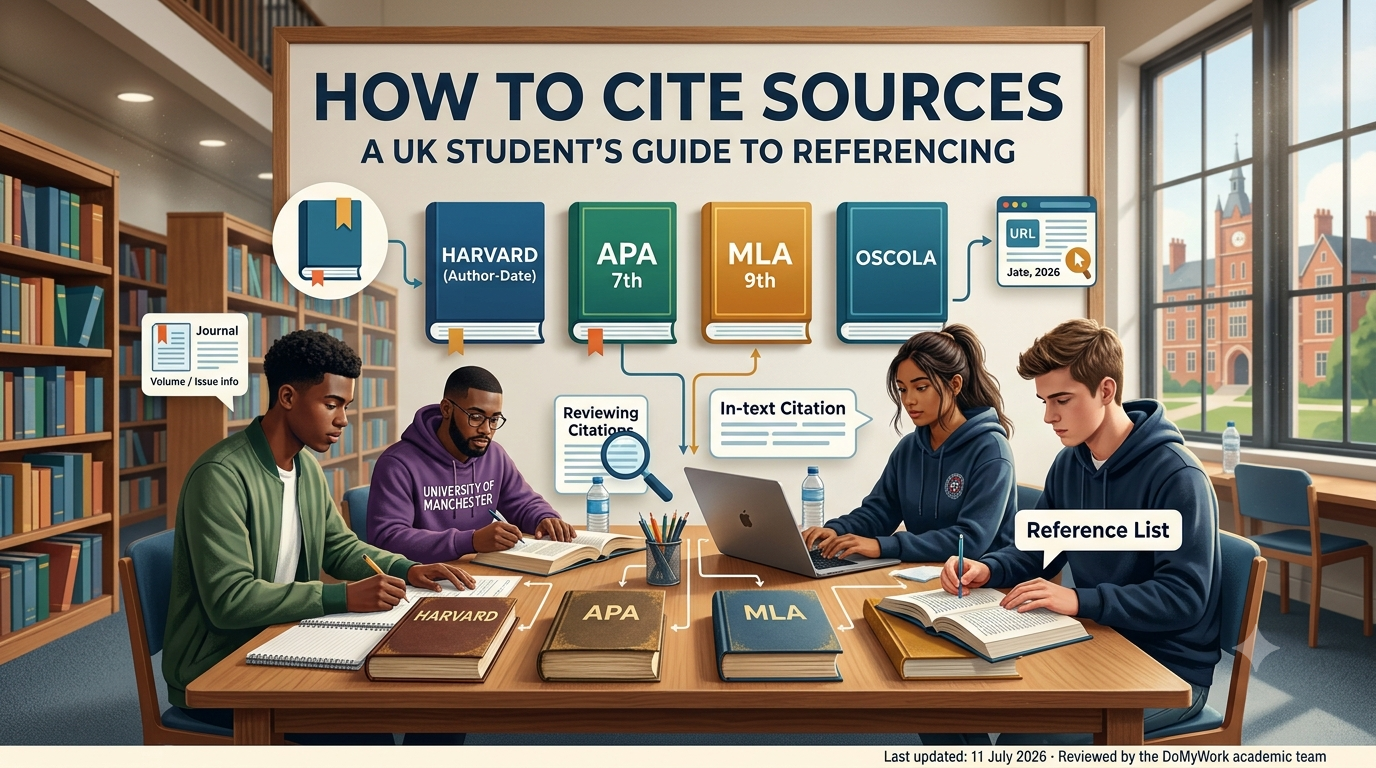
Citing a source means telling the reader exactly where an idea, fact or quotation came from. You do it twice: a short in-text citation at the point you use the source, and a full entry in your reference list at the end. The format depends on the style your department requires, usually Harvard, APA, MLA or OSCOLA.
Why does citing sources matter?
Citation does three jobs at once. It credits the people whose work you have built on, it lets your marker trace and verify your claims, and it protects you from an allegation of plagiarism. A well referenced piece signals that you have read widely and engaged with the evidence, which is one of the clearest markers of a strong academic argument.
It also protects your similarity score. Correctly quoted and cited material is expected to match sources, and markers read the report rather than the headline percentage. If you want to understand how that number is judged, see our guide to what counts as a good Turnitin similarity score.
What is the difference between an in-text citation and a reference?
Every source you use appears in two places, and both are required.
- In-text citation: a brief pointer inside your sentence or in brackets, usually the author and year, that marks the exact moment you draw on a source.
- Reference list entry: the full bibliographic record at the end of your work, giving everything a reader needs to find the original.
A citation with no matching reference, or a reference with no in-text citation, is a common reason to lose marks. Check that every one pairs up before you submit.
Which referencing style should you use?
Never choose a style by preference. Your module handbook or assignment brief states the required style, and different departments in the same university often use different ones. The four you will meet most often in the UK are set out below.
| Style | Common subjects | In-text format | Governing guide |
| Harvard (author-date) | Business, social sciences, education, nursing | (Author, Year, page) | Cite Them Right (Pears and Shields) |
| APA 7th edition | Psychology, health sciences, some social sciences | (Author, Year, p. x) | APA Publication Manual, 7th ed. (2020) |
| MLA 9th edition | English, humanities, arts | (Author page) | MLA Handbook, 9th ed. (2021) |
| OSCOLA | Law | Numbered footnotes | OSCOLA, 4th ed. (University of Oxford) |
Harvard is not a single fixed standard. Many UK universities publish their own Harvard variant, so follow your institution’s version where one exists, and use Cite Them Right as the default reference for it.
How do you write an in-text citation?
The pattern is consistent within a style, and the worked examples below use a single source, a 2021 book by Smith, so you can see how the same reference behaves.
- Harvard: Widening participation improved retention (Smith, 2021, p. 42).
- APA 7th: Widening participation improved retention (Smith, 2021, p. 42).
- MLA 9th: Widening participation improved retention (Smith 42).
- OSCOLA: Widening participation improved retention.1 (with a numbered footnote carrying the full source)
Use a signal phrase when the author is the focus of your sentence, for example: Smith (2021) argues that widening participation improves retention. Use the bracketed form when the point matters more than who made it.
How do you write a reference list entry?
The reference list gives the full record. Here is the same book across the four styles.
- Harvard: Smith, J. (2021) Access and retention in higher education. London: Routledge.
- APA 7th: Smith, J. (2021). Access and retention in higher education. Routledge.
- MLA 9th: Smith, John. Access and Retention in Higher Education. Routledge, 2021.
- OSCOLA: John Smith, Access and Retention in Higher Education (Routledge 2021).
Order your reference list alphabetically by author surname for Harvard, APA and MLA. OSCOLA uses a bibliography ordered by author surname alongside its footnotes. List every source you cited, and only those you cited.
How do you cite a website, a journal article and AI tools?
Two things change across source types: the elements you record and their order. For a journal article you add the journal title, volume, issue and page range. For a website you add the site name and the date you accessed it, because online content can change. If you have used a generative AI tool, most 2026 style guides now ask you to name the tool, the version, the date and the prompt, and to treat it as a source rather than a hidden helper. Check your own institution’s current AI policy first, since some treat AI use as an academic offence regardless of citation.
How can you avoid the most common citation mistakes?
- Mixing two styles in one document. Pick the required one and apply it throughout.
- Citing a source you did not read. If you found Jones inside Smith, cite it as Jones (2019, cited in Smith, 2021).
- Forgetting page numbers for direct quotations. A quotation without a page number is incomplete in every major style.
- Leaving sources out of the reference list because you paraphrased. Paraphrase still needs a citation. Our guide to quoting, paraphrasing and summarising explains when each applies.
- Reusing your own earlier work without citing it, which is a form of self-plagiarism.
Frequently asked questions
Do I need to cite common knowledge?
No. Facts that are widely known and undisputed, such as the date of a well known historical event, do not need a citation. If in doubt, cite it, because an unnecessary citation costs nothing while a missing one can cost marks.
How many sources should I cite?
There is no fixed number. The right amount is enough to support every claim that needs evidence. Depth of engagement with a few strong sources usually reads better than a long list of thinly used ones.
Is citing sources enough to avoid plagiarism?
Citing is necessary but not sufficient. You also need to quote directly when you use exact words, and to genuinely rewrite ideas when you paraphrase. Citation without proper paraphrasing can still be flagged.
Can I use a citation generator?
Generators are useful for a first draft of a reference, but they make errors with edition, author order and source type. Always check the output against your style guide before you submit.
Want more tips & great deals? Get them sent to your inbox
Please enter a valid E-mail
By clicking "Subscribe" you agree to be contacted via e-mail. You can always unsubscribe from the newsletter


