
Ready by 11:01pm Sep 11, 2026
Dissertation Word Count: How Many Words Each Chapter Should Be
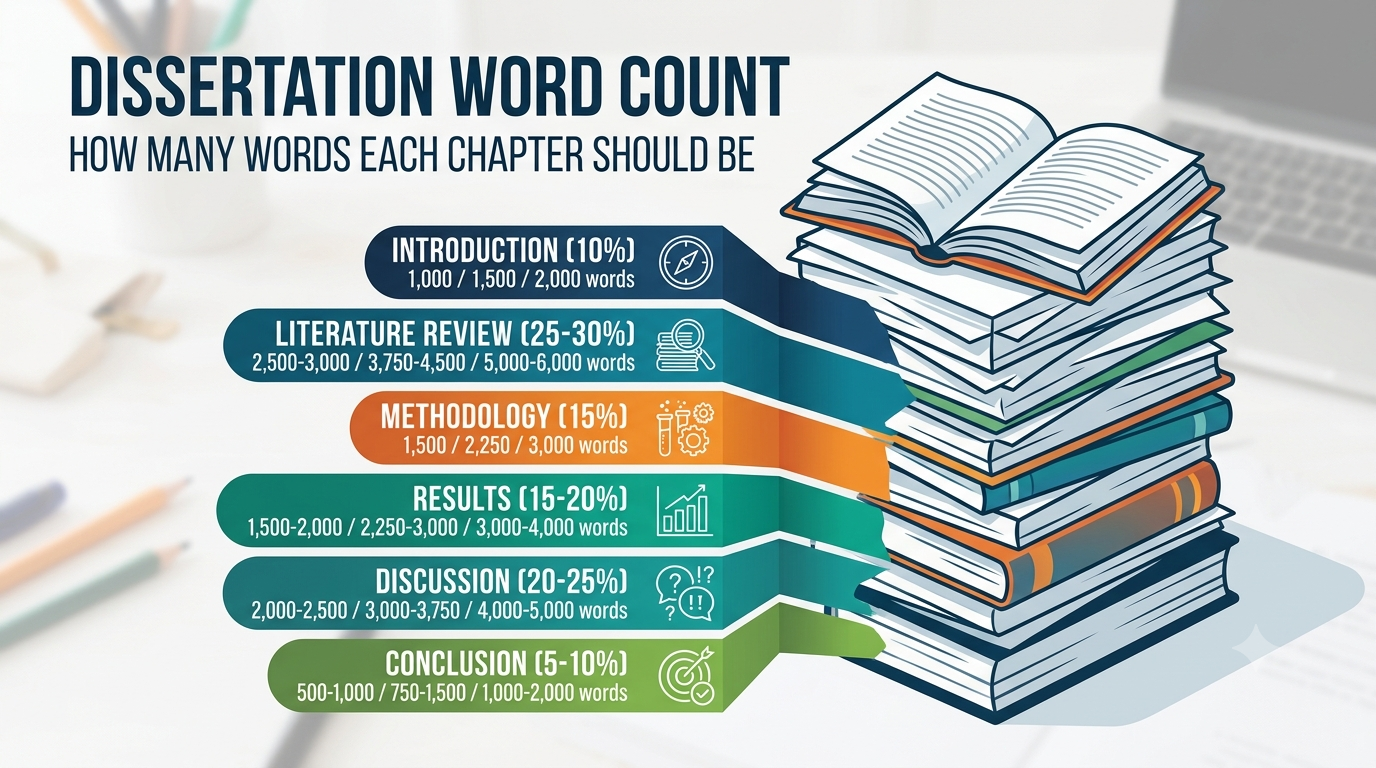
A typical UK dissertation splits roughly as follows: introduction 10 per cent, literature review 25 to 30 per cent, methodology 15 per cent, results 15 to 20 per cent, discussion 20 to 25 per cent, conclusion 5 to 10 per cent. Treat these as a starting frame, since your department may specify its own.
How should a dissertation word count be split?
By proportion rather than by page count, because the split holds reasonably well whether you are writing 10,000 words or 20,000. The percentages above are the conventional shape for an empirical dissertation in the social sciences, business, education and most health disciplines.
Two chapters dominate. The literature review and the discussion together account for roughly half the document, and that is not an accident of convention. They are the two chapters where marks are actually distributed, because both require analysis rather than reporting. Everything else describes something.
Knowing this early changes how you read and how you write, because you stop gathering material you have no room for. A student who knows their literature review is 4,000 words reads differently from one who knows only that the dissertation is 15,000.
Word count by chapter for 10,000, 15,000 and 20,000 words
| Chapter | Share of total | 10,000 words | 15,000 words | 20,000 words |
|---|---|---|---|---|
| Introduction | 10% | 1,000 | 1,500 | 2,000 |
| Literature review | 25 to 30% | 2,500 to 3,000 | 3,750 to 4,500 | 5,000 to 6,000 |
| Methodology | 15% | 1,500 | 2,250 | 3,000 |
| Results or findings | 15 to 20% | 1,500 to 2,000 | 2,250 to 3,000 | 3,000 to 4,000 |
| Discussion | 20 to 25% | 2,000 to 2,500 | 3,000 to 3,750 | 4,000 to 5,000 |
| Conclusion | 5 to 10% | 500 to 1,000 | 750 to 1,500 | 1,000 to 2,000 |
Use these as targets to write towards, not as rules to defend. If your methodology needs an extra 500 words because your design is genuinely complicated, take them from somewhere that is describing rather than analysing.
Why is the literature review the biggest chapter?
Because it does the most structural work. Its job is not to summarise everything written on your topic. It is to build the case that a specific gap exists, so that your research question arrives as the obvious response rather than as a change of subject.
That takes room. You have to establish what is known, show where the accounts disagree or run out, and connect that to the thing you are about to do. A review that is too short usually gives itself away by stating the gap rather than demonstrating it, which is the difference a marker notices immediately.
The failure mode in the other direction is a review that has grown by accumulation rather than by argument. If yours has run long, the usual cause is organisation by source rather than by theme. Rearranging the same material around three or four debates, with sources grouped inside them, typically cuts length while improving the chapter.
Because it does the most structural work. Its job is not to summarise everything written on your topic. It is to build the case that a specific gap exists, so that your research question arrives as the obvious response rather than as a change of subject.
That takes room. You have to establish what is known, show where the accounts disagree or run out, and connect that to the thing you are about to do. A review that is too short usually gives itself away by stating the gap rather than demonstrating it, which is the difference a marker notices immediately.
The failure mode in the other direction is a review that has grown by accumulation rather than by argument. If yours has run long, the usual cause is organisation by source rather than by theme. Rearranging the same material around three or four debates, with sources grouped inside them, typically cuts length while improving the chapter.Because it does the most structural work. Its job is not to summarise everything written on your topic. It is to build the case that a specific gap exists, so that your research question arrives as the obvious response rather than as a change of subject.
That takes room. You have to establish what is known, show where the accounts disagree or run out, and connect that to the thing you are about to do. A review that is too short usually gives itself away by stating the gap rather than demonstrating it, which is the difference a marker notices immediately.
The failure mode in the other direction is a review that has grown by accumulation rather than by argument. If yours has run long, the usual cause is organisation by source rather than by theme. Rearranging the same material around three or four debates, with sources grouped inside them, typically cuts length while improving the chapter.Because it does the most structural work. Its job is not to summarise everything written on your topic. It is to build the case that a specific gap exists, so that your research question arrives as the obvious response rather than as a change of subject.
That takes room. You have to establish what is known, show where the accounts disagree or run out, and connect that to the thing you are about to do. A review that is too short usually gives itself away by stating the gap rather than demonstrating it, which is the difference a marker notices immediately.
The failure mode in the other direction is a review that has grown by accumulation rather than by argument. If yours has run long, the usual cause is organisation by source rather than by theme. Rearranging the same material around three or four debates, with sources grouped inside them, typically cuts length while improving the chapter.
Because it carries the most marks per word in the document, and because doing it properly takes more space than most students allow for. A discussion has to interpret each finding, place it against the literature you reviewed, account for anything that did not fit, and set out what follows.
The common error is budgeting 1,500 words for a discussion in a 15,000 word dissertation, then finding there is only room to restate the results. That is a competent dissertation losing a grade band on arithmetic decided in week one. If you are going to be generous anywhere, be generous here.
Does the split change by level or discipline?
Yes, in two predictable ways. At undergraduate level the literature review often takes a slightly larger share and the discussion a smaller one, because the expectation is competent engagement with existing work rather than an original contribution. At master’s and doctoral level the balance shifts the other way, and the discussion becomes the chapter that decides the outcome.
Discipline matters too. A dissertation built on secondary sources rather than fieldwork often merges results into the discussion entirely, which frees up several thousand words and changes the shape of the document. Law dissertations frequently have no methodology chapter in the empirical sense at all, replacing it with a short note on approach and sources. Practice-based and reflective dissertations in nursing and education usually carry a reflective element that has no equivalent in the standard structure.
So treat the table above as the empirical social science default and adjust it against your own handbook. If your department publishes a structure, that structure always wins over any general split, including this one.
What counts towards your word count?
This varies by institution and it is one of the few rules genuinely worth confirming in writing, because getting it wrong in either direction costs marks under the presentation criteria.
- Usually excluded: the reference list or bibliography, appendices, the contents page, and the title page.
- Usually included: everything in the main chapters, including quotations.
- Varies: the abstract, footnotes, tables, figure captions, and acknowledgements. There is no safe assumption here.
The related trap is using appendices as overflow. Material that is genuinely supplementary belongs there. Material that your argument depends on does not, and a marker who has to go to an appendix to follow your reasoning will mark the chapter on what was in the chapter.
What happens if you go over or under?
Most UK institutions allow a tolerance around the stated limit, commonly ten per cent, and apply a penalty beyond it. Some mark only up to the limit and stop reading, which is worse than a deduction because it can leave your conclusion unmarked. Others treat it under the presentation criteria and apply discretion.
Coming in short is treated less mechanically but is often more damaging. A dissertation significantly under length is usually under length because something is missing, and the marker will find whatever it is. A thin literature review or a discussion that stops early loses marks on its own account, not because of the number.
Either way, check your own regulations rather than working from a general figure. The tolerance and the penalty differ enough between institutions that this is not a question worth guessing at.
How to fix a chapter that has run long
- ut description before analysis. Anything that reports what a source said without doing something with it is the first thing to go.
- Reorganise the literature review by theme rather than by source. This routinely removes a thousand words while making the chapter better.
- Move genuinely supplementary detail to an appendix, but only if your argument still follows without it.
- Compress the methodology by removing textbook explanations of standard methods. Justify your choice, do not teach the method.
- Cut breadth in results rather than depth. Three findings discussed properly beat seven listed and none explored.
- Leave the discussion until last, and cut it only if everything else has already been cut.
If you are working to a compressed timeline, set the chapter targets before you write rather than trimming afterwards, since rebalancing a finished document is far slower than writing to a number. Our four week dissertation plan builds the word split in at the start for exactly this reason, and the final 48 hours checklist covers the word count confirmation alongside the other pre-submission checks.
And if one chapter has run away and you cannot see what to cut, that is a narrower problem than it feels like. Our dissertation support works at chapter level, so a bloated literature review can be looked at on its own without touching the rest of the document.
Ready to take your dissertation further? Get specialist support.
From refining your research question and literature review to methodology, analysis and final structure, dissertation work requires careful planning at every stage. Explore our dissertation writing support for your research project.
Frequently asked questions
How long should each chapter of a dissertation be?
As a general frame: introduction 10 per cent, literature review 25 to 30 per cent, methodology 15 per cent, results 15 to 20 per cent, discussion 20 to 25 per cent, conclusion 5 to 10 per cent. Your department may specify its own split.
How long is the literature review in a 15,000 word dissertation?
Around 3,750 to 4,500 words. It is usually the longest chapter, because it has to demonstrate the gap your research question addresses rather than simply summarise what has been written.
Does the reference list count towards the dissertation word count?
Usually not, and appendices are commonly excluded too. The abstract, footnotes and table captions vary by institution, so confirm your own rules in writing rather than assuming.
What happens if I go over the dissertation word limit?
Most institutions allow a tolerance, commonly ten per cent, then apply a penalty. Some stop marking at the limit, which can leave your conclusion unread. Check your own regulations, since the approach differs.
Is it bad to be under the word count?
Often more damaging than going over, because being significantly short usually means a chapter is underdeveloped. The marks are lost for the missing analysis rather than for the number itself.


Want more tips & great deals? Get them sent to your inbox
Please enter a valid E-mail
By clicking "Subscribe" you agree to be contacted via e-mail. You can always unsubscribe from the newsletter


