
Ready by 11:02pm Sep 11, 2026
40 Dissertation Viva Questions and How to Answer Them
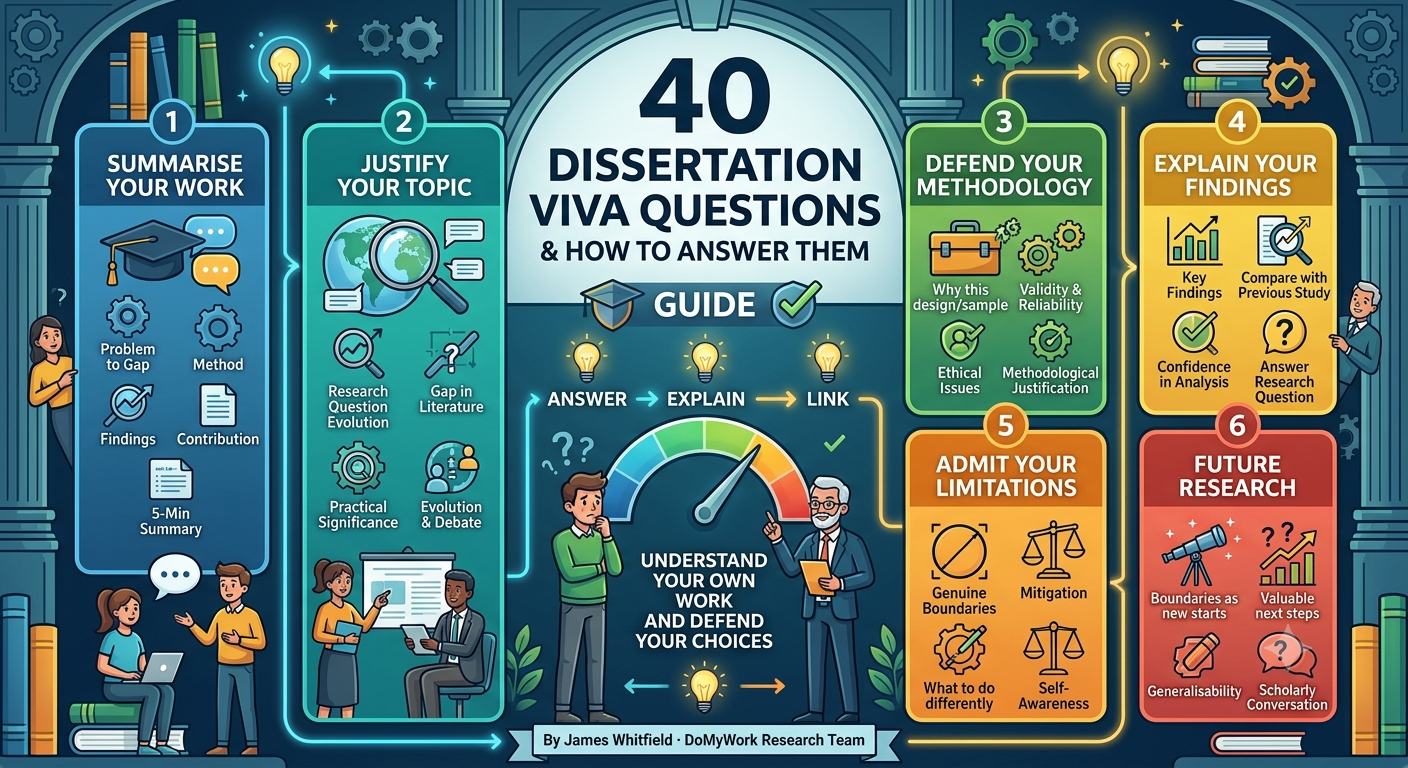
Most viva questions fall into six predictable groups: summarising your work, justifying your topic, defending your methodology, explaining your findings, admitting your limitations, and pointing to future research. Examiners are not trying to catch you out. They are checking that you understand your own work and can defend the choices you made. If you can answer the forty questions below, you can handle almost any viva.
The viva, or viva voce, is an oral examination where you defend your dissertation to examiners. It frightens people because it feels unpredictable, but the truth is that the same questions come up again and again, in slightly different words. This guide gives you the questions grouped by type, a simple structure for answering any of them, worked examples for the hardest ones, and honest advice on what to do when you genuinely do not know the answer.
What is a viva and what are examiners looking for?
A viva is an oral defence of your dissertation, usually held with one internal examiner from your own university and one external examiner from another institution. In the UK it is standard for doctoral work and increasingly used for some master’s programmes. It typically lasts one to three hours, and many universities open with a short summary or presentation from you before the questions begin.
What examiners want is not perfection. They want evidence that the work is genuinely yours, that you understand every significant decision you made, and that you can discuss your research like a scholar rather than recite it like a student. They will probe your methodology, your interpretation, and your awareness of what your study does not answer. A calm, honest, reflective candidate who can justify their choices scores far better than one who claims their work has no weaknesses.
A simple framework for answering any viva question
The single most useful habit in a viva is to answer in three moves: give the direct answer first, add a brief explanation, then link it back to your study. This stops you rambling, keeps you calm, and makes every answer sound structured even when the question surprises you.
So if an examiner asks why you chose interviews, you say the direct answer first, that interviews suited your question because you needed depth over breadth. Then the brief explanation, that your research question was about lived experience, which numbers could not capture. Then the link to your study, that this is why you interviewed twelve participants in depth rather than surveying two hundred. Answer, explain, link. Practise this rhythm until it is automatic, because under pressure it gives you a track to run on. It also naturally prevents the most common viva mistake, which is talking too much and burying your actual answer.
Opening questions
Examiners almost always start gently, to settle you in. These are the most predictable questions in the entire viva, so prepare them most of all.
The classic openers are: summarise your thesis in five minutes, tell us about your research in one sentence, what is your main contribution, and what made you choose this topic. The five-minute summary should move cleanly from problem to gap to method to key findings to contribution, and you should be able to deliver it without reading. The one-sentence version is harder and more revealing, because it tests whether you truly command what your work argues. A reliable frame is: this dissertation uses a named method to investigate a named topic and argues a named finding. Write that sentence before the viva and say it aloud until it feels natural. If you cannot compress your dissertation into one sentence, you do not yet fully own it.
Topic and rationale questions
These questions test whether your research question came from somewhere real rather than appearing from nowhere. Expect: why does this topic matter, why did you frame the question this way, how did your research question evolve, and what is the practical or academic significance of your work.
The strongest answers trace a clear line from a gap in the literature or a real-world problem to your specific question. Name the papers or the problem that pointed you there. If your question changed during the project, and it usually does, say so and explain what changed and why, because that shows a researcher responding to evidence rather than clinging to a plan. If your topic sat in a fast-moving area, this is a natural place to show you understand the current debate. For students whose topic sits in a trending area, our guide on 2026 dissertation topics shows the kind of live gaps examiners find compelling.
Literature review questions
Here examiners check that you engaged with the field properly rather than citing a convenient handful of sources. Expect: how did you select your sources, which theories underpin your work, whose work influenced you most, and how does your study fit into the existing literature.
Be ready to name your key theoretical framework and explain why you chose it over alternatives. Be ready to discuss a study that disagrees with yours, because examiners often probe whether you can hold a debate rather than just cite agreement. The strongest answers show you understand your field as a set of live arguments, not a pile of references. If an examiner names a paper you did not cite, stay composed, acknowledge it, and either connect it to your work on the spot or note it as a fair point for your corrections. Nobody has read everything.
Methodology questions
This is the most heavily probed part of most vivas, because your method is where the credibility of your findings lives. Expect: why did you choose this research design, why this sample and this size, why this analysis method, how did you ensure validity and reliability, and what ethical issues did you consider.
Every answer here comes back to justification. It is never enough to say what you did. You have to say why it was the right choice and what the alternatives would have cost you. Know why you chose qualitative over quantitative or the reverse, why your sample size was appropriate for your approach, and how you handled ethics if people were involved. If your method rested on existing data rather than new fieldwork, be ready to defend that choice, which our guide on primary versus secondary research sets out clearly. The candidate who can defend every methodological decision calmly is the candidate who passes cleanly.
Findings and analysis questions
These questions test whether you understand your own data. Expect: what are your key findings, how do they answer your research question, which finding surprised you, how do your results compare with previous studies, and how confident are you in your analysis.
Know your own numbers or themes cold. Re-read your results and discussion chapters closely before the day, because misremembering your own data in the viva is a serious and avoidable error. When comparing your findings to previous research, be ready to explain both the agreements and the contradictions, and to offer a reason for each. A finding that contradicts the literature is not a weakness. It is often the most interesting thing you have, and examiners reward candidates who engage with it honestly rather than hiding it. If you are unsure how your chapters should present findings versus interpretation, our guide on dissertation structure explains where each belongs.
Limitations and future research questions
Examiners almost always close by asking you to reflect on your work’s boundaries. Expect: what are the main limitations of your study, what would you do differently if you started again, what would you research next, and can your findings be generalised.
The trap here is either defensiveness or false modesty. Every study has limitations, and naming them clearly shows maturity, not weakness. Pick genuine ones, a sample that was small or specific, a method that captured some things and missed others, and explain how you mitigated them and what you would change with more time or resources. When asked what you would do differently, give a real, specific answer rather than saying you would change nothing, because that answer reads as a lack of self-awareness. Then turn limitations into future research, since the boundaries of your study are exactly where the next study begins.
What if I cannot answer a question?
You will probably face at least one question you cannot answer, and how you handle it matters more than the gap itself. The worst response is bluffing, because experienced examiners see straight through it. The best response is honest and composed.
If you need a moment, take it. Saying “that is an interesting question, let me think for a moment” is completely acceptable and shows a considered mind rather than a panicked one. If the question is genuinely outside your scope, say so and frame it as future research: “that falls slightly outside what this study set out to examine, but it would be a valuable direction to take next.” If you simply do not know, admit it honestly and offer how you would go about finding out. Examiners respect intellectual honesty far more than a confident wrong answer. A viva is a conversation between scholars, and no scholar knows everything.
How is a master’s viva different from a PhD viva?
The core questions overlap heavily, but the bar is different. A master’s viva confirms that you understand your research, made sound methodological choices, and can discuss your findings sensibly. Not every master’s programme even requires a viva, and where it does, it is usually shorter and less adversarial.
A PhD viva goes further, because the central requirement of a doctorate is an original contribution to knowledge. Expect PhD examiners to probe that contribution from several angles: what exactly is new here, where is the novelty, which parts are genuinely yours, and how does your work move the field forward. The methodology scrutiny is also deeper, since a PhD is judged partly on methodological rigour. If you are defending doctoral work, prepare your contribution statement more carefully than anything else, because it is the question that decides the outcome. PhD vivas also have formal outcomes, ranging from pass with no corrections, which is rare, through minor corrections, major corrections, and in some cases resubmission or the award of a lower degree.
How should you prepare in the final two weeks?
Preparation in the last fortnight is about clarity out loud, not rewriting. Re-read your entire dissertation critically, making notes on your key arguments, your methodological decisions, and the weaknesses you can see yourself, because it is far better to name them before your examiners do. Know your introduction and conclusion especially well, since examiners often open there.
Run at least one mock viva with your supervisor or a peer, under conditions as close to the real thing as you can manage, because saying your answers aloud exposes gaps that reading silently hides. If you can, read your examiners’ own published work to understand the perspectives they are likely to bring. Prepare your core answers, your five-minute summary, your one-sentence thesis, your contribution, your limitations, and your what-would-you-change answer, and practise them until they feel natural rather than memorised. On the day, you are usually allowed to bring your dissertation with tabs or sticky notes marking key sections, which takes pressure off your memory. Sleep, arrive early, and remember that a pause to think is not a failure. It is what thoughtful people do.
Ready to take your dissertation further? Get specialist support.
From refining your research question and literature review to methodology, analysis and final structure, dissertation work requires careful planning at every stage. Explore our dissertation writing support for your research project.
Frequently asked questions
How long does a viva last?
Most vivas run between one and three hours, though this varies by institution and level. Master’s vivas tend to be shorter, PhD vivas longer. Some open with a short presentation from you before the questions begin.
What is the most important viva question?
For a PhD, it is the question about your original contribution to knowledge, because that is the central requirement of the degree. For a master’s, the most probed area is usually your methodology and why you made the choices you did. Prepare both more than anything else.
Can I bring notes into my viva?
In most UK vivas, yes. You can usually bring your dissertation with tabs or notes marking key sections. Practice varies, so confirm with your supervisor beforehand, but marking your thesis for quick reference is common and sensible.
What happens if I fail my viva?
An outright failure is rare. Far more common outcomes are minor corrections, completed within a month or so, or major corrections, allowed up to around six months. Examiners may occasionally recommend resubmission with a new viva. Corrections are a normal part of the process, not a failure.
Should I admit the weaknesses in my own work?
Yes. Every study has limitations, and naming them clearly shows academic maturity. Trying to claim your work has no weaknesses reads as a lack of self-awareness and usually invites harder questioning. Name genuine limitations and explain how you handled them.
How do I answer a question I did not expect?
Use the answer, explain, link framework, and take a moment first if you need one. If the question is outside your scope, say so and frame it as future research. If you do not know, be honest and describe how you would find out. Composure and honesty matter more than having every answer ready.
Defending your dissertation soon? Make sure the work behind it is watertight. Confirm your final similarity result with the official Turnitin report for $5, revisit your dissertation structure chapter by chapter, and get dissertation writing support if you want a second pair of eyes before the day.


Want more tips & great deals? Get them sent to your inbox
Please enter a valid E-mail
By clicking "Subscribe" you agree to be contacted via e-mail. You can always unsubscribe from the newsletter


