
Ready by 10:56pm Aug 24, 2026
Results or Discussion: What Actually Goes Where
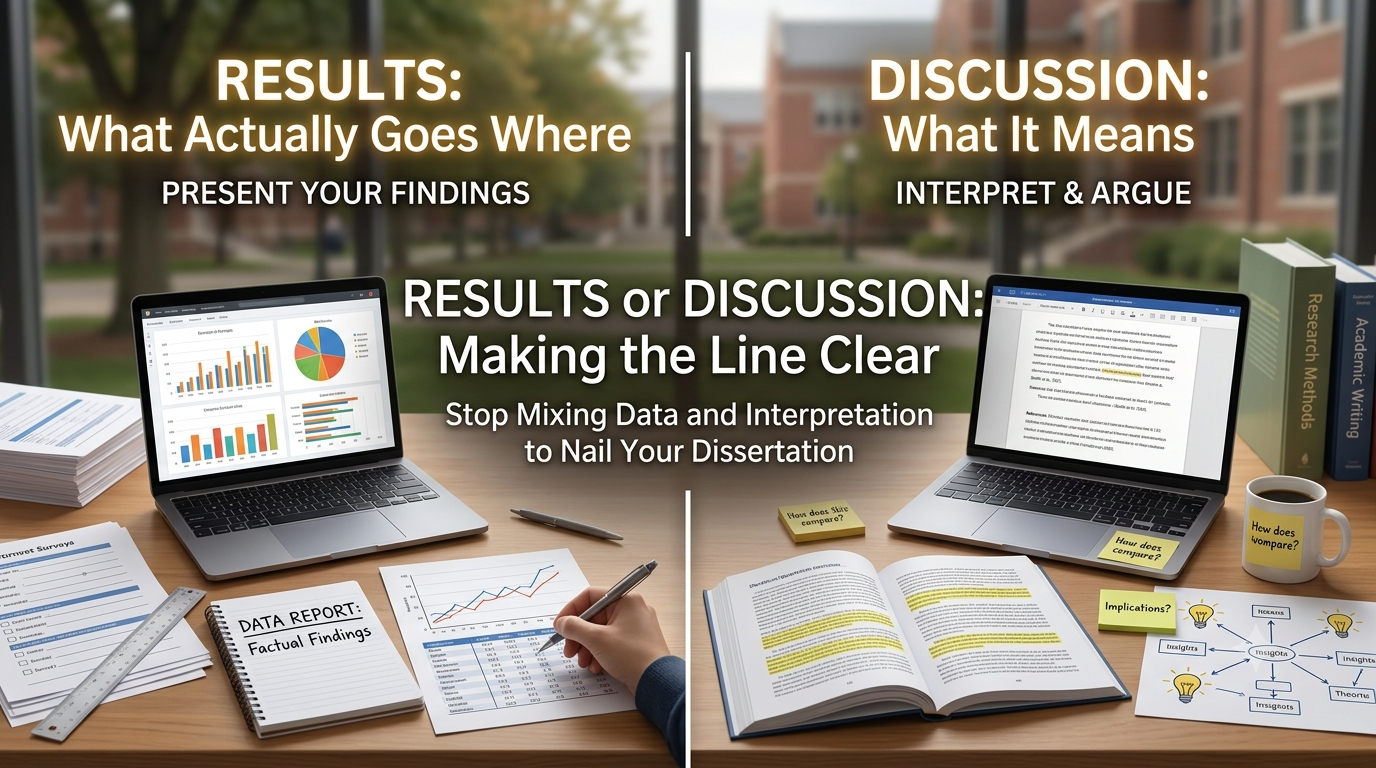
Results present what you found. Discussion explains what it means. If a sentence states a finding, it belongs in results. If it interprets that finding, compares it to the literature, or draws an implication, it belongs in discussion. Mixing the two is the most common structural error in dissertations.
These two chapters confuse more students than any other part of a dissertation, and getting the line between them wrong quietly costs marks. The good news is that the rule is simple once you see it, and a couple of quick tests will tell you which chapter any sentence belongs in.
What is the actual difference?
Results are a factual report. This is what the data showed, presented clearly, with no interpretation. A reader should be able to disagree with your conclusions and still accept your results chapter completely.
Discussion is where you argue. What does this finding mean, does it agree with the literature you reviewed, what explains it if it does not, and what follows from it. This is the chapter that carries the most marks per word in the whole dissertation, which is why squeezing it costs so much.
Why does keeping them separate matter?
Credibility. If your interpretation is woven into your reporting, a reader cannot tell where the data ends and your reading of it begins. Keeping them apart is what lets a marker trust your findings independently of your argument about them.
Think of it like a court case. Results are the evidence, presented plainly so everyone can see it. Discussion is the argument about what the evidence means. A good lawyer does not blur the two, because the evidence has to stand on its own before the argument can build on it.
What belongs in the results chapter?
- Response rates, sample details, and any data cleaning you did.
- The findings themselves, organised by research question or theme.
- Tables and figures, numbered, captioned, and referred to in the text.
- For quantitative work, the statistical output behind each finding.
- For qualitative work, themes with example quotes, presented rather than analysed.
- Findings that did not support your expectations, reported with the same care as the ones that did.
That last point matters more than students expect. Leaving out an inconvenient result is a research integrity issue, not a presentation choice, and a marker who spots a gap between your data and your discussion will look for it.
What belongs in the discussion?
- What each finding means for your research question.
- How it sits against the literature: confirming, contradicting, extending, or complicating it.
- Explanations for anything unexpected.
- Implications, practical or theoretical.
- Limitations of your study and what they mean for your claims.
- What further research your findings make is worth doing.
How do you tell which chapter a sentence belongs in?
Two quick tests settle almost every case.
| Ask this | If yes, it goes in |
|---|---|
| Could this be checked against the data alone? | Results |
| Does it interpret, or say what a finding means? | Discussion |
| Does it compare to another study? | Discussion |
| Is it a number, a rate, or a theme with no comment? | Results |
Sixty per cent of respondents reported the opposite is a result, because anyone could check it against your dataset. This suggests policy framing matters more than incentive design is discussion, because it is an interpretation people could dispute.
How should you order your findings?
Order them by research question, or by theme, and keep the same order in both the results and the discussion. If you have three research questions, present the findings for question one, then two, then three, and discuss them in the same sequence. This lets the reader hold one structure in their head across both chapters, rather than having to reassemble your findings when the discussion jumps around. What does not work is ordering by the tool you used or the order you collected data, because that reflects your process rather than your argument.
Should you ever combine them?
Sometimes, and your department will tell you. Combined results and discussion chapters are common in qualitative research, where separating a theme from its interpretation can feel artificial, and in dissertations built on secondary sources where there is no separate dataset to report.
If you do combine them, keep the distinction visible inside the writing. Present the finding, then interpret it, in that order, within each section. The risk of a combined chapter is that the interpretation swallows the evidence and the reader loses track of what was actually observed.
Do you need a separate findings chapter?
Most dissertations have one, but some subjects merge findings into the discussion, especially in qualitative or secondary source work. Follow your department structure. If you are unsure, a separate results chapter is the safer default, because it keeps your evidence clearly visible before you argue about it.
Why do most dissertations lose marks here?
Because the discussion describes instead of discussing. A student presents their results, then writes a discussion that restates the same findings in prose with a few citations added. It reads as thorough and earns very little, because nothing in it is an argument. The fix is mechanical: for every finding, write what it means, whether it agrees with the literature, and what follows. This is the same skill that separates the grade bands across the whole dissertation.
How do you present quantitative results?
Lead with the finding in words, then support it with the number. Repeat purchase was higher among frequency scheme members, then the statistic. A results chapter that opens every paragraph with a test statistic forces the reader to decode before they can understand.
Use tables and figures for anything that would be tedious as prose, but do not repeat a full table in the text. Pull out the one or two figures that matter and point to the table for the rest. Every table needs a number, a caption, and a mention in the body, or it reads as decoration.
How do you present qualitative results?
Organise by theme, and open each theme with a plain statement of what it is before any quote appears. Then use quotes as evidence for that statement, not as the statement itself. A results chapter built from long quotes with linking sentences between them makes the reader do your analysis for you.
Keep quotes short enough to read in one pass, label them consistently with whatever anonymised identifier you set up in your methodology, and choose the clearest example rather than the longest. Resist interpreting as you go, because that is what the discussion is for, and holding that line is what makes the discussion feel earned when it arrives.
How long should each chapter be?
Results are usually fifteen to twenty per cent of the total, and discussion twenty to twenty five, so the discussion is normally the longer of the two. If yours is the other way round, that is a warning sign, because it usually means the discussion has been squeezed into a summary of the results.
Frequently asked questions
What is the difference between results and discussion?
Results report what you found, without interpretation. Discussion explains what it means, how it sits against the literature, and what follows. A reader should be able to accept your results while disputing your discussion.
Can I combine results and discussion?
Sometimes, and it is common in qualitative work and secondary source dissertations. Check your department guidance, and if you combine them, present each finding before interpreting it.
Do I cite sources in the results chapter?
Rarely. Results chapters cite the literature only to explain a method or measure. Any comparison to another study belongs in the discussion.
Should I include findings that did not fit my hypothesis?
Yes, always, and discuss them properly. Unexpected findings are often the most interesting part of a dissertation, and leaving them out is a research integrity issue.
Which chapter is longer?
The discussion, usually. Results are typically fifteen to twenty per cent of the total and discussion twenty to twenty five. If yours is reversed, the discussion has probably been squeezed.
Popular posts

How to Make Money as a University Student in the UK
March 17, 2026

How Student Content Creators Can Get Paid Brand Deals in 2026
March 23, 2026
What Do UK University Markers Actually Look For? Inside the Marking Criteria
May 14, 2026
Turnitin Alternatives for Students and Researchers
July 3, 2026
Ratio Analysis Explained: A Student Guide With Worked Examples
July 14, 2026

Want more tips & great deals? Get them sent to your inbox
Please enter a valid E-mail
By clicking "Subscribe" you agree to be contacted via e-mail. You can always unsubscribe from the newsletter