
Ready by 11:02pm Sep 11, 2026
Best AI Content Detectors in 2026
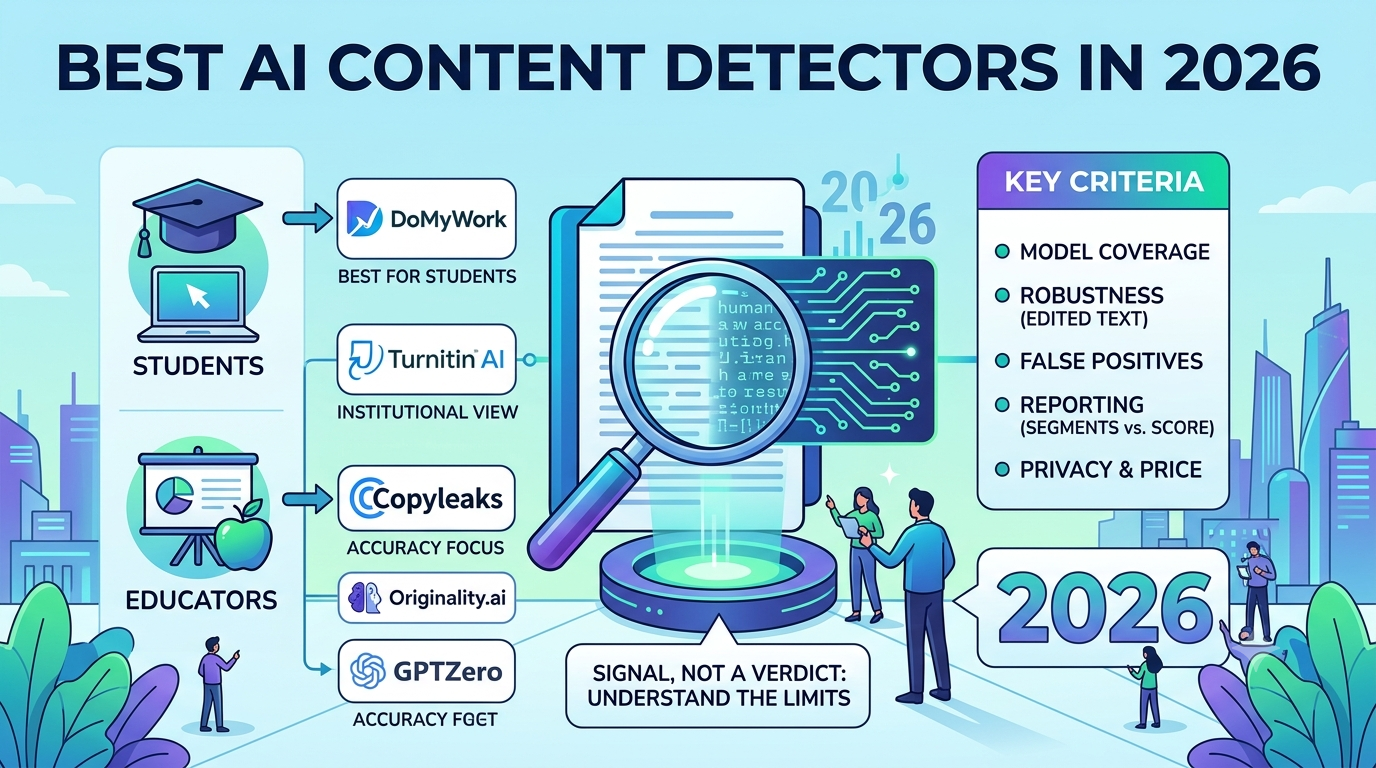
The best AI content detector depends on your need. For students checking their own work before submission, you want a tool that covers the major models and explains its result. For educators you want consistency and clear reporting. No detector is fully reliable, so the best ones are honest about false positives and treat the score as a signal, not a verdict.
AI writing tools are everywhere, and so are the detectors that claim to spot them. The market is noisy, the claims are bold, and the reality is messier than the marketing suggests. No detector is perfect, and the gap between the best and the worst is mostly about honesty, coverage and how clearly they present a result you still have to interpret. This guide ranks the main options by use case and is straight about their limits.
What is the best AI content detector?
For a student who wants to check their own work before submitting, the best detector is one that covers the major models like ChatGPT, Gemini and Claude, shows you which sections look AI generated, and is clear that the result is an estimate. That last point matters more than raw confidence, because a tool that hands you a single number with false certainty is more dangerous than one that flags sections for review. Our own AI content detector is built around reviewing flagged passages rather than delivering a verdict.
How accurate are AI detectors?
Honestly, less than their marketing implies. Detectors work by spotting patterns associated with machine writing, mainly how predictable and even the text is, and that is an indirect signal rather than a fingerprint. They get a lot right, but they also produce false positives, flagging genuine human writing, and false negatives, missing AI text that has been edited. The accuracy varies by tool, by the model that produced the text, and by the writing style of the human involved. We go deeper in how accurate AI detectors are.
How we tested them
A fair comparison has to look past the headline accuracy claim. We weighed how many models a detector recognises, how it handles edited and mixed text, how clearly it reports its findings, and crucially its false positive behaviour on genuine human writing, since flagging honest work is the most damaging failure a detector can have. We also considered privacy and price, because a detector that stores your unpublished work is a poor choice regardless of accuracy.
- Model coverage: does it recognise the major tools, not just one?
- Robustness: how does it handle edited or part human, part AI text?
- False positives: how often does it flag genuine human writing?
- Reporting: does it show which sections are flagged, or just a number?
- Privacy and price: is your work stored, and what does it cost?
The main AI detectors at a glance
| Tool | Best for | Model coverage | Notes |
|---|---|---|---|
| DoMyWork | Students checking before submission | Major models | Flags sections to review, plus a Turnitin option |
| Turnitin AI | The institutional view | Major models | What many universities use, via your login |
| Copyleaks | Strong detection focus | Broad | Subscription, aimed at organisations |
| Originality.ai | Publishers and web teams | Broad | Built for content teams, subscription |
| GPTZero | Quick individual checks | Major models | Popular, free tier available |
Best for students
Students need to see what might get flagged before a tutor does, and then fix it, so the best student tool shows flagged sections clearly and lets you recheck after editing. The point is not to obtain a clean number to brag about, it is to identify passages that read as machine written, even in honest work, and rework them in your own voice. The official Turnitin report also includes AI detection, so you can see close to the institutional result before you submit.
Best for educators
For educators, consistency and clear reporting matter more than a high confidence score, because the result will feed into conversations and sometimes decisions about students. The most useful tools for teaching contexts are honesty about uncertainty, flag sections rather than condemning whole documents, and pair the score with guidance on interpreting it. A responsible educator uses a detector as one input alongside knowing how a student usually writes, never as sole proof.
Why false positives matter
This is the part the marketing skips. A false positive, where a detector flags genuine human writing as AI, can seriously harm an honest student, and it happens more often to certain writers, including those writing in a second language and those with a very even, structured style. A detector that boasts high accuracy while quietly producing false positives is doing real damage. The best tools are upfront about this and frame their output as a signal to review, which is the only safe way to use any detector.
How to use a detector well
Use a detector to guide a review, not to deliver a verdict. Run your work, look at the flagged sections, and ask whether each one reads in your own voice. Rework the parts that feel generic or uniform, add your own examples and analysis, and recheck. If you are an educator, treat a flag as the start of a conversation, not the end of one. Either way, the result is information, and the judgment stays human. For how the Turnitin indicator fits in, see Does Turnitin detect AI.
How do AI detectors actually work?
Understanding the mechanism explains both their usefulness and their limits. Detectors do not read a hidden watermark in most cases. Instead they measure how predictable your writing is, on the theory that AI tools tend to choose the most likely next word again and again, producing smooth, even text, while humans write with more variation and surprise. The detector turns that predictability into a likelihood that a machine wrote the text. Because it is reading style rather than a fingerprint, it can be confidently wrong in both directions, which is the root of every limitation that follows.
Free vs paid AI detectors
Free detectors are fine for a quick personal check, to get a rough sense of how your writing reads before you submit. Paid tools tend to offer broader model coverage, clearer reporting, and features aimed at organisations, but a higher price does not buy certainty, because the underlying problem of false positives affects all of them. So treat the free or paid choice as one of convenience and features rather than a path to a reliable verdict. For a student, a free check that shows flagged sections is often all you need to rework your own writing.
The privacy question with AI detectors
As with plagiarism checkers, consider what happens to the work you upload. Some detectors retain submitted text, which matters if your work is unpublished or sensitive. A detector that deletes your file after the check is the safer choice, particularly for a thesis or a manuscript. This is easy to overlook when you are focused on the score, but it is worth a moment to confirm, since you are handing over your own writing to find out how it reads.
Can you beat an AI detector?
It is the wrong question, but worth answering honestly. Heavily edited AI text can slip past a detector, because editing breaks the predictable pattern it relies on, which is exactly why a clean score does not prove writing is human. But trying to disguise generated work misses the point of an assessment, which is to show your own understanding. The constructive use of a detector is the reverse, to check your own genuine writing and rework anything that reads as generic, so that honest work is not unfairly flagged. Using it to launder AI text is both risky and self defeating.
How educators should use detectors
For anyone teaching, the safest stance is that a detector informs a judgment rather than making one. A flag should start a conversation, not end it, because false positives fall hardest on second language writers and very structured writers who have done nothing wrong. The strongest practice pairs any detector result with knowledge of how a student usually writes, a look at their drafting history, and a direct discussion. Treating a score as proof risks real harm to honest students, which is why the better tools frame their output as a signal. See how accurate are AI detectors for the evidence behind this caution.
Should students use AI detectors at all?
Yes, but for the right reason. The value of a detector for a student is not to prove anything, it is to see how your own writing reads before someone who grades you does. If a section of your honest work reads as machine generated, an AI flag warns you while you can still rework it in your own voice. Used this way, a detector is a safety check against being unfairly flagged, which matters because false positives are real. Used the wrong way, to launder generated text, it is both risky and beside the point of an assessment.
What a responsible AI detection policy looks like
Whether you are a student reading your institution’s rules or an educator setting them, a fair policy shares some features. It treats a detector score as one signal among several, never as sole proof. It accounts for false positives, especially for second language and highly structured writers. It pairs any flag with a conversation and a look at drafting history rather than an automatic accusation. And it is transparent, so students know detection is in use and what disclosure is expected. A policy that treats a percentage as a verdict will eventually harm an honest student, which is why the better tools frame their output as a prompt to review.
Frequently asked questions
Are AI detectors reliable?
They are useful but imperfect. They produce both false positives and false negatives, so the result should guide a review rather than serve as proof.
Can a detector prove I used AI?
No. It estimates the likelihood based on writing patterns, which can be wrong. It is evidence to consider, not a verdict.
Which detector do universities use?
Many use the Turnitin AI indicator, accessed through your institution. You can see a similar result yourself with an official report before submitting.
Will my human writing get flagged?
It can, especially if your style is very even or you write in a second language. This is why checking your own work first and reworking flagged sections is worthwhile.
Which AI detector is most accurate?
No detector is reliable enough to be treated as proof, and accuracy varies by the model that wrote the text and the writer’s style. The best tools are honest about this and flag sections to review rather than delivering a verdict.
Can AI detectors be fooled?
Yes. Heavily edited AI text can slip past, which is why a clean score does not prove human authorship. It also means a flag is not proof of AI use.
Are paid AI detectors more accurate than free ones?
Not necessarily. A higher price can buy broader coverage and clearer reporting, but the underlying problem of false positives affects all detectors, so none should be treated as proof.
Can I rely on an AI detector’s percentage?
No. Treat it as a signal to review rather than a measurement. The judgment about what the score means belongs to a person who can weigh context.
Do universities tell students they use AI detection?
Practice varies, and not all are transparent about it. Since detection may be running whether or not it is announced, the safest approach is to make sure your work is genuinely your own and to check it yourself first.
Can an AI detector check my work privately?
Some can, if they delete your file after the check. Confirm the storage policy before uploading, especially for unpublished or sensitive work.
Want to see what might get flagged? Run an AI check, or get the full result in the Turnitin report for $5.

Want more tips & great deals? Get them sent to your inbox
Please enter a valid E-mail
By clicking "Subscribe" you agree to be contacted via e-mail. You can always unsubscribe from the newsletter


